
Working together for change
Sep 21, 2022
story
Seeking
Collaboration
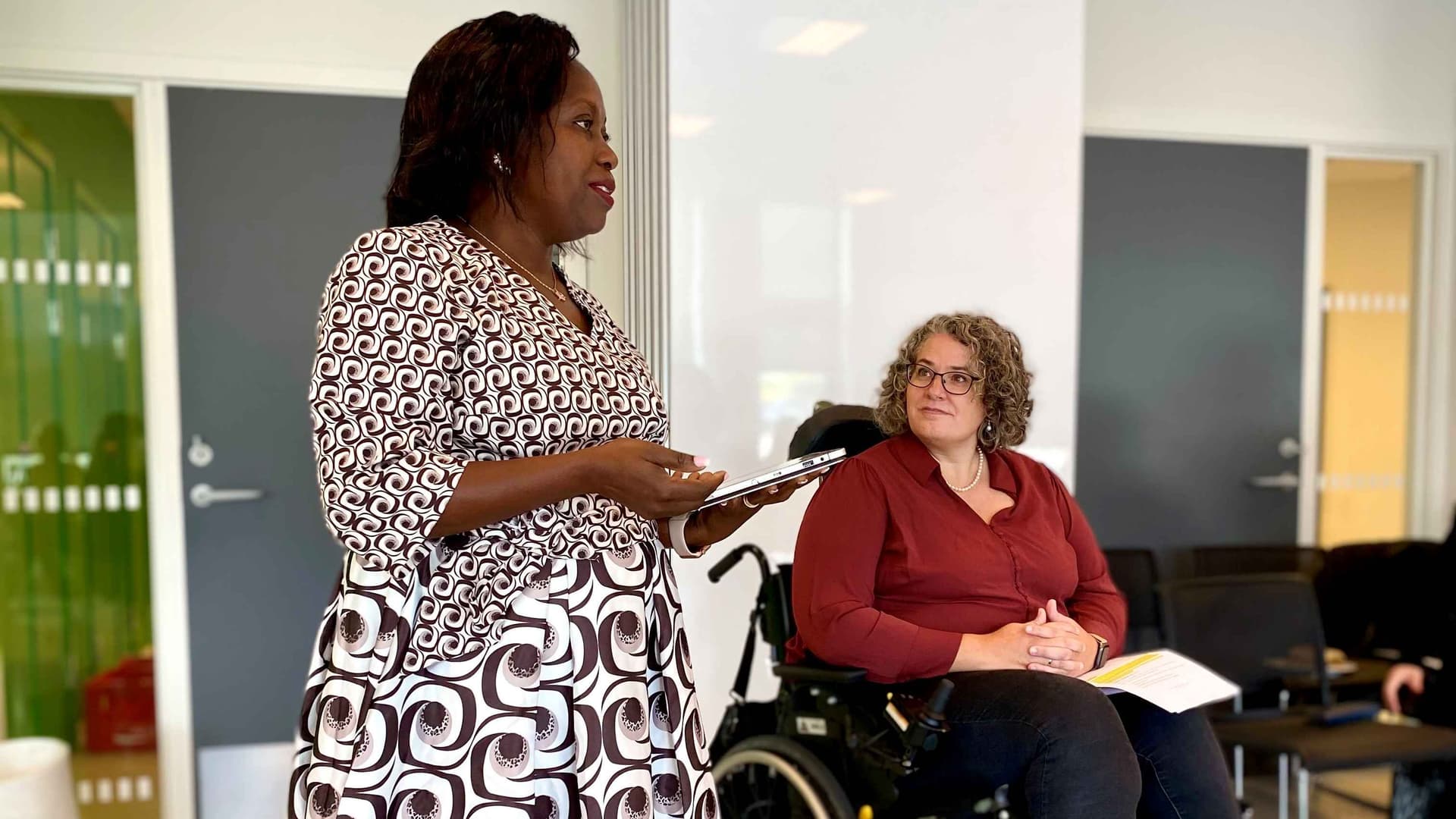
Photo Credit: Alberte Lørup, DPOD
A special lunch meeting
Yesterday I hosted a very special lunch meeting. One of these meetings, where you give a presentation that allows all the participants to learn something new, while enjoying their lunch. This presentation was me interviewing my guests; the national director of the Epilepsy Association of Uganda (ESAU) Sarah Nekesa and two representatives from the Danish Epilepsy Association. The photo shows Sarah talking and me listening.
The topic of the talk is the story I wanted to share here. It is the story of 25 years of friendship and cooperation. A story of the small and sometimes frustrating steps we take as we work for disability justice. And the importance of women supporting each other.
I am vice-chair of the Danish disability umbrella, Disabled People’s Organisations Denmark. I am also the chair of our development grant committee. The development funding goes to the projects our member organisations develop in partnership with disability organisations from the Global South. The funding is provided by the Danish Foreign Ministry as part of the Danish Development Aid.
Just over 25 years ago my organisation was working with the Ugandan disability organisation NUDIPU, which was ready to become a real disability umbrella. At that time, der var no organisation for several disability groups, including persons with epilepsy, so to include a broader representation, my organisation helped create a contact between the Danish Epilepsy Association and some very dedicated Ugandan doctors and a social worker who wanted to improve the conditions for persons with epilepsy.
Throughout the world there is unfortunately still a lot of stigmatisation related to having epilepsy, and in Uganda 25 years ago it was very difficult to live of epilepsy or have a family member living with epilepsy. Seizures considered evil spirits or mental illness. The illness itself being seen as a punishment from God, a punishment for something the patient or the family might have done. The lack of knowledge, sometimes even among medical staff, leading people to fear being infected. And so many more misunderstandings of what epilepsy is and what a person with epilepsy can do.
The new partners knew it would be difficult to establish a organisation consisting of such a stigmatised groups of patients, so the cooperation began with small steps. Radio announcements that epilepsy patient could come for a consultation and get some medicine at a given time and place. While they waited their turn under the local mango tree, the social worker tried to encourage them to come together, network, organise themself, but most were not ready. They, or their family, were too scared.
In the end, however, 15 persons came together, and ESAU was formed, as a small, local association with a brave man with epilepsy as a leader. It grew, slowly, more branches were formed, later it became a national organisation and later even more branches. Now, 25 years later and after many projects, the organisation has grown. Now, the organisation has more than 10,000 members, it has 20 district branches and 125 local branches.
Epilepsy medicine is difficult to access in Uganda, but ESAU is working to ensure temporary access and lobby the local health clinics for more permanent solutions. ESAU plans to educate healthcare professionals. ESAU helps the families and the patients with disability. ESAU raises awareness, trying to ensure that children with epilepsy aren't sent home from school, when they have an attack, that you can hold a job and be part of society and they have just achieved official recognition of epilepsy as a disability. It is really something special.
And the 25 years of friendship and cooperation between the Ugandan and the Danish epilepsy association is something special. And the cooperation in the Ugandan disability movement is something special. And Sarah shared that a special bond was formed among the disability organisations, who had women leaders. The disability umbrella, the women's disability organisation, the youth's disability organisation. They take tea together, support each other in difficult times, they make each other aware of funding opportunities. Something that there is always a need of.
The road has been long and sometimes rocky. But it shows that a few dedicated individuals can make a huge difference, that even 15 persons coming together, that even one person who has the courage to talk public about living a life with a stigmatised illness, can create change for thousands. That women who come together, can create change. We can create such a difference, when we believe, have courage and work together.
I was inspired by my guests. Inspired by the many years of dedicated partnership, by the co-operation, the hard work, the belief on what we can achieve. I asked Sarah for permission to share this photo, to share their story and she gave it. For we all need to reach out, we need to network and to inspire each other.
- Disability Justice
- Health
- Leadership
- Stronger Together
- Collaboration Stories
- Our Impact
- Our Voices Rising
- Global