
Women’s Leadership and Economic Empowerment is Critical in Advancing Climate Justice
Apr 9, 2022
first-story


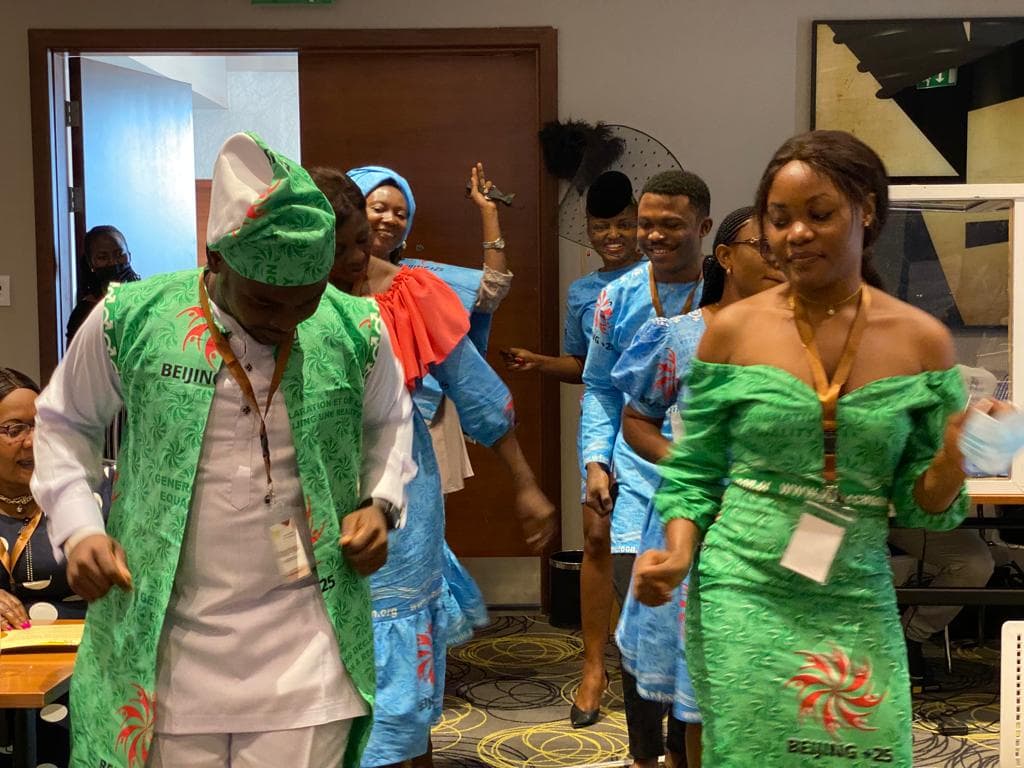
Central Africa delegates dancing during the Africa CSW66 conference in Nairobi, Kenya
It is undeniable that climate change is brutally impacting on African women and girls and poses a threat to their livelihood and wellbeing. While governments acknowledge the gravity of this menace, the legal frameworks and diverse interventions seem to only pacify the problem rather than mitigate it. Governments have committed huge resources and funds in implementing climate change response strategies, legislative policies and sectoral plans to address the challenges of climate change. Sadly, these interventions are developed without engaging the most affected.
Patriarchal leadership in gender-related thematic areas remains the greatest undoing in advancing gender equality as one of the most critical Sustainable Development Goals. Equal representation and meaningful representation of women in decision-making processes is yet to be realized 66 years after the formation of the Commission of the Status of Women and 26 years after the adoption of Beijing Declaration; the first global policy framework to confirm gender mainstreaming as a key strategy for realization of gender equality and women’s empowerment.
Many African countries are yet to achieve equal representation in parliament where key policies are formulated. In Kenya, for instance, implementing the two-thirds gender principle, an affirmative action plan is still a mirage despite the many commitments and heavy investments injected in achieving gender equality. It is the lack of gender-sensitivity that contribute to the formulation of gender-blind policies and interventions.
In line with CSW 66 thematic priority ‘Achieving gender equality and the empowerment of all women and girls in the context of climate change, environmental and disaster risk reduction policies and programmes’, African women and girls must amplify their VOICES and POWER in demanding for inclusive adaptation and mitigation measures to climate change. They must disrupt the norm by policy makers attending regional and global conferences to make exclusive commitments and must therefore make them accountable. What commitment did your gender minister make at the CSW66? What are the strategies? Are they realistic?
As I shared affirmative action plans put in place by the Government of Kenya to promote access to government procurement opportunities (AGPO) and financing the marginalized communities during the CSW66 side event on Economic empowerment of Women through Public Procurement and Financial Inclusion, I couldn’t resist the urge to address the existing gaps in the strenuous enterprise registration processes, lack of start-up capital and tendering finances by women, insecure by-laws, hefty interest accrued from bank loans, corruption in the award of tenders, unequal power dynamics and political influence in the private sector, poverty inequalities, climate effect on agri-businesses and most unfortunate, the lack or under-representation of women in procurement committees and financing decision-making.
Climate justice is interlinked with leadership and economic empowerment of women. As such the realization of a just and dignified world must integrate effective inclusion of women in climate adaptation and mitigation processes through implementation of the Women Empowerment Principles. Furthermore, FEMNET has proved beyond any reasonable doubt that homegrown approach is key in solving home inflicted problems.
- Economic Power
- Leadership
- Education
- Human Rights
- First Story
- Africa