
Where is the Funding for Agroecology in Africa?


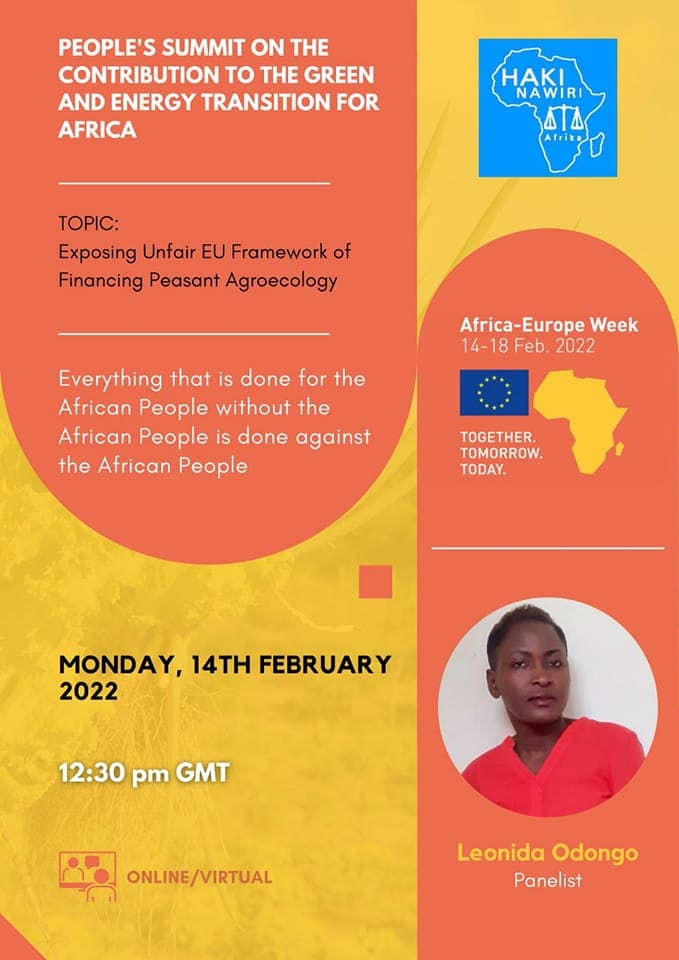
As part of the People's Summit on the contribution to the Green Energy and Transition for Africa , I represented the African continent by making a presentation entitled \"Exposing Unfair EU Framework of Funding Peasant Agroecology\".
The presentation started with a current situational analysis of the African realities which include:
•Rising cases of obesity
•Soaring hunger (811 million)
•Non communicable diseases
•Rising malnutrition (161million)
•Food wastes
•Criminalisation of seed saving through laws and policies
•Techno fixes on the food system
•Climate change related pests e.g desert locusts ( which resulted into devastating losses in several African countries)
•Disappearing seed varieties and
•Techno-fixes on food and climate (biotech, GMOs)
The presentation discussed :
Complicity of EU's funding and implications of these funds in the African continent for example:
•Climate Smart Agriculture- this contributes to intensification of chemical and fertiliser use which are major culprits in climate crisis( promotion of herbicide tolerant crops, fungicides and insecticides, GM seeds , patents on seeds ,biofuels and large scale industrial plantations
•Funding monoculture forms of agriculture –which results into biodiversity loss
•Public-Private partnership projects which continues to marginalise small food producers
•Funding “nature based solutions” some of which are skewed towards commodification of nature and promotion of monoculture e.g carbon offsets, genetic engineering ,these do not reduce emissions but harm indigenous people, result into mass land dispossession
•Despite the EU funding to conventional agriculture , world hunger has not reduced –SDG targets 2.1 and 2.2 on ending hunger , ensuring access to safe and nutritious and sufficient food for all is yet to be achieved
Key Ask for Africa as a continent in relation to EU's funding model were:
•The EU to allocate more funding to agroecology because within the African continent , smallholder producers are the ones feeding the continent and not corporations
•Funding to be redirected to smallholder food producer networks and CSOs working with smallholder farmers because they are on the ground and hence more aware of the situation and have the capacity of ensuring the funds bring out the intended transformation ( funding to women groups , youth organisations and smallholder farmer networks)
•Donors to engage in an in-depth and ongoing dialogue with food producer organizations to examine and increase the quantity and effectiveness of funds that are allocated towards agroecology, and to improve the quality of delivery this is because agroecology is restorative
•A shift from focus on yields and global market to an all rounded productivity that ensures protection of people and enhances planetary health.
•A shift from top-down funding model to one that is participatory and allows for the recipients of funding to participate in decision making ( People centred funding).
•Increased allocation of funding for agroecological practices that work in tandem with planetary health and human health and dignity
- Economic Power
- Environment
- Health
- Human Rights
- Africa