
Ugandan Women Pursuing Dreams End Up in Trafficking Nightmare
Mar 29, 2017
story


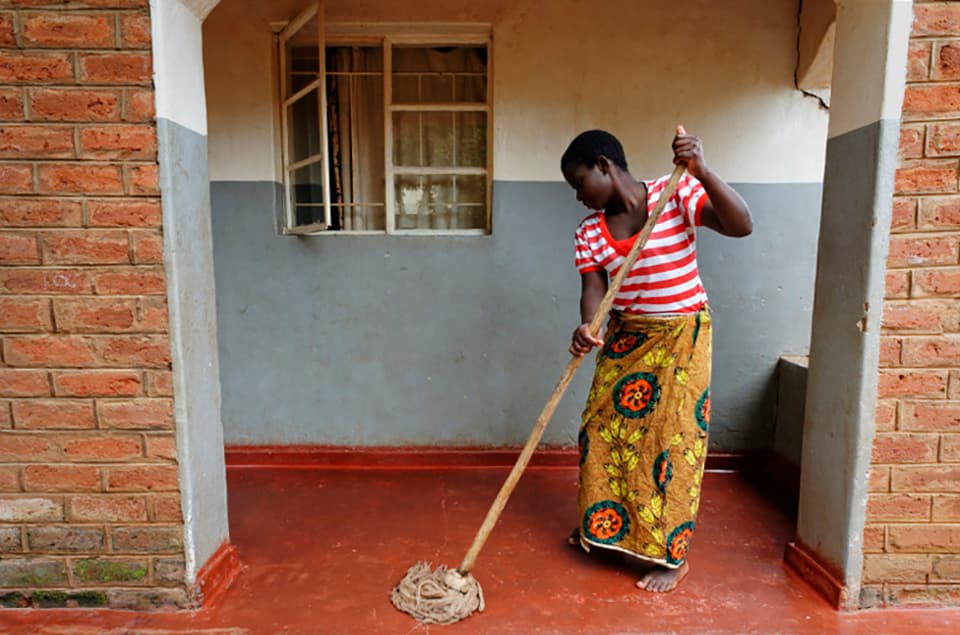
Photo by International Labour Organization / Creative Commons Attribution-NonCommercial-NoDerivs 3.0 IGO License
Migrant domestic workers labor, and often live, within the confines of private homes. There, they can slip out of sight from the laws meant to protect them. Roughly 1 out of 5 domestic workers in the world is an international migrant. Most of these workers are women. They cook, clean, and care for others’ families—often far from their own. When isolated from their support networks and dependent on an employer for survival, these workers can become vulnerable to exploitation.
A global movement has arisen to create and enforce human rights protections for migrant domestic workers, and bring the struggles of this population to light. In several countries, high profile cases of domestic worker abuse have led to new legislation. Indonesia, Philippines, Nepal, Sri Lanka, and Ethiopia have recently taken steps to prevent their citizens from migrating for work in countries with track records of abuse. But this hasn't solved the problem. The exploitation of migrant domestic workers is a pressing human rights issue that defies borders. It is a topic that has ignited the voices of World Pulse members from Nepal, from the Philippines, from the Maldives. And now, from Uganda.
In this story, Patricia Lindrio takes us into the hidden world of trafficked Ugandan maids in the United Arab Emirates, letting their voices ring out.
I could hear the voices of happy children playing in the background as Namu* sobbed, telling the story of how her own joy had been taken from her.

Namu’s journey began in Kampala, Uganda when a friend recommended her to a work recruitment agency. Fresh from graduating with a diploma in Tourism and Catering, Namu immediately applied. She believed the agency would help her secure work as a chef in Dubai. With excitement for a better life ahead, she rushed to tell her mother the good news. Together, they started looking for funds to pay the agents. They needed 1, 500 US dollars, which would include airfare and visa fees—surely a small amount for pursuit of a bigger dream. Namu could not stop fantasizing about her new salary and how easily she could clear her debts in a couple months’ time.
Namu was told her flight would be direct to Dubai. Instead, she landed in Kenya, where a month-long detour would become the beginning of her nightmares.
As weeks went by without the promised visa, Namu spoke up. “I asked my agent for a refund, ” sobbed Namu. “However, the agent threatened me to pay the moneyshe spent on me in terms of accommodation and food for which I didn’t have. ” With no money and no way to communicate with her family back home, Namu decided to wait it out. There was no way she was going back home to her poor mother in debt.
Finally, a place opened up. Namu’s traffickers confiscated her passport and sent her to Dubai under a different woman’s name. She knew she had lost who she was back in Kenya in that small room. She also believed she had left behind her misery and troubles. She reached Dubai, nameless and with big dreams. Those dreams faded quickly as she realized she was to be the sole maid for a household of over 12 adults and an infant. She was stuck with a ruthless boss who abuses her on a day-to-day basis.
“There is so much hardship here, ” she said. “I know we are poor back home but this is not a way to live. ”
Namu’s story is not unique. Namu is one of over thirty women who shared their stories in a Whatsapp group for Ugandan housemaids in the United Arab Emirates. Whatsapp audio recordings are the only means of communication available to many of these women. Some of the women have their phones confiscated and granted to them for about five hours a day. Others aren’t allowed to communicate with the outside world at all. I heard about some of their ordeals from their counterparts. Some manage to sneak in telephones.
The women I heard from did not find the better life they were looking for abroad, and many aren’t sure how —or if—they can ever return to their life back in Uganda.
“My search for a better life led me to real hell, ” lamented Kyomu*, a 36-year-old mother of four who left her children behind in Uganda to pursue work in the United Arab Emirates.
“I have been here for a year now. The treatment by my bosses is terrible. When I fall sick, I am locked in the house. I work from 5am to 1am usually. I do all the manual labor in a household of 15 people.
“I blame myself for my ordeal sometimes, ” said Kyomu. “I bought into the cliché. I just thought I could be one of the lucky ones, the ones who get good homes. The agencies that bring us here completely sell us, so they don’t care what happens to us after. ”
Namu and Kyomu are like many women who feel trapped in their circumstances and at the mercy of their employers after being trafficked into the country. They stay because they have no way to leave. They’ve had their travel documents taken, or they have gone through all their life savings. They fear being ridiculed by society and their families. They worry what their agents will do to them if they return to Uganda.
“How can I go back home? ” Cried Kyomu. “I have absolutely nothing to show for my stay here, nothing! And How will I earn a living when I go home; I haven’t saved anything because of my situation. I have nowhere to start! ”
Many of these women find themselves living off of meager wages and their employers’ food scraps: one meal a day of plain white rice and tomato.
Without the resources to leave, domestic workers are at risk for violence. “Heassaults me every other day, sometimes for no reason whatsoever, ” says one woman of her employer. Another woman describes how behind closed doors, her boss rapes her, threatening to take away her pay if she speaks up. Other women suffer verbal abuse by employers who call them dogs and monkeys.
I will never forget the voice of a woman crying from bondage in a bathroom cell. She had not had a meal all day. “I am tired, I think this is the end of me. I am thinking of taking my life. ” It was not the first time she was locked in the filthy bathroom.
“Don't do it, ” cried the other girls in the Whatsapp group. “Please, don't! ”
These 30 women represent many more women who are still in limbo, held captive in their places of work, with no voice, and in debt to their masters.
Some steps have been taken to combat human trafficking, but we need to do more. According to the National Preventing of Trafficking in Persons Office, reported trafficking cases in Uganda have declined from 837 cases in 2013 to 294 cases in 2014.
In January, in light of human rights abuses in another Gulf state, Saudi Arabia, the Ugandan government took the preventative step of banning housemaids from being sent there. This can be considered a victory, but the Ugandan government needs to do more to show its commitment to combating human trafficking.
Employers only get away with abusing maids because they are aware nothing can be done to them. There is continued need to investigate recruitment agencies and bring the criminals to Justice.
The lives of trafficking victims are often forgotten until a visible tragedy, like a death, brings the issue to light. There are still women in bondage who will need to be returned safely home.
I dare the government to crack down on incompetent recruitment agencies and traffickers and to ensure that there is accountability when a case of trafficking arises. I ask individuals to think of how they treat maids in their homes and what example they are teaching their children. And I challenge us all to keep fighting for women like Namu and Kyomu.
*Names have been changed to protect identities.
Take Action: join Patricia in raising your voice on this issue. Sign her Change. Org petition.
- Human Rights
- Africa