
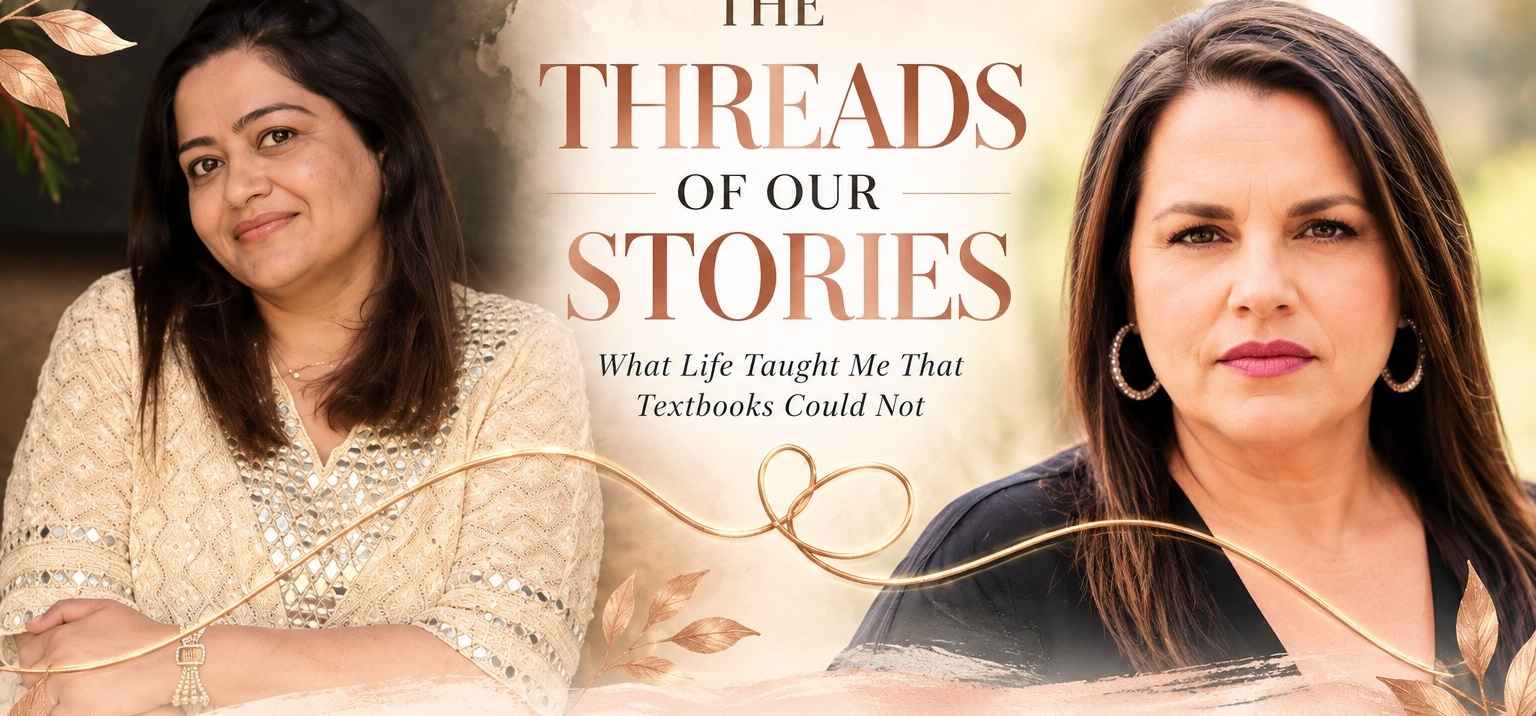
The Threads of our stories
Oct 7, 2026
story
Seeking
Action

Real queens fix each others crown
Meeting Colette
When the Threads of Our Stories Met
Some meetings stay with you because of what was said. Others stay because they make you think differently about something you thought you already understood.
Meeting Colette Martin did that for me.
I came to our conversation as a psychiatrist. Colette came with the knowledge of someone who has lived through coercive control and intimate-partner violence. Those are very different ways of knowing something, and I don't want to pretend otherwise. Her story is hers. My professional experience is mine.
But somewhere in that conversation, the threads met.
I have spent more than a decade in psychiatry. I was trained to recognise symptoms, make diagnoses, understand psychopathology and formulate treatment. Yet some of the questions that have stayed with me longest were never complicated clinical questions.
They were questions such as:
“Doctor, is this normal?”
I have heard that question from women describing relationships in which they had slowly stopped trusting themselves. Sometimes there was no visible injury. There was monitoring, isolation, financial dependence, sexual distress, humiliation, fear, or the gradual narrowing of a person's world.
From the outside, an individual incident might appear insignificant. Inside a relationship, a pattern can become a prison.
Medicine gave me a language for understanding some of this.
Life taught me what textbooks could not.
It taught me that being educated, professionally successful or outwardly strong does not protect a person from hurt. It taught me that strength and vulnerability can exist in the same person. It taught me that violence does not always leave a bruise and that control does not always announce itself as control. Sometimes it arrives looking remarkably like concern.
It also changed the way I listen.
When somebody sits across from me today, I am still a psychiatrist. I bring my training and clinical judgement into that room. But I am also conscious that beneath the symptoms, the person in front of me may be asking something else:
Do you believe me?
Does this count?
Am I imagining it?
Do I matter?
No diagnostic manual can answer those questions for another human being.
What Colette Knows
This is part of why Colette's story matters to me.
I don't want to retell the most painful parts of her life. Survivors are asked to do that far too often. We seem to require people to prove their suffering before granting them the authority to speak about it.
Tell us what happened.
Tell us how bad it became.
Tell us why you stayed.
Tell us how you left.
Only then, perhaps, will we believe you.
But a survivor's trauma is not public property. Pain should not become the price of admission to advocacy.
Perhaps there is a better question than simply:
“What happened to you?”
What if we also asked:
“What do you know now that the rest of us need to understand?”
That question changes the position of the survivor. She is no longer simply the person something happened to. She also holds knowledge.
Colette knows coercive control from the inside. I know it through psychiatry, through patients and through years of working at the intersections of trauma, gender, sexuality and violence.
These forms of knowledge are not interchangeable.
But they can speak to each other.
A textbook can explain coercive control. What it cannot tell me is what an ordinary Tuesday morning feels like when someone else has gradually taken control of your choices, your relationships, your money or your sense of reality.
That knowledge matters too.
From “What Is Wrong With Me?” to “What Is Happening to Me?”
We speak often now about giving people with lived experience a voice.
Increasingly, I wonder whether giving voice is even the right expression.
People already have voices.
The question is whether the rest of us are prepared to listen—and whether anything changes after we do.
Maya Angelou wrote:
> “There is no greater agony than bearing an untold story inside you.
There may be another agony too: finally telling your story and finding that everyone applauds your courage, but nothing changes.
We invite people with lived experience onto panels. We quote them in campaigns. We ask survivors to tell their stories at conferences. Then the conference ends.
For me, the more important question is:
What did we do differently because we listened?
Did clinical practice change?
Did a doctor ask a better question?
Did the language we use change?
Did a journalist tell the story differently?
Did somebody recognise coercive control before it escalated?
Did one woman finally realise that what she was experiencing had a name?
That last question matters particularly to me as a psychiatrist.
There can be an enormous difference between asking:
“What is wrong with me?”
and asking:
“What is happening to me?”
The first places the problem inside the person. The second creates room to see the environment, the relationship and the pattern.
Sometimes that change in language is where help-seeking begins.
Why I Want Colette's Voice to Travel Further
Colette now has an opportunity to take her conversations about coercive control, intimate-partner violence and healing to a much wider audience through the Top Host competition.
The opportunity could give her a six-episode podcast produced by iHeartRadio, $25,000, and an appearance on On Air with Ryan Seacrest.
Those are significant opportunities.
But they are not the main reason I am writing this.
I am supporting Colette because I know what one conversation can do.
A podcast will not end intimate-partner violence. One campaign will not dismantle coercive control. And no survivor should carry the impossible burden of representing every survivor.
But somebody may hear Colette speaking and recognise her own life in a sentence.
Someone may finally find a word for something she has been unable to explain.
Someone may send an episode to a friend and say:
“This is what I was trying to tell you.”
As a psychiatrist, that possibility matters to me.
Because sometimes recognition comes before help-seeking.
Sometimes language comes before recognition.
And sometimes a conversation is where both begin.
When the Threads of Our Stories Met
Colette's story belongs to Colette.
Mine belongs to me.
And whoever is reading this carries a story I may know nothing about.
Our stories do not have to be identical for us to stand beside one another.
Mine comes through psychiatry and years of listening.
Colette's comes through lived experience and her decision to use what she has learned to help others understand coercive control, violence and healing.
Different journeys. Different forms of knowledge.
The threads simply met somewhere.
Perhaps yours meets ours here.
There is a saying I have always loved:
Real queens fix each other's crowns.
I used to think it was simply a lovely line about sisterhood. I understand it more practically now.
Sometimes fixing another woman's crown is saying her name in a room she isn't in.
Sometimes it is opening a door.
Sometimes it is believing her.
Sometimes it is sharing your platform without taking over her story.
And sometimes it is saying:
I have a microphone here. Come and use it.
That is what I would like to do for Colette.
Not speak for her.
Not rescue her.
Simply help her voice reach a larger room.
Perhaps Your Thread Meets Ours Here
If Colette's story speaks to you, read it. Share it. Talk about coercive control. These are conversations we need long after any competition ends.
And if you believe this particular conversation deserves a larger microphone, you can vote for Colette Martin in Top Host before the current voting cut.
[Vote for Colette Martin — Top Host](https://tophost.org/2026/colette-martin?utm_source=chatgpt.com)
I am not asking because women need to rescue one another.
I am asking because sometimes another woman's voice deserves a little help reaching the room.
Today, I can help Colette's reach it.
And perhaps that is what fixing another woman's crown really means.
Not wearing it for her.
Just making sure she never forgets that it is still hers.
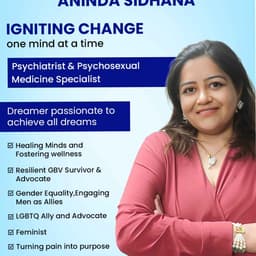
Dr. Aninda Sidhana
Psychiatrist | Psychosexual Medicine | Women’s Mental Health | Trauma-Informed Care | Founder, The Dignity Dialogues™
- Peace & Security
- Gender-based Violence
- Collaboration Stories
- Stronger Together
- #EndGBV
- Global