
SWEDEN: My Beautiful Curly Hair Affirms My Authentic Existence
Jan 23, 2022
story

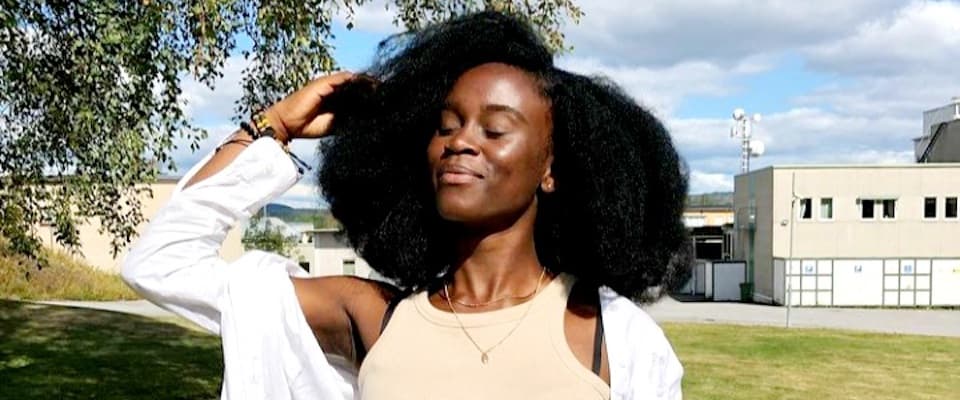
After moving to Sweden and experiencing discrimination at a hair salon, Catherine took matters into her own hands to advocate for Black women and affirm natural Afro hairstyles.
Our organization is building and restoring self-confidence in many young girls who have hated their curly hair for a long time.
Moving away from my homeland of Cameroon to Sweden was a joint decision between my husband and me. We thought we would be able to raise our children in a society where prejudice and injustice were less prevalent. That was until the reality of living here became a fight for my basic existence as a Black woman.
Even my beautiful curly hair became a question to my identity. I felt very proud of my curly hair but the societal beauty standards in Sweden are not inclusive. I was constantly advised to straighten my hair to make it more manageable.
I walked into a hair salon for a hair wash and I was told, \"Vi behandlar inte denna hår typ, ” meaning “We do not treat this hair type. ”
As I tried to explain myself, the hairstylist said, \"Vi behandlar inte SVARTA PERSONS HÅR HÄR I SVERIGE, ” or, “We do not treat Black people’s hair here in Sweden. ”
My luscious curly hair, outstanding in its texture, glowing in its originality, was attacked. I felt pushed against a wall with no escape other than to fight back.
“Why can’t you wash my hair? ” I Asked.
“You will have to ask my teachers where I studied my trade, ” the stylist replied.
The whole place was quiet for a moment. I stood tall, affirming my hair as a work of art, steadying myself as I asked to be treated equitably.
\"I am overdetermined from without, ” I murmured, quoting from Frantz Fanon’s world-renowned book, “Black Skin, White Masks. \" “I Am the slave not of the ideas that others have of me, but of my own appearance and opinions of myself. \"
I asked the stylist, “What is the name of the institution where you studied? ”
Then, I gathered my courage, and I reached out to the institution to get an answer. It took me two years and three months to get a full response.
“There is no study plan for curly Afro hair, \" the vocational training inspectors in Sweden wrote. “But we welcome suggestions. ”
I took matters into my own hands, learning to braid, style, and do natural treatments on my hair at a vocational college. My grandmother’s oil recipes came in handy as I advocated on behalf of Black people and curly Afro styles in Sweden.
Today I run a registered NGO called Working Across Borders Empowerment Center (WABEC).
We teach everyone who cares to know about the beauty of natural, curly hair. We teach young girls, along with mothers and fathers who are biological and adopted parents, how to care for their loved ones’ curly hair. With these training sessions, we are seeing noticeable changes in people’s attitudes toward natural hair.
Our organization is building and restoring self-confidence in many young girls who have hated their curly hair for a long time. The feeling of being racialized by your hair or other characteristics is an everyday battle for many young people with African heritage in Sweden and within the E. U. At large.
Our organization empowers women on matters beyond hair, however. We also offer career development through motivational speaking events and other collaborations with the local chapter of the United Nations in our community of Kramfors, Sweden.
For my kids and many kids born and raised here, to be Black is to stand out in a society where Blackness is a racial marker as a counter-position to whiteness. To be Black in a country where you don’t have ancestral roots is to be called coconut kid (Black on the outside, white on the inside). Belonging becomes a confusing in-betweenness.
WABEC has worked with more than 300 boys and girls and more than 50 parents, with plans to reach even more. It’s powerful to witness young people embracing their natural Afro hair.
I’ve come to a place where my beautiful curly hair helps me affirm my personal being as well as others. My hair creates tangible links to an authentic existence and acceptance from self and others. I am a complete representation of my beautiful curly hair.
This story was published as part of World Pulse's Story Awards program. We believe every woman has a story to share, and that the world will be a better place when women are heard. Share your story with us, and you could receive added visibility, or even be our next Featured Storyteller! Learn more.
- Leadership
- Arts & Culture
- Europe