
Sexual Rights for Sexual Minorities
Feb 7, 2017
story

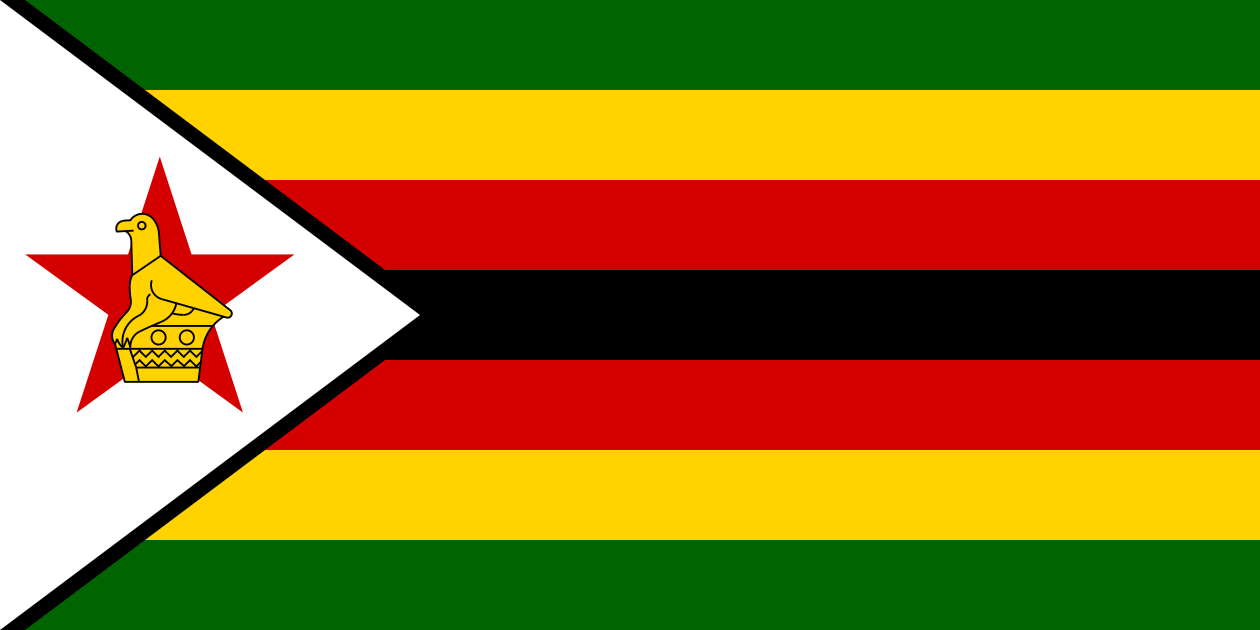

Irked by growing dissent from all sectors of the population, President Robert Gabriel Mugabe, the 29-year leader of Zimbabwe, vented his anger towards a gay rights group that had made calls for constitutional reforms. President Mugabe’s response was to call for the arrest of anyone \"caught practicing homosexuality.\" This statement has dealt a body blow to Zimbabwe’s attempts at achieving universal access to sexual and reproductive health and rights.
“Lesbians and gays are ‘sexual perverts‘ who are ‘lower than dogs and pigs,’” said Mr. Mugabe.
The gullible state-controlled media joined the fray, castigating homosexuals. Scores of innocent citizens have fled the country after being exposed as gays or lesbians. Some have resigned from government employment, including Mr. Alum Mpofu, chief executive officer of the country’s sole broadcaster, Zimbabwe Broadcasting Corp. Mpofu resigned in 2002 after being caught in a compromising position with a male partner.
The consequences of President Mugabe’s statements are there for everyone to see. Homophobia has resulted in the exclusion of sexual minorities in Zimbabwe from development programs. One such program is the Maputo Plan of Action (MPoA) for Universal Access to Comprehensive Sexual and Reproductive Health Services.
Dr. David Parirenyatwa, former health minister and one of President Mugabe’s right hand men, represented Zimbabwe in Maputo and endorsed the document with other health ministers in Africa. Fearing President Mugabe’s hatred of homosexuals, Dr. Parirenyatwa deliberately ignored sexual minorities in the Zimbabwe National Maternal and Neonatal Health Road Map. The road map, adopted to achieve MPoA goals, fails to acknowledge the existence of homosexuals and sex workers and it does not address their sexual and reproductive health challenges.
The Zimbabwe Republic Police, a partisan force, has also taken a cue from President Mugabe’s statements against gays. Arbitrary arrests and detention using draconian legislation have been used to harass gays. For instance, it is an offense for two people of the same sex to hold hands, hug, or kiss under Zimbabwe’s Criminal Law (Codification and Reform) Act [Chapter 9.23], Act 23/2004. The Miscellaneous Offences Act is used to arrest sex workers for “loitering for the purpose of solicitation for prostitution.”
Homophobia is rampant in the health sector. During a public discussion meeting for medical doctors, one doctor said that he felt uncomfortable providing medical services to sex workers and gays.
Comments by medical doctors are just the tip of the iceberg and provide a general insight into Zimbabwean society. Gays, lesbians, and sex workers have limited access to sexual and reproductive health services and care because they live in constant fear of violence, stigma, and discrimination.
The Anglican Church is facing problems globally over the ordination of gay bishops and this issue has ignited violent demonstrations and squabbles in Zimbabwe. Reverend Nolbert Kunonga, after being charged of violating the church’s constitution, turned tables against his accusers. Kunonga, who is related to President Mugabe, alleged that his opponents were gays seeking to oust him because he was straight. What was a simple case of impropriation turned into a political fiasco as President Mugabe brought in anti-riot police officers to back up Kunonga.
Scores of Zimbabweans were beaten up, arrested, and detained. Those who were backing Kunonga attended church services under heavy security guard. For some time, Anglican churches in Zimbabwe became temporary garrisons.
President Mugabe’s statements on gays will continue to hound many sectors of Zimbabwean life. No one in government can stand up to challenge his statements. Zimbabwe needs to develop a clear plan of action to achieve goals set in the MPoA without taking into consideration the president’s ill-advised statements.
Zimbabweans need to stand up to President Mugabe and call for the decriminalization of sex work and the recognition of the rights of gays and lesbians to enable them to receive the highest attainable standard of sexual health, including access to sexual and reproductive health care services. This can be achieved through rectifying laws that undermine the rights of minority groups. The Ministry of Health and the civil society need to provide training to medical staff on providing health services to minority groups.
- Technology
- Human Rights
- Africa