
Scrape Her Head and Lay Her Bare – Widowhood Practices and Culture
Apr 7, 2022
story


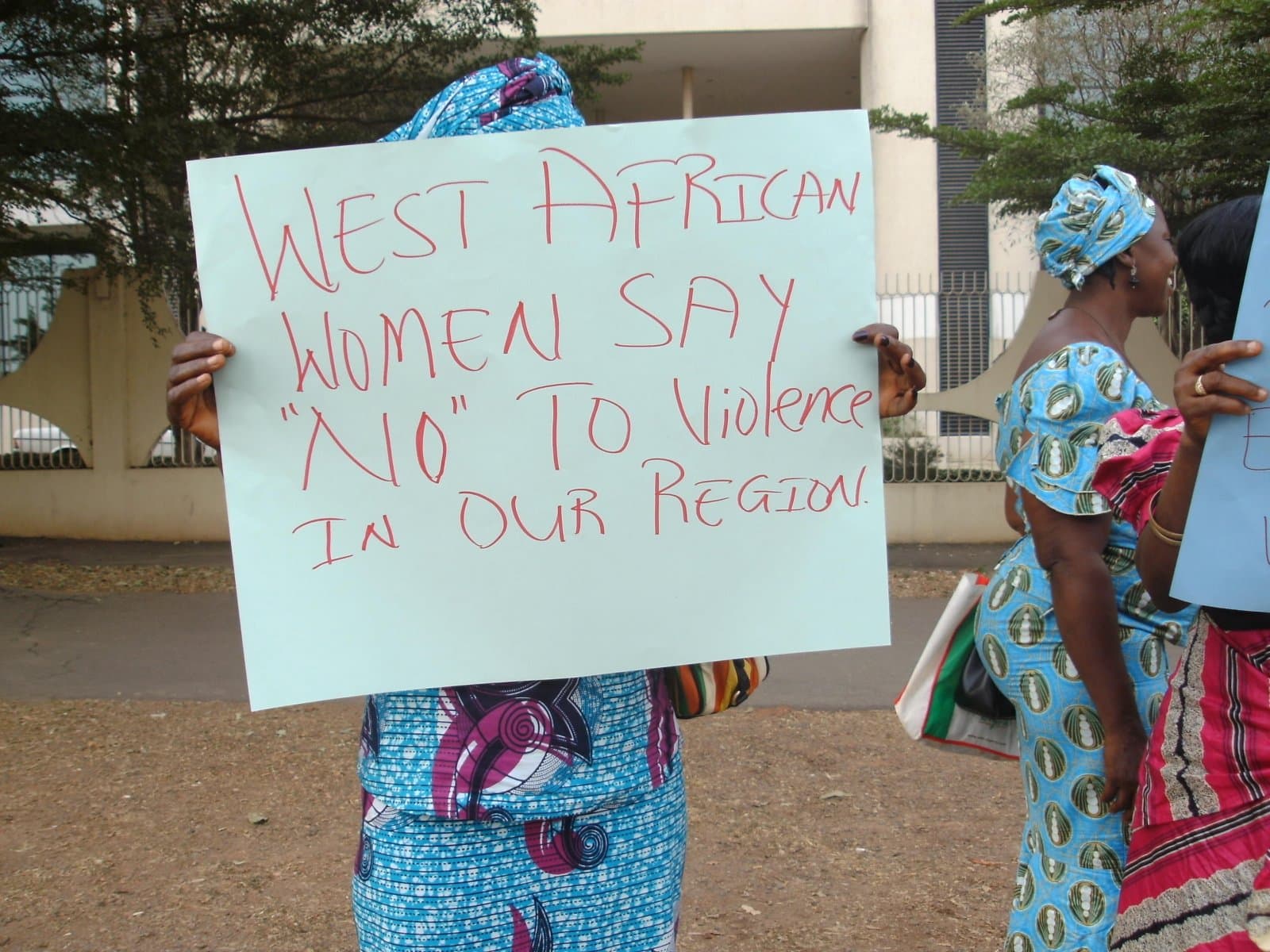
West African Women say no to violence in our region
Oh Death, where is thy sting? But for the widow, a woman who has just being bereaved of her husband, death stings, strips her bare and exposes her to humiliating physical and psychological violence; often in the name of culture, usually by those who should console her and support her in her time of bereavement.
Widowhood practices in West Africa are considered part of cleansing rituals that removes the bond that links a living spouse to a dead one. These practices are carried out as part of culture, therefore, anyone who fails to fulfil the requirements risks social exclusion and apparent family or personal calamity. The Igbos of South-Eastern Nigeria (comprising Imo, Ebonyi, Abia, Enugu and Anambra States) have similar widowhood practices which have impact on the life, health and wellbeing of women.
Violence against women, by Article 1(j) of the Protocol to the African Charter on human and peoples’ rights on the rights of women in Africa, means “all acts perpetrated against women which cause or could cause them physical, sexual, psychological, and economic harm, including the threat to take such acts; or to undertake the imposition of arbitrary restrictions on or deprivation of fundamental freedoms in private or public life in peace time and during situations of armed conflicts or of war.”
When violence is directed against a woman because she is a woman or where such violence affects women “disproportionately,” this has been described by the Committee on the Elimination of Discrimination against Women General Recommendation No. 19 as Gender based violence. This violence also includes “acts that inflict physical, mental or sexual harm or suffering, threats of such acts, coercion and other deprivations of liberty.”
Widows suffer a disproportionate form of ritual cleansing compared to widowers in Igbo culture. Widows may be subjected to the following (Better Live Programme for Rural Women, Widowhood Practices in Imo State (1989)):
- Scraping or Cutting of hair (on the head and pubic area) with a blunt razor
- Crying loudly for long and sustained periods
- Lying down or sleeping next to the corpse of the dead spouse
- Forced to drink water which has been used to wash the dead spouse
- Stripped naked or made to bathe in public, in a stream
- Jeered or pushed around, if she fails to cry loud enough or long enough or sleeps off
- Made to sit on a hard floor while she cries
- Dressed in filthy clothes or rags as a sign or mourning
- Subjected to hurtful comments and possibly accused of causing the death of her spouse
- Prevented from washing or having a bath until after a determinate period
- Forced to eat from unwashed bowls
- Requested to be in mourning period for a period of 1 year
A widow may suffer a mix of the above but the treatment of widows during mourning differs from state to state and there may be different practices within the same states (Dr. Esther Nzewi, Widowhood practices: A female perspective (1989)). However, a common sign of bereavement is the scraping of the widow’s hair probably, all of it by the “Umuada” – the daughters of her spouse’s lineage. These are women who are related to the dead spouse, often his sisters. They play a unique role in the widowhood practice as they ensure that the widow complies with the demands of 'culture.’ Infact, the time of mourning exposes the widow to violence and the amount inflicted depends on the relationship she has with her in-laws and whether they are jealous of her. This is an opportunity to demean her and make her worthless. The widow would be lucky if she has matured daughters as they also by connection to their father are part of the Umuada and can ensure their mother’s treatment is as painless as possible. If the widow’s relatives are influential or rich in their own right, they can also bribe the leaders of the Umuada to be lenient on her.
A widower on the other hand, enjoys lighter treatment. In some Igbo towns, he may be required to shave his head, beard and moustache as a sign of mourning, but this would be done by his brothers or relatives (Nzewi 1989). Compared to a widow, whose hair is shaved by her in-laws, even when her daughters are part of the Umuada, they are not permitted to shave her hair. The widower may remain for 28 days in his compound but he is free to go about his daily business. Unlike a widow who is restrained from having social calls or going to the market (Nzewi 1989).
Some writers have tried to explain the culture imposed widowhood practice. That the treatment of widows as impure until the completion of widowhood rites usually at the end of the one year mourning period (seen as approximately 7-9 months based on the local Igbo Calendar year “mgba aho”) represents a full circle of life depicting regeneration (Joseph Therese Agbasiere, Shirley Ardener, Women in Igbo life and thought Routledge 2000). “It can be as a ritual assertion of the continuous informing and reforming dimensions of a woman’s life.”(Agbasiere & Ardener 2000)
However, the continued physical and psychological violence inflicted on widows as part of the ritual cleansing can be removed as it is now an opportunity for abuse and maintains unequal power relations for women. It also perpetuates the belief in the superiority of male over female since men are treated favourably over women. Culture evolves and human rights standards of fairness and gender equality is a part of modern day culture.
The imposition of widowhood practices in recent times has been affected by the changing work environment, as many women now have full-time jobs and the migration from rural to urban areas. However, while the length of a widow’s mourning may be reduced, she is still at risk of being subjected to the cultural shaving and wearing of rags. Some Igbo states in Nigeria like Enugu (Prohibition of Infringement of Widow and Widower’s Fundamental Rights Law 2001) and Anambra (Malpractices against Widows and Widowers (Prohibition) Law, 2004) have enacted laws prohibiting harmful widowhood practices and refusing to recognise them as part of culture. Implementation of these laws is very poor as culture is ingrained in the people and the custodians are unwilling to modify it.
The existence of the Umuada, who are a homogenous group of women, provides a platform to stop the infliction of violence against women during mourning period. With access to education it is surprising that educated women are still continuing the practice especially since they are also at risk of being violated by members of their husband’s family on his death. Sustained and active human rights education aimed at improving rights knowledge and increasing women’s opportunities to economic and welfare schemes may help to curb this perpetuation of violence which has been sustained under the vehicle of ‘culture’ (Amobi Linus Ilika, Uche Rose Ilika, Eliminating Gender-Based Violence: Learning from the Widowhood Practices Elimination Initiative of a Women Organisation in Ozubulu, Anambra State of Nigeria African Journal of Reproductive Health, Vol. 9, No. 2, August, 2005, pp. 65-75) The Umuadas can be instrumental to changing male controlled traditional institutions by refusing to partake in such practices against women.
The State has the greatest responsibility to take appropriate and effective measures, not only legislative measures, to modify social and cultural patterns of conduct, protect women’s right to dignity and freedom from violence, prevent, punish and eradicate violence against women, and ensure equal treatment (Articles 2(2), 3(4), 4(2), 5, 20 & 21 Protocol to the African Charter on human and peoples’ rights on the rights of women in Africa). The most useful tool, the state can use to eliminate violence against women within the cultural context is education; particularly directed at custodians of culture including the Umuada who can help eradicate widowhood practices that harm women.
Note: This post was originally published 28 October 2011 as part of the the series ‘Culture and Human Rights: Challenging Cultural Excuses for Gender-Based Violence’ hosted by Gender Across Borders and Violence Is Not Our Culture. Sadly, widows continue to face discrimination, gender-based violence, stigmatisation and abuses of their human rights including dispossession of landed property by their late husband's family in Nigeria. Enforcement of women's human rights would help curb these violations together with education leading to an end to such harmful traditional practices.
- Arts & Culture
- Health
- Gender-based Violence
- Human Rights
- Africa