
Request to help for flood relief work in Pakistan
Aug 31, 2022
story
Seeking
Action


Concept Note
Emergency Relief
Problems statement:
· Pakistan is among the top ten countries highly vulnerable to climate change and is currently facing powerful floods that have taken over the whole country.
· This year Pakistan has received 60 percent of the total monsoon rains in just three weeks of July causing heavy floods, flash floods, landslides, and Glacial Lake Outburst Floods (GLOF) across the country.
· The humanitarian situation in Pakistan has deteriorated further over the past two weeks as heavy rains continue to cause flooding, and landslides resulting in displacement and damage across the country. Sixty-six districts have been officially declared to be ‘calamity hit’ by the Government of Pakistan – 31 in Balochistan, 23 in Sindh, 9 in Khyber Pakhtunkhwa (KP), and 3 in Punjab.
· The situation remains dynamic, and many more districts have been affected; the number of calamity-declared districts is expected to rise as rains continue to fall.
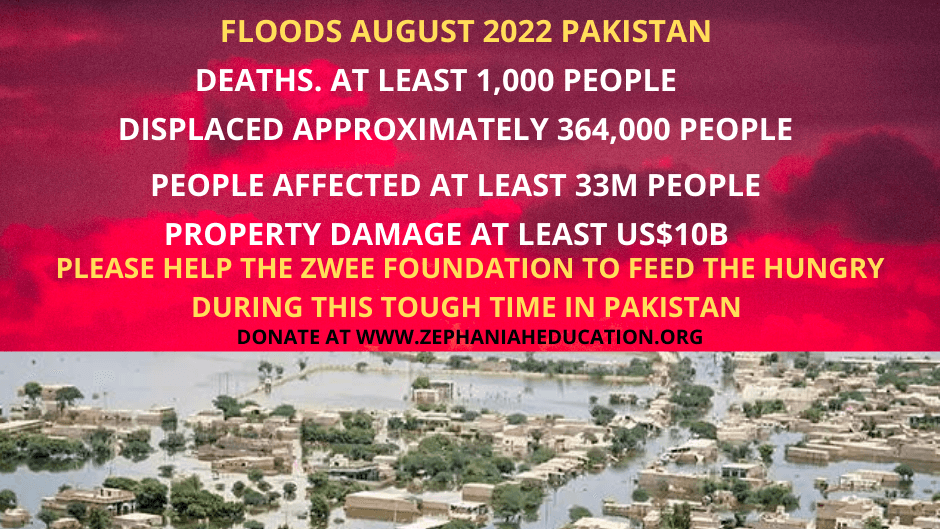
· The adverse weather conditions have incurred significant human and livestock casualties and widespread damage to private homes and public infrastructure, especially in Balochistan and Sindh provinces. The National Disaster Management Authority (NDMA) reports some 33 million people in Pakistan have been affected. As of 25 August, Pakistan has experienced 375.4 mm of rainfall – 2.87 times higher than the national 30-year average of 130.8 mm. These rains have primarily fallen on Balochistan, Sindh and parts of Punjab, with Balochistan receiving five times its average 30-year rainfall and Sindh receiving 5.7 times its 30-year average.1
· Over 218,000 houses have been destroyed and a further 452,000 damaged since 14 June, according to the NDMA. Livelihoods are also being heavily impacted – more than 793,900 livestock – a critical source of sustenance and livelihoods for many families – have died, of which some 63% are in Balochistan and 25% in Punjab. Around 2 million acres of crops and orchards have also been impacted, including at least 304,000 acres in Balochistan, 178,000 acres in Punjab, and some 1.54 million acres in Sindh. Damage to infrastructure has further worsened the humanitarian situation, as the partial or complete destruction of over 3,000 km of roads and 145 bridges impedes the ability of people to flee to safer areas or to travel to access markets, healthcare, or other vital services, and restricts the delivery of aid to people in need. Internet outages have also been reported, with the Pakistan Telecommunications Authority attributing widespread internet cuts in central and northern Pakistan on 19 August to technical faults in the fibrotic network resulting from the heavy rains and floods.
· Provisional data from provincial Education Departments show that at least 17,566 schools have been damaged or destroyed due to the emergency: 15,842 schools in Sindh, 544 in Balochistan and 1,180, in Punjab. Additionally, at least 5,492 schools are reportedly being used to accommodate displaced people. A rapid need assessment (RNA) conducted in 10 districts of Balochistan found that 977 classrooms were completely destroyed (304 in Khuzdar, 193 in Lasbela and 167 in Jhal Magsi), while minor damage was reported in 975 classrooms (304 in Khuzdar, 156 in Lasbela and 174 in Jhal Magsi), and 577 schools were being used as shelter (254 in Killa Saifullah, 105 in Jhal Magsi and 84 in Lasbela).
· Near incessant rainfall is compounding flash flooding and rain-induced landslides by rapidly filling up dam reservoirs, posing further risk to people in the vicinity and downstream. On the Indus River, which traverses the length of Pakistan, the Tarbela Dam in KP province – the world’s largest earth-filled dam – has already reached its maximum conservation level of 1,550 feet (472 meters), while the Chashma Barrage in Punjab province only has seven feet (2.13 meters) remaining before it also reaches its 649 feet (197 meters) maximum conservation level. On 26 August, the Pakistan Meteorological Department (PMD) Flood Forecasting Division (FFD) issued a warning that very high to exceptionally high level flooding is expected in River Kabul at Nowshera in KP province, as well as in tributaries of the Kabul and Indus rivers until 28 August. The FFS also warned of high to very high flood levels at Kalabagh and Chashma along the Indus River between 27 and 28 August, posing further risk to people in the vicinity and downstream.
---------------------------------------------------------------------------------------------------------------------
https://reliefweb.int/report/pakistan/pakistan-2022-monsoon-floods-situation-report-no-03-
26-august-2022
Initiatives to counter these problems:
ZWEE Foundation has been working to uplift women and children for over 25 years through free education and empowerment. Now it is time for us to uplift them from sorrow, hopelessness, hunger and insecurity. This is a time for us to bring little hope in their life.
· There is a need of an urgent relief operation and activities for the people in calamity as they have no shelter, clothing and food. They are subject to misery, starvation and homelessness. The moderate and high level flooding in Punjab and across the country has paralyzed the whole economic and social life there. There are multiple ways to provide urgent relief to the affected ones.
· This can be done by providing Food Packages (Flour, Rice, Lentils, Sugar, Salt, Cooking Oil, sanitary pads, diapers for children, and more);
· Dignity Packages (Tarps, Mosquito Nets, Water Containers, Kitchen Sets);
· Shelter Home Kits (Bamboo, Roofing Materials, Doors, Windows, Tarps); and
· Mobile Medical Services.
So it is the need of the hour to work with other NGOs and state institutions to provide relief and help to those who have nothing but hope in their eyes.
Need of the affected people:
· Currently we have to provide them Groceries, dry eatables, milk, sop and sanitary pads for women, Diapers for children and clean drinking water
Total budget requested against reserve: PKR. 2000,000
(200 beneficiaries* PKR. 10,000 per ration pack = PKR. 2000,000)
- Global