
PHILIPPINES: Women Hold Together the Caregiving Fabric in Mindanao
Apr 30, 2019
story


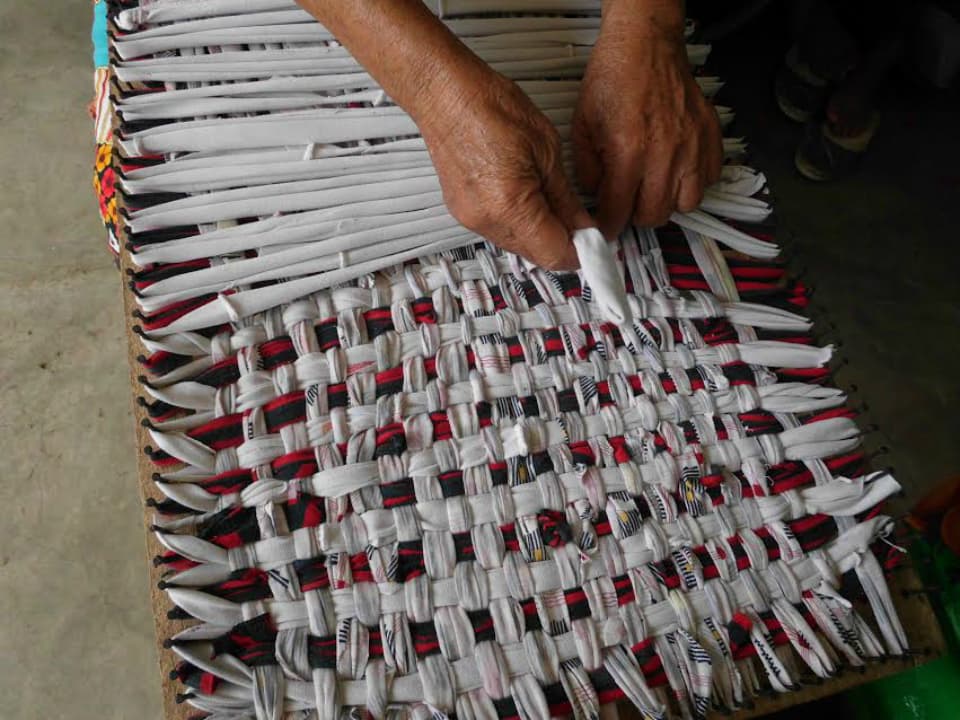
Photo courtesy of Lina Sagaral Reyes
Lina Sagaral Reyes shines light on the female face of mental health caregiving in the Philippines—and the neglected needs of caregivers.
For so long, the wellbeing of mental health caregivers has been consigned to the backburner.
A tight huddle of women is hunched over portable looms at the kiosk by the tall steel gates of the House of Hope, Northern Mindanao’s lone psychiatric custodial facility.
They are here every day, weaving strips of stretched fabric on the contraptions and looking like members of a chamber orchestra soundlessly strumming many-stringed square cellos. Visitors to this facility have often wondered who they are. Could they be clients in recovery? Do They belong to the Catholic congregation running this institution? Are They volunteer artisans?
The women are called 'the watchers'—caregivers keeping watch over their kin. House of Hope has broken away from the traditional practice of hiring professional caregivers or interns to take care of clients experiencing acute psychotic episodes. Instead, it requires a family to send a member to watch over one of their own who is weathering a psychiatric crisis.
The watchers make use of after-care free time by up-cycling old unwearable shirts into sturdy house rugs they can sell in trade fairs. The funds raised from the sales buy essential anti-psychotic medication and antidepressants for the facility’s poorest clients, who otherwise cannot afford to comply with the dosages.
This scene at the kiosk is familiar to me as House of Hope has become my home over the past few years. I came here first as a client recovering from a psychotic break in 2013. Later, I returned to provide support services for recovered individuals who have opted to pursue self-reliant, independent living.
Over the years, I have observed that women, especially mothers, are at the forefront of caregiving for the mentally ill in most families in these parts of Northern Mindanao. In fact, 68 percent of the caregivers of House of Hope clients are women. They are mostly mothers, but also sisters, aunts, wives, and daughters. In contrast, the clients are mostly men.
These findings are part of a study by Aileen Duldulao evaluating the facility’s intervention program. Duldulao is a friend from way back who recently visited House of Hope on a respite from public service work in Portland, Oregon in the US.
After meeting the staff at House of Hope, Duldulao—an epidemiologist with a doctorate in social work—abandoned her plans of sightseeing at the nearby resort island. Instead, she volunteered her time to research House of Hope’s powerful caregiving model. She was in awe of the rare commitment ofthe House of Hope staff despite threadbare resources, a commonplace challenge in health care in a low-income country like the Philippines.
A groundbreaking solution
House of Hope is the only mental health facility in Mindanao, and perhaps even in the Philippines, to have tried this arrangement of involving family members as caregivers. The policy began four years ago after a push from social workers and nursing staff to shift the focus from facility-based care to community-based recovery.
Duldulao's study revealed that the practice saves the family precious caregiver fees and at the same time provides opportunities for family members to learn caregiving lessons, preparing them for when their loved ones eventually return home.
After talking with my friend Aileen Duldulao about the outcome of her research and the power of this unique community-based model, I set out to learn more. I spoke with Cleinton Ubarco, senior nurse at House of Hope, who is critical of programs that keep people with mental illnesses in facilities long term rather than integrating them back into the community.
\"The longer a patient stays inside the isolation cell, the more difficult it becomes for that patient and the family to cope and re-adapt to each other and for the recovered ones to reintegrate and participate fully in the community, \" he told me. House of Hope’s model prepares family and friends to transition care and support to the family after their time in treatment.
Who Is Watching the Watchers?
While this approach is groundbreaking, there is risk of placing too much burden on the women caregivers who may not have the support they need to shoulder the care of a loved one.
House of Hope’s model, however, emphasizes the importance of cultivating independence in patients to alleviate potential pressure on the watchers. Dr. Dina Nadera, a psychiatrist and former mental health consultant of the World Health Organization, said that Duldulao’s findings affirmed her own belief in the positive potential of this approach. “Informed mental health survivors are able to take responsibility for their own wellbeing and can make options about their own health care, ” she says.
As an informed former client myself, I agree with Dr. Nadera. House of Hope encouraged me to take the heddle and weft. I learned to make a living of my own through handiwork, thus freeing my family members of the backbreaking and mind-bending task of caregiving.
dr. Nadera went on to caution that House of Hope as an inpatient facility cannot be the only solution for community-based mental health care. She said community-based mental health care needs to also be embedded in the government’s primary health care program.
Communities must be empowered to enable the reintegration of recovered patients. Also, caregivers themselves need access to mental health support.
dr. Dures Tagayuna, another medical professional I spoke with, is working on just that: bringing caregivers in families throughout the country the support, attention, and care-giving they themselves need.
\"For so long, the wellbeing of mental health caregivers has been consigned to the backburner; it has never been a government priority, either nationally or locally, \" she said.
\"It’s about time we spearhead a program along with the plan for a gender-sensitive mental health plan not only for House of Hope but for the city as well, \" she added.
She proposed a massive mental health information drive modeled after campaigns led by breast cancer survivors. She added that women who hold families together as breadwinners must be encouraged to remain healthy or else they will burn out or succumb to mental health conditions themselves.
On the national front, mental health advocates are now lobbying for a national mental health policy, the passage of which has eluded three generations.
MOTHER HEN
Back at the kiosk, a watcher I’ll call Loretta (not her real name) hopes her daughter, currently confined to an isolation cell, can cultivate resilience. At 67, Loretta is the oldest among the watchers and has earned the moniker Ina-an(Mother Hen). \"I Hope [my daughter] learns to bounce back on her own and would seek support once she feels ill. When I am gone, how will she be able to cope? \" She worried, her arthritic fingers tightening the knots on a nearly finished rug.
The House of Hope management is aware of the risks of bearing witness. It conducts Sunday gatherings over a campfire at sunset by the coconut grove so that women like the Ina-an can mull over their travails together and relieve the stress and tensions of caregiving through song, prayer, and games.
But, of course, all these are just swatches in the herring-boned patchwork of worn souls. It will take time—and political will—to put together a comforting quilted blanket of self-care for women caregivers.
STORY AWARDS
This story was published as part of the World Pulse Story Awards program. We believe everyone has a story to share, and that the world will be a better place when women are heard. Share your story with us, and you could be our next Featured Storyteller! Learn more.
- Health
- South and Central Asia