
PHILIPPINES: Pursuing College at 35
Apr 30, 2019
story
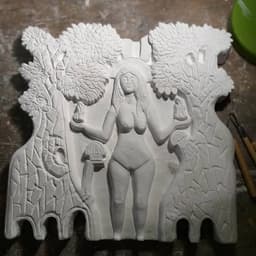

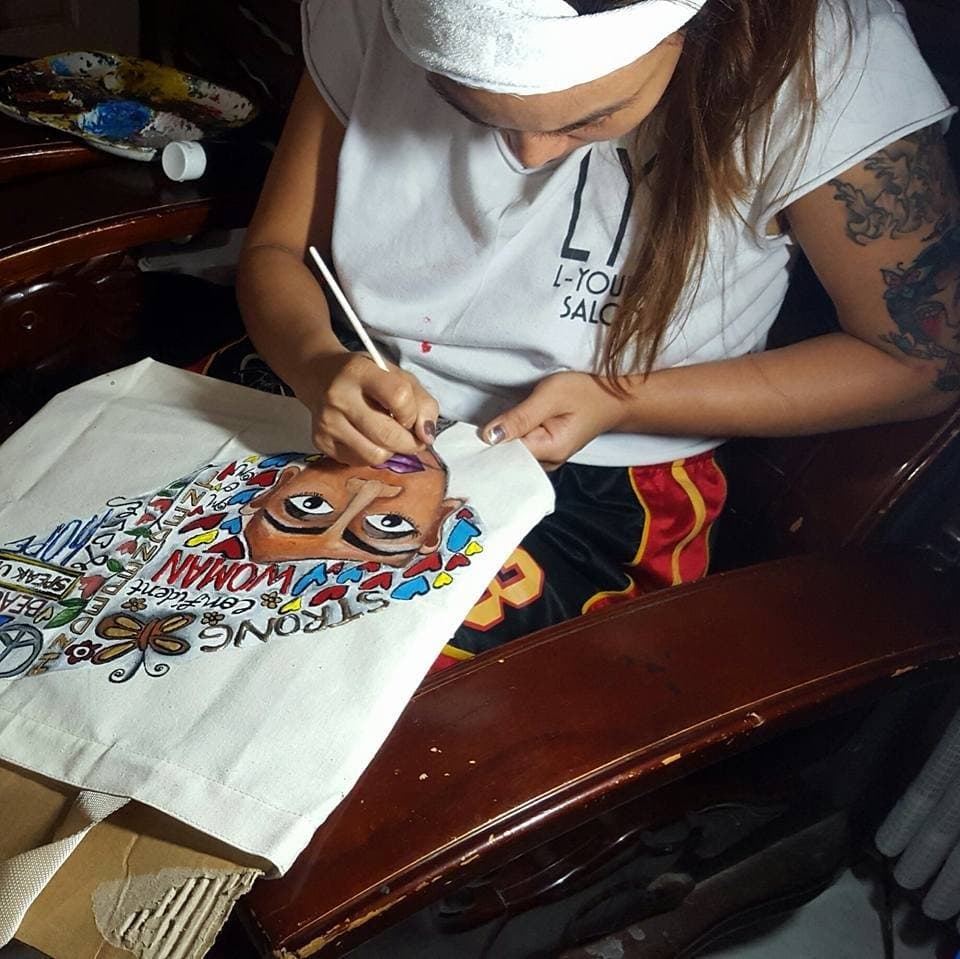
Photo courtesy of Cecille Pauline Sanglap Montenegro.
After a decade as a migrant worker, Cecille returns home to the Philippines and uncovers her true calling.
Painting is what my limbic brain tells me to do.
My name is Cecille Pauline S. Montenegro. I was born in Panay Island, Iloilo City and raised in Metro Manila. I am 35 years old and I live with my partner and two beautiful children. Anda is 12, and Jun is 10 years old.
This year I realized what my heart has wanted ever since I was a child—to speak up and fight for the rights of women and children through art.
When I was a child, I loved to draw. I collected cardboard and any materials I could find to draw on and explored all the vivid colors of life through paper and pencils.
I can still remember how excited I was each time my father brought home tracing paper and blue prints from his work as a civil engineer. There were always tons of papers everywhere in the small room we called home, the room my mom, a housewife, was forever tidying.
I come from a poor family. I, along with my four younger siblings and my parents, lived in my grandparent’s home, partitioned by dividers to make up tiny rooms.
I used to tell my parents that when I grew up I wanted to become an architect, a designer, or a painter. I wanted to build us our own house and paint it. Although my parents mostly encouraged my dreams and pursuits, they cautioned me that painters lived in their own realities and didn’t earn any money.
Heeding their warning I resolved never to become a painter, but I continued making dolls and doll clothes out of cardboard and paper.
When I started high school my father went abroad for work in order to make more money for our family. My mother was then able to save enough for us to rent our own one-room apartment. In my second year of high school, however, my father returned home. He had resolved never to work abroad again.
Even though we had no money for it then, I wanted to continue school. I asked my aunt to help support my studies, and in return, I would help her with the household chores. I also volunteered to tutor my two younger cousins in their schooling. With my aunt’s help, I graduated secondary school with honors.
After high school, I enrolled in college to study fine arts and major in interior design, but neither I nor my aunt could afford the tuition fees. My aunt suggested I work alongside my studies, so I worked at a local bar as a singer—the first job I could find as a 16-year-old girl. I made relatively good money, and no one recognized me with makeup on, but it was extremely exhausting and took a toll on me and my studies.
After a year and a half of this work, I leapt at an opportunity my neighbor offered me in the entertainment business in Japan. My goal was to go abroad and save money in order to continue my interior design studies. I reasoned that if I worked abroad I would earn a lot more than I could in the Philippines. While this was true, the flip side was that during my years working in Japan life couldn’t have been harder.
I drudged my way from Tokyo to Toyama as an entertainer. I was making a living to help support my family back in the Philippines, but there were moments my work almost drove me insane.
The language barrier was a problem, and though my visa and job title stated I was a singer, I had to dance onstage as well. I also had to serve customers when I was not onstage performing. This work was so difficult. I returned to the Philippines after only three months, but because my family needed the financial support and I was now in debt to my manager, I had to go back to this work in Japan.
I went back and forth like this, about five or six more times about every six months. I soon forgot my initial reason for working in Japan—to save money and continue college.
When I decided to return home for good in 2010 after nearly ten years in Japan, I was a single mother of two having left my abusive Japanese husband two years earlier.
Back home in the Philippines, I set up a beauty salon with the support of my partner. I worked hard at the salon as well as in the cosmetology classes I was taking. I still had the strong desire to draw and paint, but every time I passed an art shop, thoughts about my past and the fear that I was too old to start painting again prevented me from entering.
Four years after returning from Japan, however, inspired by my new life with my partner and my children, I started to paint again. I was nervous and excited at the same time because it had almost been a decade since I had last picked up a paintbrush.
My first painting was of a woman with women in her Philippine flag hair. I kept painting and haven’t stopped since.
I continue to paint on canvases and even walls; I have made murals locally and globally; I have also been featured in many different art exhibits, all focused on showcasing women’s art. I never knew that I was an art activist until I read about art activism and realized that all my artwork highlighted the empowerment of women and children.
Around the same time I started painting again I became involved with an organization called Batis AWARE (Association of Women in Action for Rights and Empowerment). Now I volunteer as its president.
We are a group of returned migrant Filipino women. Most of us are victims and survivors of human trafficking, slavery, and domestic violence. Our mission is to empower women and to advocate for our rights.
Last July, through Batis AWARE, I was invited back to Japan by KGU Kwansei Gakuin University and SALA Asian Shokudo restaurant to create an advocacy art project about migrants in Japan and to speak about our organization.

Advocacy Art: Cecille painting \"Empowerment of All People\" mural in Japan. Photo courtesy of Ms. Naoko Kuroda and Mr. Hibiki Fuse, SALA.
When I left Japan I never thought I would return. It was a thrilling and fascinating experience to go back to the country six years later as an advocate and artist rather than as a migrant worker in the entertainment business.
Now I want to return to school to formally develop my painting skills. I am currently in the process of enrolling in a fine arts painting program at University of the Philippines in Quezon City.
I know that what my parents told me about being a painter was not true. For me what is true is what is in my heart. Painting is what my limbic brain tells me to do. This is my passion, this is me—i am a painter and this is what I want me to be.
STORY AWARDS
This story was published as part of the World Pulse Story Awards program. We believe everyone has a story to share, and that the world will be a better place when women are heard. Share your story with us, and you could be our next Featured Storyteller! Learn more.
- Gender-based Violence
- Education
- South and Central Asia