
PERU: Feminists Are Brewing Something Big
Mar 12, 2020
story

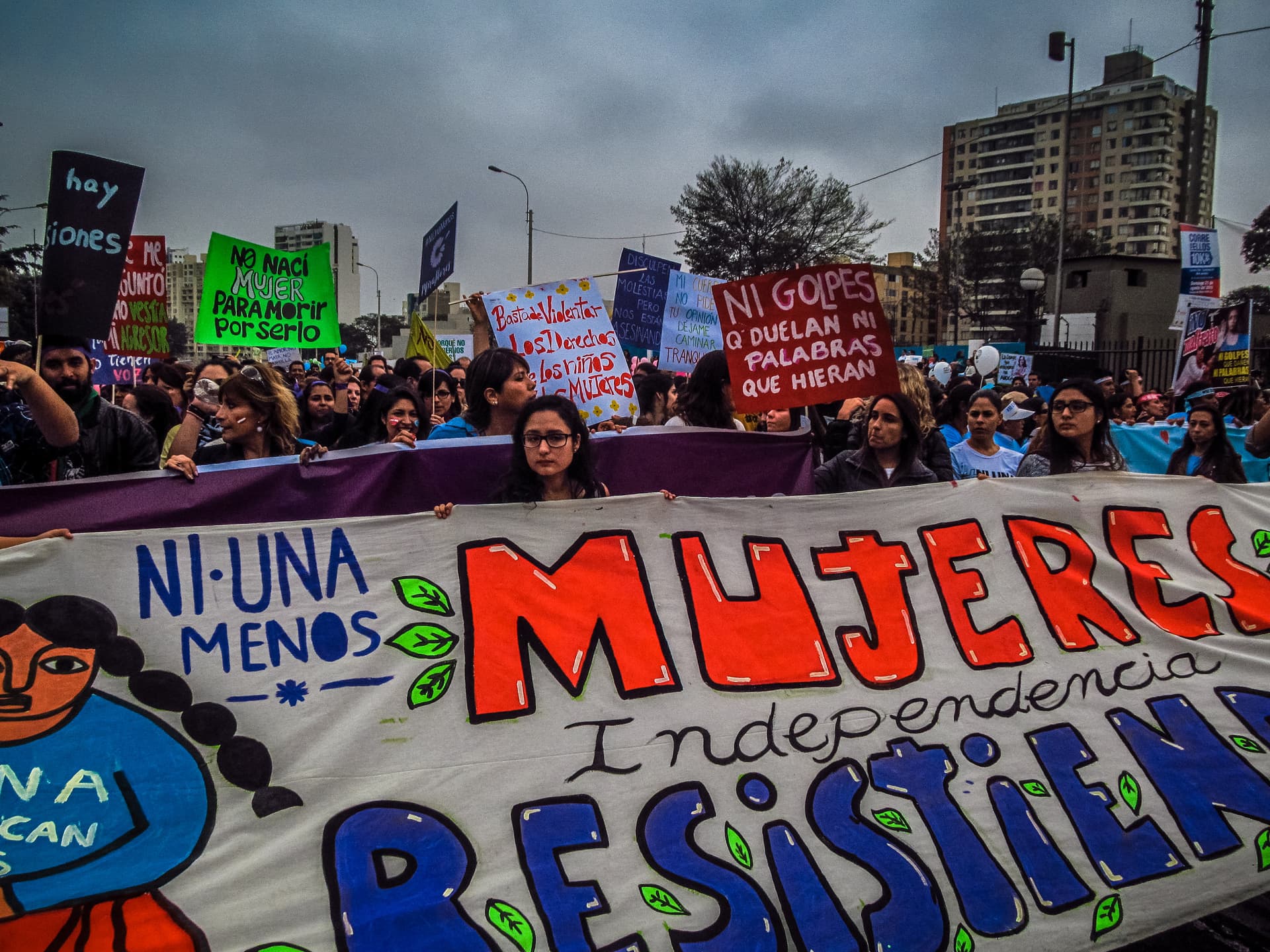
Photo © katherinephotography10 | Flickr CC BY-NC 2.0
Enmita Marínis witnessing a shift in Peru as hashtag activism grows into an unstoppable, public movement.
Women in my country have gradually awakened over the years, but it is in this last month that I have really felt their angry energy.
On July 28, Ana María Choquehuanca, Peru’s newly appointed head of the Ministry of the Woman, told a media outlet, “Peru does not need feminism. ” She said she believes “in the equality of opportunities, but not in feminism. ”
What the hell? Peru Has the third highest femicide rate in Latin America. According to the numbers gathered by Choquehuanca’s own ministry nearly one femicide attempt and eight sexual assaults are reported every day in Peru. From January to May 2017, 45 cases of femicide and close to 105 attempts to commit this crime across the whole country have been reported. These are the known numbers, only the tip of the huge iceberg of violence against women that exists in Peru.
According to the Oxford English Dictionary—and many feminist organizations—the definition of feminism is: the advocacy of women's rights on the ground of the equality of the sexes. In a country with the aforementioned statistics, it cannot be denied that we need feminism. We need it, and in enormous doses.
On July 31, women all over the country spoke out on social mediaand made our presence felt. We rose up with a #Tuitazo (which could be roughly translated as “huge tweet”), making use of the hashtag #ministrafeminismoes, which means “ministerfeminismis. ”We gave our new minister a lecture about feminism, and in just a few hours, we became a trending topic.
https://twitter. Com/ninfasdesafo/status/892219352581328898
#ministrafeminismoes entender que no es posible el emprendimiento y empoderamiento de mujeres sin derribar prejuicios hacia el Feminismo
— Vict8r Eduardo (@victoreduardo8a) August 1, 2017
this angered some people. We received some chauvinist commentssuch as: “What are you doing in social networks? You Should be in the kitchen! ” But We also generated unity, inspiration, sisterly support, and media attention. The next day, Choquehuanca spoke to the media saying: “The fight of all Peruvian women is my fight”.
But no, we were not done.
The press had not yet finished covering the impact and scope of the #Tuitazo when a new march was announced. This march was designed to serve as a remembrance of last year’s #niunamenos march, which made people aware of the extent of gender-based violence and femicide and the need for policies to confront these problems. “Ni una menos” can be translated as “not even one woman less. ” This year, we planned to march again to say: We’re still here. We are present and still awaiting the implementation of policies aimed at providing equality. We want justice brought against all those who assaulted us.
The tide is restless in many social networks. Something big is brewing. Women in my country have gradually awakened over the years, but it is in this last month that I have really felt their angry energy, their search for justice. I belong to two social network groups: One is open to all feminists and the other is focused on feminist women who are also mothers. On Facebook, I used to count four to five notifications per day; this past week, it’s gone up to around 45 notifications per day.
On August 3, a new #Tuitazo united our voices in the lead-up to the march. We used the hashtag #niunamenos to share what drives us to march again this year. Some march for feminist ideals; some march to demand justice; some march against sexual abuse of children; some march against disgusting street harassment. A considerable number of women march to ask, “What ever happened to our sisters? ” What Happened to Solsiret, Shirley, and Esthefanny, women who have all been missing for months?
I’m now feeling the anger of thousands of women due to the injustices inflicted upon us in my country. I feel their sorrow and angst, which has become my sorrow and angst. I’ve become an “angry feminist. ” I too want to know where my sisters are; I too want people to stop throwing obscene epithets at me when I walk down the street; I too want justice; I too want the sexual abuse of children to end—right now. Not tomorrow, right now! I feel strengthened by our shared anger.
Women in my country are rising with a roar. It is suddenly more common to see a woman who has been harassed or assaulted denouncing the act on social media. The victim’s feelings of shame before society are becoming a thing of the past. As violent acts are made public, hundreds of women are responding to support the victim, share her story, get outraged, provide counseling and a virtual comforting shoulder. We all unite against the one who dared to hurt one of our sisters, a total stranger we only know through social networks.
On Saturday, August 12, after rallying on Facebook, Twitter, and whatsapp, women marched in the streets of Lima and in the streets of Piura, Ayacucho, and Iquito, and several other cities. This time, I couldn't get away from my work responsibilities as a medical doctor, so I joined the marchers virtually through social networks, using the hashtags #12A and #niunamenos. I spent as much time as I could posting, reposting, tweeting, and retweeting news and photographs of the march. I wasn’t the only one.
People posted messages like \"I may not be marching right now, but my heart is with your ideals. \"
I saw anotherpost that said\"I had to work today, but it is because of the freedom to be able to work that I make myself felt in the march with you, sisters! \"
I felt a sense of courage, bravery, unity, anger, and outrage, but above all: sisterly love and empathy. You could feel it watching the march on TV and in the photographs circulating of marching women and men (yes! There were men! ).
Some signs from today's march #niunamenos pic. Twitter. Com/wi4rhwwfe5
— Ximena Jimenez (@ximenajzr) August 13, 2017
Seguimos en la lucha por una sociedad de respeto e igualdad! #niunamenos #12A pic. Twitter. Com/yen9cbmnlu
— unidastodolopodemos (@unidastlp) August 14, 2017
No somos una o dos, somos todas a una sola voz.
— Inés 🌬 (@agnesrodriguezc) August 13, 2017
Así fue la marcha #niunamenos en Trujillo. pic. Twitter. Com/3hdjorboe0
We stood together against those attempting to undermine us. On the same day of the march, a newspaper released false information about supposed animosity between two feminist leaders (accusing one of them as a homewreckerand man-stealer). Some people used this story as a reason to make fun of the march, the march leaders, and all women.
In my mind and in the minds of many, those newspapers slandered these women. Their lawyers have demanded a public apology and a correction of the information. Those demands, at present, have not been met.
Then something truly unusual happened around this unsavory event: Women stood up and defended our leaders fiercely on social media; we supported and believed in each other, and by doing so, we stood up and defended feminism in Peru.
We may not have gotten any new laws passed yet, but I’m seeing more and more women reacting against male chauvinism and gender-based violence. We're getting ever more united and ever stronger; we’re becoming ever more sure of our roles in this fight, and ever more committed.
We know that feminism is not a bad word. We are proud to be feminists. And in this moment, when we see how strong we are together, we are the proudest we’ve ever been to be women.
STORY AWARDS
This story was published as part of the World Pulse Story Awards program. We believe everyone has a story to share, and that the world will be a better place when women are heard. Share your story with us, and you could be our next Featured Storyteller! Learn more.
- Leadership
- Gender-based Violence
- Latin America and the Caribbean