
PANAMA: Chronicles of a Resilient Life
Dec 16, 2021
first-story

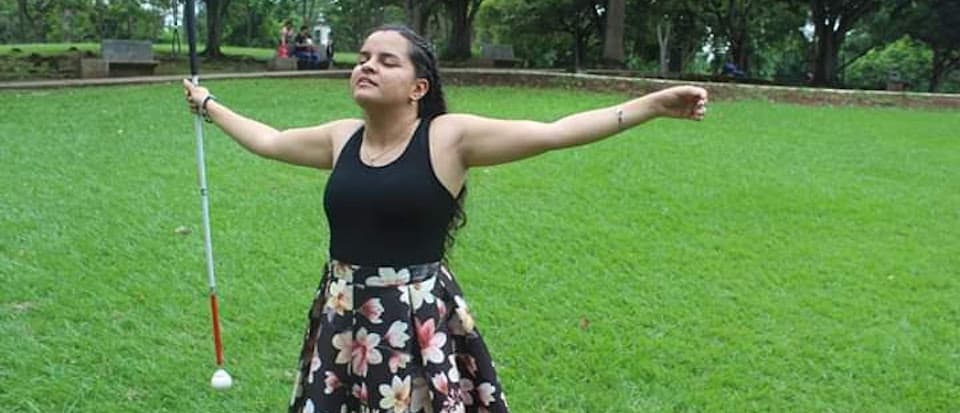
The image shows Estefanía standing in a green field with arms outstretched, holding her white cane. (Photo courtesy of Estefanía Cubillos Nova)
Estefanía Cubillos Nova speaks out on growing up blind and the power of connecting with other women with disabilities to advance her leadership in the world.
Above all, I hope that we will be able to live safer, more resilient lives, full of possibility.
*Editor's note: This story has been translated from Spanish. You can read the original version and hear Estefanía’s Spanish narration here.
*Nota del equipo editorial: Esta historia fue traducida al inglés de su versión original en español. Puedes leer y escuchar la narración original de Estefanía aquí.
i'm Estefanía. I am currently 28 years old, and I have been practically blind from birth. I was born premature, and when the doctors took me to the incubator for my organs to develop, they forgot to cover my eyes and I was blind.
It was a difficult time, especially for my mother, because she thought that I would never go to school, that I would never work, and that my life had simply ended as soon as I was born. With the passage of time this reality changed, and I received support from teachers at school and by family members. I learned to read and write with the support of my mother through the Braille system.
Not everything was easy in my childhood. I was born in Colombia, and as a child, I was a victim of bullying due to wearing dark glasses in a mountainous city in Colombia. In my adolescence it was complicated because I always compared my life with the lives of other girls without disabilities. In addition, I did not use a white cane to help myself navigate. I was very ashamed, and I thought that having a cane would make me stand out and would make it so that no one would truly see me.
When I graduated from high school, my life took a 180 degree turn. In 2013, I traveled from my homeland of Colombia to Panama to study journalism. It turned out that, in addition to being a woman with a disability, I would become an immigrant.
In Panama, my problems continued: the problems of independence and autonomy. One day, I made up my mind and went to Patronato Luz del Ciego , an institute that helped me learn orientation and mobility skills. Little by little I got ahead, and began moving about between my house and my university on the subway. Later I began speaking more in public thanks to my studies in journalism and the opportunities people gave me.
My first international challenge was to travel to Eugene, Oregon in the United States to participate in the WILD Institute on Leadership and Disability with Mobility International USA (MIUSA). I had previously traveled alone from Panama to my home country, but I had never had a layover. I had to travel from Panama to San Francisco completely by myself. My English language skills are basic, and I had to stay in San Francisco for several hours at the airport. I got lost, but I found kind people who helped me get back to where I needed to be.
The experience in Eugene was wonderful. I met other women leaders with disabilities who have achieved a lot for their communities. I also learned to seek sponsorships for my projects and above all to generate international alliances with other sisters and organizations. You can imagine all the changes that have been achieved in me thanks to this training! As I Mentioned, I faced many problems at the beginning of my life due to having a disability and not knowing how to accept myself. But thanks to the accompaniment of other women with disabilities and the appropriate training, I have been able to get ahead.
My challenges on a personal and professional level continue, as challenges do. Right now, my goal is to find paid employment. Meanwhile, my work is to continue to help other women and girls with disabilities who went through similar struggles to mine: struggles related to overprotection from families and not recognizing in time that disabilities are conditions that should be worn proudly. We must bear in mind that a disability is something that we must project in a positive way, something that we should not be ashamed of.
I am very excited about the achievements that have been made for women and girls with disabilities. Above all, I hope that we will be able to live safer, more resilient lives, full of possibility, so that we can develop in the areas we want to: whether as journalists, teachers, lawyers, and more.
This is my story. I greet you from Panama with the intention of sharing my life testimony. Let my story be a listening opportunity for those women who have not yet found their way and those who are looking to find their way now.
This story was published as part of World Pulse's #disabilityjustice campaign and Story Awards program. We believe every woman has a story to share, and that the world will be a better place when women are heard. Share your story with us, and you could receive added visibility, or even be our next Featured Storyteller! Learn more
- Leadership
- Disability Justice
- First Story
- Latin America and the Caribbean