
NIGERIA: Activism Is a Forever Job
Apr 30, 2019
first-story


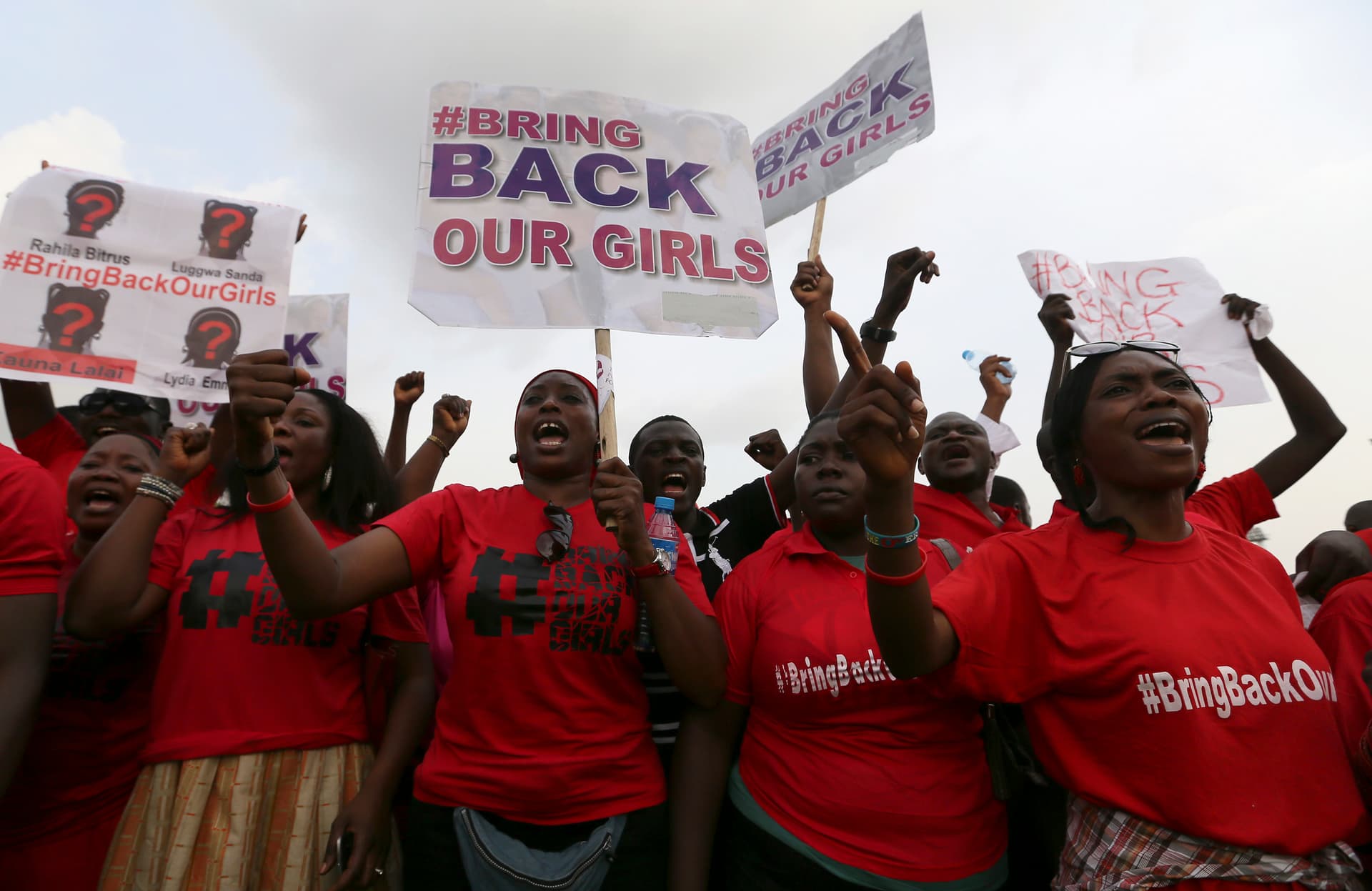
Photo © Reuters / Afolabi Sotunde
In 2014, Bring Back Our Girls became a rallying cry. Years later, the message is as important as ever.
If we forget, then society forgets and our government forgets.
\"Will they listen? You Think? \" Maryam Asked. \"The Presidency. \"
I bent over to tie my shoelaces. I had switched the low-top Converse I was wearing earlier with a pair of Adidas high-top sneakers. They felt firmer and the colors were a match for the occasion: black with red and white highlights.
\"I think the question is. .. \" I Said as I stood up straight and adjusted the brim of my black tam hat over my twist-out hair, \"will we let them forget? \"
May 1st, 2014. Abuja, Nigeria
I looked at my friend Maryam, wearing a red hijab, and my Indian friend Lakshmi, visiting from Germany. The three of us were marching for women’s rights for the first time in our lives.
The previous month’s kidnapping of over 200 girls in Chibok, Nigeria touched us to the core. Boko Haram extremists kidnapped the girls from their boarding school, taking them away in trucks to the Sambisa forest. This sparked an international outpouring with the message and hashtag #bringbackourgirls. We felt we had to join the Bring Back Our Girls march.
Each of us had our own stories of deprivation and persecution based on our femininity. By marching, we hoped to connect more deeply with each other as friends with similar experiences across different nationalities and religions. We hoped marching would connect us with women and girl children globallyand with the Chibok girls and their grieving parents.
Lakshmi had a plane scheduled to return her home in two days time, and I wanted to send her back to her family in one piece. I too would be leaving after the event—if I made it out alive.
Anything could go wrong. This was a period of heightened insecurity in Nigeria. Bombs would often go off split seconds apart. Blasts occurred every month, sometimes many times in a single month. Decapitated bodies were almost a daily scene.
Boko Haram terrorists often dressed like average citizens, blending in with unsuspecting crowds to carry out their monstrous acts. Therefore, the advice was always to stay away from crowds. But here we were, going to join an activist group. We were conspicuously dressed in red, the color of the campaign, and we were speaking directly against what Boko Haram stood for. We were nervous, knowing our actions would invoke the rage of the terrorists.
Still, we marched.
I can still recall the overflow of emotions as we arrived at the waiting grounds and first saw the crowd, which was bigger than we expected. I climbed a tree about 20 feet above the ground to see the end of the crowd. It looked to me like there must be over 600 marchers in attendance—an impressive number given how many people stayed indoors out of fear of reprisal from the terrorists.
The atmosphere was solemn and mournful. We gave money to a woman holding out her hat asking for contributions for the cause. We then made ourselves useful, grabbing buckets to join her in collecting funds for the Bring Back Our Girls Campaign.
As the march began, it was all we could do to keep our tears from falling. Our thundering feet determinedly traced a path to the presidential residence at Aso Rock. A few people spoke in hushed tones about the progress of the march, but most marchers spoke silently through the signs they held up. Some people wore gags to demonstrate their resolve not to say anything inciting. Others, like my friends and I, were effortlessly speechless.
Meeting resistance
We had anticipated retaliation by Boko Haram, but one thing we did not think to take into consideration was the police.
The police confronted us dressed in riot gear, showing their readiness to push us back violently. When pro-government thugs emerged, chanting political slogans and pelting marchers, the police did nothing to defend us. We raised our placards and banners as shields.
We felt misunderstood. How could our message be so despised? It Was appalling that anyone would ignore the humanitarian catastrophe at hand, repress the Bring Back Our Girls Campaign, and persecute the campaigners.
Through it all, however, the crowd remained calm, focused, and non-violent. Women leaders began to read their speeches over microphones, despite the disenfranchising attitude of the police. We could no longer hold back our tears.
A powerful, unifying spirit gripped the marchers at the moment the speeches began. Strangers locked eyes, hugged each other, and wept freely. Over 200 girls were kidnapped, hungry, afraid, confused, enslaved, raped, tortured, some sold for pennies, some martyred. We were and we are their only hope.
From a march to a movement
After the march we gathered in Maryam’s room, physically exhausted but grateful to be alive. Maryam’s question resurfaced as we talked into the night.
Would the presidency listen? Would They acknowledge our march and the growing outcry on the #bringbackourgirls hashtag? How Was it, we wondered, that the international community displayed more zeal and solidarity than our own community? And Could our leaders awaken from their bureaucracy and flamboyant excesses and disgraceful complacency to draw compassion from their human instincts?
It came down to us, this growing movement, to form a phalanx to make things happen.
I reminded my friends that the police resistance was obviously only the beginning of the opposition our movement would have to overcome before we see the Chibok girls rescued and value duly placed on the rights of the girl child.
The government and their supporters, as well as some sections of the media that were pro-government, accused the Bring Back Our Girls movement of renting a crowd for the march in opposition to the ruling elite. If that were true, the movement would have disintegrated after the ruling and incumbent party at the time had been toppled in the elections. But it didn’t.
We are in the third year since the events in Chibok shook the world. A few of the girls have been rescued and returned to their parents. Many of us involved with the Bring Back Our Girls movement feel crushed in our spirits because this did not happen sooner or in larger numbers.
Damage has already been done. It is discouraging to see the number of people participating in sit-ins fluctuate or to see the #bringbackourgirls hashtag fade and flicker, to light up only on annual remembrances. However, we have to work to overcome this feeling every day until we save the very last of the girls. The campaign is still on.
I believe now as I believed then that the Bring Back Our Girls movement needs to meet the opposition’s fury and indifference with civility, discipline, and keen resolve. We can only maintain pressure on our leaders through strategic, creative civic education and action.
The call to advocate for human rights is a call to a forever job. It is a job that demands our commitment to the cause beyond clichéd poetry and the beams of the media spotlights. Indulgence in amnesia is not permissible, for we must not further afflict the afflicted.
If we forget, then society forgets and our government forgets. When the lights are out, when no one cares, we must still sit in solemn silence, ponder the lessons learned, and create new ways forward. We must engage our minds, engage our wallets, engage the grassroots, engage the afflicted, engage the officials, engage the enemy of the common good.
Change never did happen in a single day. Our job is to know that it may take weeks and months and years and decades, but to get up every day and do it anyway. The real test comes when it looks like we won't win. Will we keep trying? Will we keep sane and civil while we keep working to reason and to explain and to dialogue and to act?
I've signed up for the forever job. Have you?
STORY AWARDS
This story was published as part of the World Pulse Story Awards program. We believe everyone has a story to share, and that the world will be a better place when women are heard. Share your story with us, and you could be our next Featured Storyteller! Learn more.
How to Get Involved
Join queenvirtuous in keeping the Bring Back Our Girls Campaign alive. From organizing a town hall meeting to leading a teach-in, here are some ideas for taking action.
- Girl Power
- Human Rights
- First Story
- Africa