
'Men need to start talking about menstrual hygiene. Period!': Dr.Sujata
May 31, 2023
story
Seeking
Encouragement


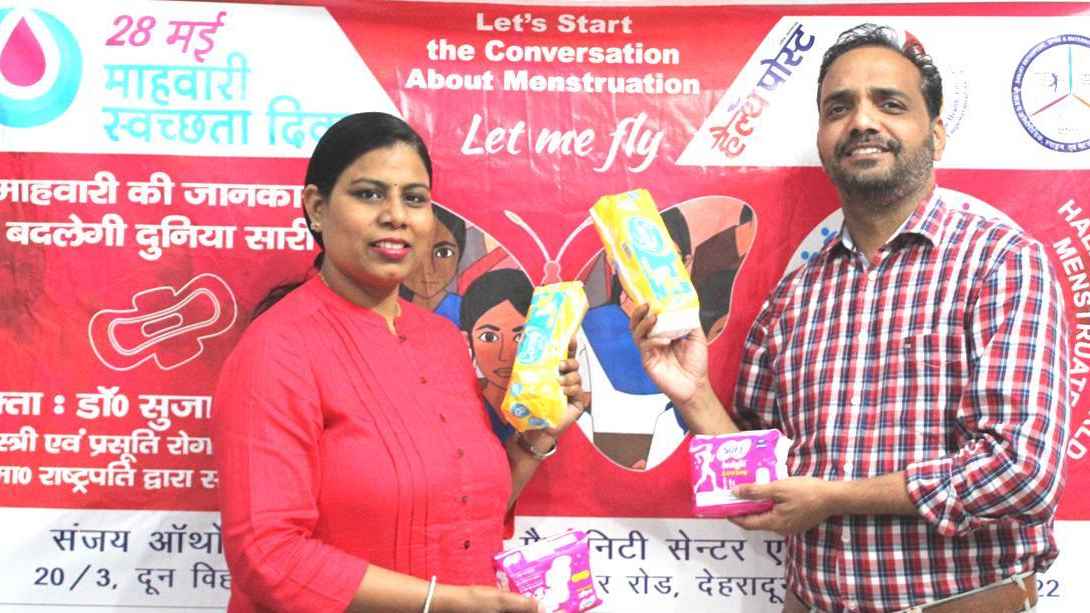
Photo Credit: shewa ngo
Men’s can play important role in menstruation awareness
On the occasion of World Menstrual day , Sanjay Orthopaedic Spine and Maternity Centre, Jakhan and SHEWA NGO did awareness programs in which More than 150 students were sanitized and 110 sanitary pads were distributer to students of Manav Bharti school, Nehru colony to ensure hygiene and prevent girls from any medical complications during menstrual cycle.
Dr. Pratik says men should participate equally to speak up about it to break the social taboo attached to menstruation.
"It is essential that both men and women talk about periods. Only by initiating a dialogue will the taboo and stigma lose its power.If both mothers and fathers were able to talk about periods to their daughters, then there would not be statistics such as the 70 per cent of girls in India who have no knowledge of menstruation before their first period" said Dr.Pratik.
Gynaecologist Dr. Sujata Sanjay from Sanjay Maternity Centre added, "Talking about menstrual health is still a social taboo. In many families, menstruating women are not allowed to touch pickles because they believe it will turn bad if they did so. Menstruating women are not allowed into some temples, and, under some customs, made to stay in an outhouse during the period of bleeding. Some don't even take a bath during periods. It is generally observed that there are so many taboos about menstruation due to our socio-cultural restrictions and mindsets. The socialization process is so strong that even the women themselves think that during menstruation they become impure. Studies show that most of the girls are not properly explained about menstruation and they believe that the menstrual blood is impure. Besides, menstrual hygiene is highly ignored in the society that affects women’s health. The young could end up changing the mindset of older people, which would percolate down to the next generation”
Women menstruating should take a bath more than twice a day and change sanitary towels thrice a day. Poor practices can increase a woman's susceptibility to reproductive tract infections (RTI) and Urinary tract infection (UTI).
The biggest barrier to using a sanitary napkin is affordability. Around 70% of women in India say their family can't afford to buy them.
“Across India, there are 73 per cent urban women using hygienic methods of protection during menstruation and only 47.6 per cent women using hygienic method in rural areas. Inadequate menstrual protection makes adolescent girls (age group 12-18 years) miss 5 days of school in a month (50 days a year). Around 28% of these girls actually drop out of school after they started menstruating. said Dr Sujata.
"Being a woman is the most complete experience. We embody and express naturally the qualities of nurturing and empathy, gentlesness and compassion and an incredible inner strength. We are Laxmi, Saraswati, Parvati, Durga and Kali. I also want to create more awareness about female foeticide and gender bias” she said
"There is an urgent need to remove the taboo that is associated with sanitary napkins. I think awareness is needed about the subject of menstruation. Starting from the medical shop owner, who wraps the napkin packets as if they are forbidden goods, to talking freely about problems a woman faces during periods, everything needs to be discussed. Men and boys have a key role to play. We live in a patriarchal society, that is why the onus is on men who are in a position to make a difference and create awareness on menstrual hygiene “said Dr.Pratik
- Education
- Human Rights
- Girl Power
- Youth
- Stronger Together
- Global