
INDIA: We Will Not Be Left Out of History
Apr 30, 2019
story
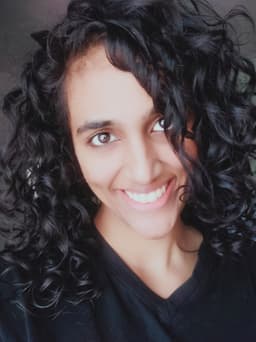

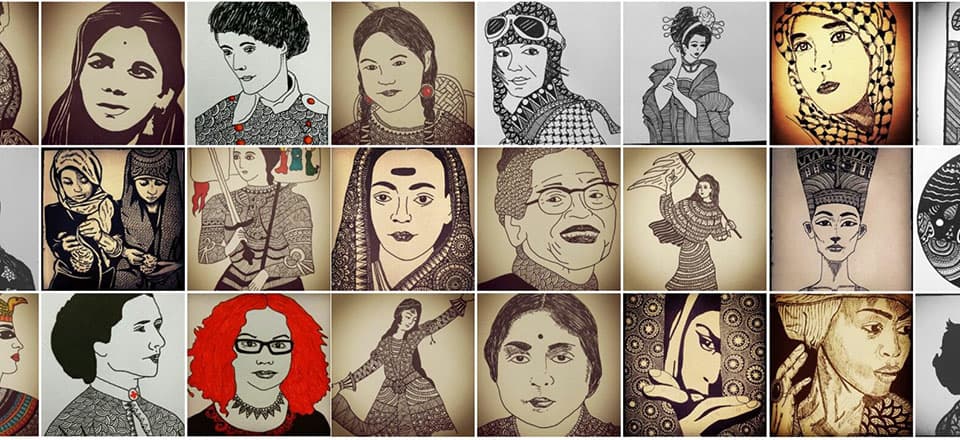
Art by Kirthi Jayakumar from the Femcyclopaedia
Kirthi realized that if nothingchanged, women's contributions would continue to be made invisible. So she decided to act.
I knew I had to fight this silence.
I was in 9th grade and my history teacher had just assigned a 1, 000-word report on an important historical leader. She began calling out the names of the leaders she had chosen for each student: Mahatma Gandhi, Winston Churchill, Ronald Reagan. I waited patiently for my turn—in alphabetic order, I was number 16.
She continued calling off male names: Benito Mussolini, Adolf Hitler, Pandit Nehru, President Tito, Nelson Mandela. Finally, it was my turn.
Dag Hammarskjold, a former Secretary General of the United Nations. I wrote down the name, feeling mildly dejected for a reason I couldn’t put a finger on.
I paid rapt attention until my teacher reached the end of the list of 39 students. Of the lot, there were only two women: Indira Gandhi and Sarojini Naidu.
Why did men account for 37 out of the 39 leaders allotted for us to learn about? Where Were the women?
When class ended, I ran outside to speak with the teacher.
“Ma’am, can I have another leader to base my report on, please? ”
“Why? You Have a pretty interesting one. I know you’re interested in a career in the United Nations; this should be good! ”
“That’s really thoughtful, ma’am, but I want to write about a woman. ”
“A woman? Who? I Already allotted the two that are prominent. ”
“I don’t know yet, ma’am. I need to find a name. Will you give me a day? I’ll Be back with a name tomorrow. I promise. ”
She thought for a moment, perhaps wondering if this would set a precedent, sparking other students to ask to change the leader they were allotted.
Finally, she agreed.
“Alright. Tomorrow, first thing in the morning, you give me a name. When you’re searching for a name, make sure that you can access information to base your report on. I don’t want you coming to me later, saying you couldn’t find information and asking for another change. Okay? ”
I nodded eagerly, shrugging off her warning. I mean, how difficult would it be to find information about a woman leader once I decided the one I was working on?
Here is what my 13-year-old mind did not grasp: If I couldn’t come up with a name for a woman leader on the spot, there had to be a reason—and it wasn’t me. I was a vociferous reader and devoured books like my life depended on it.
That evening, when I went home, I scoured my history textbook. I looked through texts from my school library and the few encyclopedias that I could get my hands on. This was 2001, when dial-up Internet was expensive and reserved for special occasions, so I couldn’t just “Google” it.
These books listed scores of men: benevolent leaders, smart leaders, cruel leaders, downright naïve leaders, leaders with myopic senses of policymaking, leaders by chance, leaders by choice, leaders by circumstance.
Most of the books mentioned Sarojini Naidu, but relegated her to a role as the “Nightingale of India” for her lyrical poetry, without mentioning her work as a suffragette, social reformer, and politician. Indira Gandhi got a single line in most texts, which told us only that she was India’s first female prime minister. Apart from these two women, the only other name that stood out was Margaret Thatcher.
I was astounded by the invisibility of women in the books I came across, and it scared me. I wasn’t willing to give up on my dream of writing about a woman, and I knew I had to fight this silence.
I went back to my teacher the next morning and offered up Margaret Thatcher. She smiled at me and told me to go ahead. When I submitted my report, she told me that I had made her think.
Well, I had made me think, too.
History has traditionally been written by the male hand, so women are seldom mentioned. The oppression of women’s free speech continues today. Even as women find outlets for expression through the Internet and digital media, they frequently face censorship or threats to their safety.
There are so many attempts to shut down women’s voices. This looks like authorities arresting Zainab Al Khawaja in Bahrain for her political dissent, or terrorists shooting Malala Yousafzai for blogging about her life and daring to get an education; this looks like protests against poet Kutty Revathi for writing a book of poetry called Breasts, or the mistreatment of Tamil actress Kushboo Sundar for her views on premarital sex. Shutting women’s voices down looks like Instagram removingRupi Kaur’s posts from a photo essay on menstruation.
This simply has to stop. It’s time the world realizes that herstories matter.
Since the dawn of time, there have been so many invaluable women. Did you know that the American Red Cross was founded by a woman, Clara Barton? Did You know that King Charles remained in power because of Joan of Arc? And Yet he didn’t protect her when she was tried and burned at the stake. How about Rosa Parks, whose act of defiance led to the dismantling of legalized racial segregation in the United States? How About Manal al-Sharif who fought for Saudi women’s rights to drive?
By ignoring and downplaying women’s contributions in history, we constantly devalue women’s roles in society and keep gender inequality alive. When we offer a male-centric history, we convey to women and girls that no matter what they may do, what change they may inspire, and what action they may take, their narratives will be erased from history.
No girl should have to hesitate to name a woman leader or have to struggle to find information about her. That’s why I am working through The Red Elephant Foundation, the organization I founded, to make women’s stories visible. I created an Instagram account called Femcyclopaedia where I curate my own doodled portraits of inspiring women from history. I post these images along with a short note about each woman’s contributions. I also started a petition with my team to revise Indian history textbooks to incorporate women’s stories and achievements.
I am inspired by generations of women whose voices and stories have been erased from history. I am inspired by women of my own generation, whose voices are elbowed out of most public dialogue. We will not be silenced. We will raise our voices today and every day until women’s voices are valued.
STORY AWARDS
This story was published as part of the World Pulse Story Awards program. We believe everyone has a story to share, and that the world will be a better place when women are heard. Share your story with us, and you could be our next Featured Storyteller! Learn more.
How to Get Involved
Follow Femcyclopaedia on Instagram to learn more about women leaders and their herstories. You can also join Kirthi in urging the government of India to revise school syllabi and textbooks to significantly include the historical contributions of women. Sign the petition.
- South and Central Asia