
Human Rights in Underserved Communities
Feb 16, 2023
story
Seeking
Collaboration


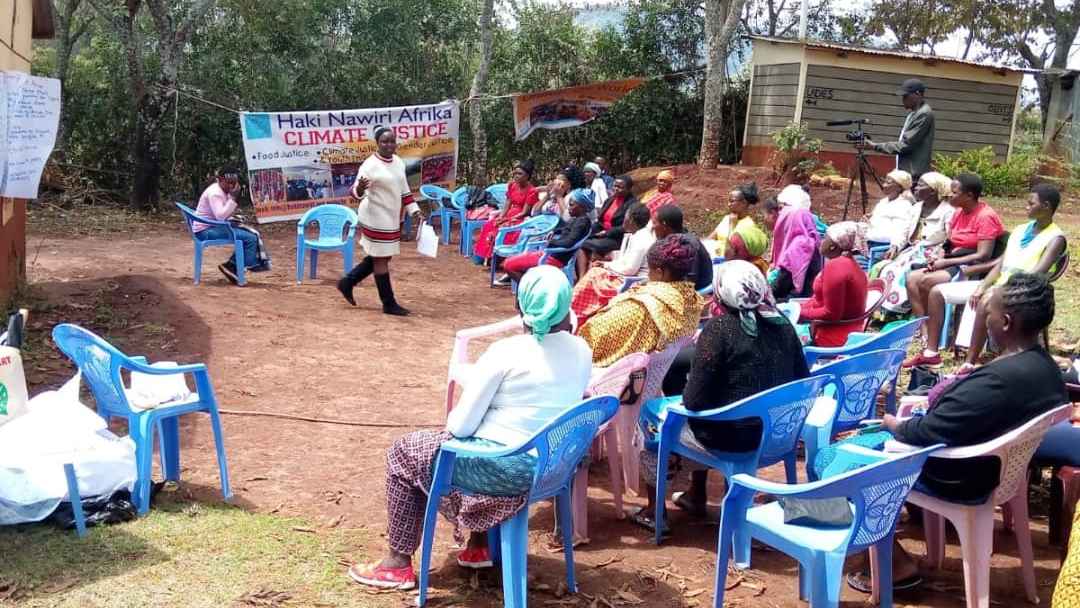
There is a stark difference when one carries out a comparative analysis between urban and rural populations in terms of human rights and access to justice . In urban areas, more civil society organisations operate, providing multiple services hence communities can at least have access to human rights information near their doorsteps. The number of CSOs operating in rural and hardship areas is often less. Communities in rural areas are hence at a disadvantage when it comes to information about human rights. Many people in rural communities in Kenya have normalised oppression because they do not have information that this is a violation or due to ignorance. When a rights violation occurs in a rural space more often, they will hush about it and turn a blind eye, leaving the victim to suffer the consequences which more often than not is both physical and mental anguish as they relieve the violation that they have gone through.
Conversations with rural communities in Muvuti- a locality in eastern part of Kenya reveals that for every right violation experienced in the community, the local pastor is deemed the solution. For example, when there are conflicts in the family – report to the pastor, when a child is truant and does not want to go to school -report to the pastor, when there is land conflict -report to the pastor. The community does not understand that there are some injustices that cannot be dealt with in a spiritual way but have to be handled legally to ensure access to justice for the affected one. In some instances family members fear reporting cases to the police because they do not want to destabilise the family fabric .To many , it is better to keep quiet about an injustice rather than face disapproval from family members .Community members also share that in families based in rural areas , when there are cases of incest ,the girl is secretly married off in a far off village , but sadly she continues to bear the trauma of the violence by the very people who are supposed to protect her. The distance between her ‘new home” and her village does not erase the fact that she is a victim of incest. It is easy to brush away other people’s pain, but when one is the victim, that is when the reality sets in.
Rural communities have limited interaction with justice systems. When faced with a justice issue many become confused and intimidated by the process. Many have not stepped in the local courts just to understand what goes on there. This can be a major pre-emptive defense in familiarisation with how the justice system works. Those with cases talk of giving up on their cases because of the everyday challenges they face. Some speak of having their sons and other kin accused of crimes in order to force families to give up on their ancestral land. Women speak of gender-based violence and psychological violence at the hands of husbands and other family members, and yet the culture of silence and in the process of painting the picture of ‘our family is fine’ they continue to exist in the very same space with their abusers.
The breathtaking scenery as you visit the Eastern part of Kenya is a sight to behold. In the local households , children go through a myriad of rights violations .For some it is due to the family’s economic situation , for others it is as a result of orphan-hood and being left to brace the world on their own, while for others the suffering is because they live with elderly parents , who no longer have the energy to fend for their grandchildren and whose brittle bones cannot allow them to work , so the best they can do is to sit in the sun, mutter silently to themselves and hope tomorrow will be a better day .
Conversations with local children in a rural setting on what ails them, reveals that the suffering is experienced at home and within learning institutions. At the moment and being a semi-arid region, the ravages of climate change are adversely affecting children. For example, children speak of lack of enough food, some go to school without taking breakfast. It is said that human rights are universal, but for children in underserved rural communities, this universality of rights is a mirage. How can a child go to school and pass exams when they do not have food, how can they concentrate in class and end up becoming an advocate, engineer and any other career of choice when their stomachs are rumbling?. How can they transition to secondary school when the parents have no stable source of income. Imagine the amount of indignity when one goes to school with a torn uniform because they cannot afford to buy a new one. Half the time in class is spent being conscious of how one’s pair of short or dress is torn or has zigzags in the form of patches.
In some instances, children are forced to undertake more work than their frail bodies can accommodate, all this is done in the hustle and bustle to put food on the table and other survival related expenses. Urban contexts as underserved communities face various challenges. Ignorance on rights is one of the top challenges. Other vulnerabilities in urban contexts come with poverty, more so in informal settlements. Substance abuse, family instability all contribute towards rights violations for urban based disadvantaged communities.
Through organised human rights sessions based in the community, some ray of hope is evident. Haki Nawiri Afrika organises sessions on child rights and child protection for underserved children in urban based informal settlements and rural communities .These sessions bring children together to discuss rights challenges , what they go through and seek solutions to the identified problems .The spaces provide opportunities for the children to express their views and in so doing slowly by slowly build their confidence .For young people , the awareness on rights enables them to make informed choices and defend not only their rights but the rights of others. These spaces also enable provision of material support. For example ,organising donations of clothing, sanitary pads through friends and like-minded institutions helps to address some of this burden on children and youth. Through psychosocial support sessions in institutions of higher learning, young people are enabled to express themselves , break the silence on emotional issues they are grappling with. For women resilience building sessions held in rural communities, in the local community hall, offers a respite to women on the bottled emotions they have. In safe spaces, women get to talk out what is happening in their lives without fear of judgement. They get opportunities to be listened to, to pour out their fears and anxieties. Discussions on human rights enables women realise they can demand to be treated differently and have a voice that they can use to demand change. Legal rights awareness enhances access to justice and this helps women and the community in general shift from being bystanders or selective seers when an injustice is happening to championing rights for themselves and the community.
“Since Haki Nawiri Afrika started engaging with us, confidence levels among children has improved”-Head Teacher, General Mulinge Primary School
Addressing the human rights challenges of rural communities calls for concerted efforts of all stakeholders. The situation of underserved communities is dire in relation to human rights , calling for more collaborations to make the world a better place. Awareness raising and consciousness about human rights alone is not enough, it must go hand in hand with transformative activities that enable the realisation rights.
- Human Rights
- Moments of Hope
- Africa