
How We're Building an Online Culture of Collective Care
Apr 19, 2022
story

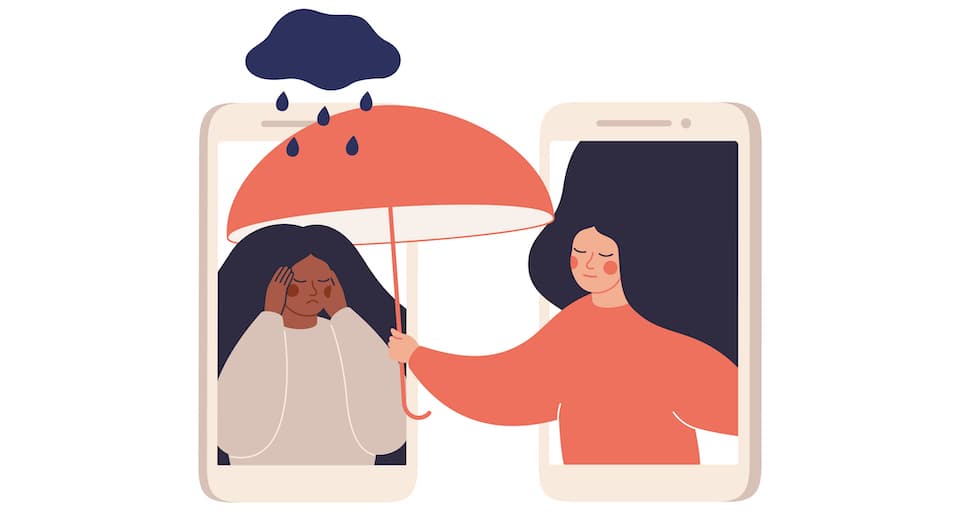
Cartoon illustration shows a woman, framed by a cell phone. She holds an umbrella to block a rain cloud over another woman, who also appears to be framed by a cell phone.
The leadership of women with disabilities provides a roadmap for building inclusive online worlds.
by Arrey Echi Agbor-Ndakaw and Jensine Larsen
I hope that by helping women and girls, especially those with disabilities, fully take advantage of digital tools, they will also be empowered to bring about a new world powered by women.
-Veronica Ngum Ndi, World Pulse Digital Ambassador, Cameroon
Over 20% of the world’s population of women are disabled and more are online than ever before. They’re innovating how the web can better include not just them, but everyone.
Over the past decade, we’ve had a front row seat to the potential of technology to energize ordinary women to create change. We are leaders of World Pulse, a safe social network that connects tens of thousands of women and allies from across 220+ countries to tell their own stories and grow their global voice.
At World Pulse, we have learned that it is possible to consciously design sustainable online spaces that enable women — including women with disabilities — to speak out, join together, and become leaders in their communities. We know that access to the right online environment can nurture women’s ability to make tangible, offline change: Today the members of our network report going on to impact 21. 6 million lives via their new movements, businesses, and influence on social-norms and policy change.
A foundation that incubated inclusion
From our founding days, women with disabilities led the establishment of our community values. Today the World Pulse community has a culture unlike most in the online universe; one we can only describe as centering inclusive, collective care. The unique voices of members with disabilities who logged on and began speaking proudly have been integral to establishing this culture, and their voices continue to guide us.
Neema Namadamu, a peace leader who survived polio in the DRC, works with disabled women and survivors of violence. When she joined World Pulse she wasted no time proclaiming, “We are not victims, we are liberators. ” Her “limousine” was her wheelchair – secured with hard-won effort from partners outside her country. Celine Ebere Osukwu in Nigeria used World Pulse to forge bonds with women in the United States who partnered to support her education. She went on to start radio campaigns to encourage millions with disabilities to vote in Nigeria. Tiffany Brar, a blind leader in India, leads training programs to serve hundreds of blind women and girls in rural areas of India. She even advises on how to make digital content accessible for those with disabilities.
From Syria, Samia Al sayed, who builds artisan programs for women refugees with disabilities, said, “When women survive crises, they can produce creative works that tell stories of challenge, ability and creativity. ”
These members were instrumental in cultivating World Pulse’s warm, supportive culture. Their participation in the community and identification of the need for those who share their stories to be met with love, gave rise to our Encourager program. Today, World Pulse has hundreds of members who hold an Encourager badge and fill a unique leadership role in our community: they leave supportive comments on each story, ensuring that every World Pulse member who bravely shares their thoughts is met with recognition and kindness.
Because of these World Pulse disability rights leaders, our culture is infused with an essence of inclusion. Passionate about bringing women and girls with disabilities online so that they could speak for themselves, these leaders built cyber centers with free transportation for women with disabilities and started accessible training programs in their living rooms. These efforts extended the web of inclusion across borders and identities, impacting those with disabilities as well as indigenous women, transgender individuals, ethnic and religious minorities, those in rural areas with little access to internet, adolescent girls, and other historically marginalized groups.
They also helped to establish the World Pulse Digital Ambassador program, a network of 150+ leaders in 30 countries who provide trainings in digital skills, so that more women and girls can become digitally empowered leaders. Now, World Pulse is powered by disability justice leaders who nurture connections, celebrate each other, and warmly welcome new faces to our community. They have even gone on to win multiple global and industry awards and to speak on international stages, such as the United Nations and the high-level plenaries of the World Summit on the Information Society (WSIS).
The online world as liberating space
In story after story, these leaders tell us how liberating online spaces can be. When they cannot access a visa, or have physical limitations to step outside their homes, or stigma means discrimination or even attack, online spaces provide women with disabilities what they call a “passport” to connection and opportunity.
“As a girl-child growing up with a disability, I was a laughing stock, ” says Celine Ebere Osukwu. “But [despite unstable electricity and poor connections], the World Wide Web has opened doors to opportunities and resources. Connections with other women around the world have helped me define who I am. I’ve found many things that I share in common with my network of sisters from around the world. The transformation starts in my mind. When I believe in myself, I change stereotypes and societal beliefs. Supporting each other in this web of sisterhood, we break barriers together. ”
Vweta Chadwick, who lost her voice following a surgery, shared a similar sentiment: \"[When I began sharing online], people began to see me as an intelligent human being again. They saw me before my disability. They almost couldn’t reconcile how a girl with this croaky voice could be so vocal online. \"
This access to connection and opportunity is essential when the data show that odds are stacked against women with disabilities:
Studies have shown that only 45 countries have disability-specific, anti-discrimination laws. That means most countries do not have specific legal protections for women with disabilities. According to UNDP, the global literacy rate for adults with disabilities could be as low as three percent — and only one percent for women with disabilities.
Globally women with disabilities, and especially women of color, are most at risk of sexual violence, discrimination, and exclusion. According to the United Nations, “a small 2004 survey in Orissa, India, found that virtually all of the women and girls with disabilities were beaten at home, 25% of women with intellectual disabilities had been raped and six percent of women with disabilities had been forcibly sterilized. ”
But online, digitally savvy women with disabilities can log on and access education and resources. In online communities, they can be known for their voices, ideas, and hearts. We’ve learned that disability inclusion can be experienced as love.
In some online spaces it can be revelatory to break free from isolation and be included in community and movements. New technologies mean that cross-disability organizing and collaboration become possible; for example, blind women can use readers and Google language translation to connect with their deaf sisters from different countries and in different languages.
Yes, being disabled online also means more vulnerability to being attacked, and more must be done to protect women with disabilities from online harassment and abuse. But an online community of solidarity can help guard against these risks. On World Pulse, leaders have led the development of internal policies to ensure our community is safe and protected, and that no troll or attack will go unblocked.
In our 2021 report, She Transforms Tech, World Pulse crowdsourced explicit ways that technology design can be improved for women with disabilities. Approximately 8. 7% of survey participants indicated they had a disability. To make technology more accessible for all, these participants recommended the following actions: reducing the cost of assistive technologies; increasing the availability of digital skills training resources for women with disabilities; making the work of women with disabilities visible; taking disability into consideration at every stage of the design process; making content available in a variety of formats (e. G. Subtitles, alternative audio, alt text); simplifying processes to have fewer steps; and reducing the use of advertisements that distract and disrupt reading tools.
Women leaders with disabilities have guided World Pulse to adopt inclusivity and accessibility policies. We’ve learned that even the act of being responsive to the needs of disabled persons can be experienced as revolutionary, as acts of love:
“As someone who is hard-of hearing, disability inclusion can be love. When I requested the World Pulse team to start live transcription in Zoom calls, they did. In these calls, I feel loved. I feel heard. I feel everyone is just as excited to see me as I am to see them. Are there times I wish I could actually hear and get engaged in the chatter and all? Yes. Still, I do not feel left out or slighted because I have been reminded so many times that my presence and voice matters. In fact, seeing everyone of my dear sisters passionately ready to go the extra mile and doing so happily means so much to me. Because of this, I set my standards high on what I can expect from a Zoom call. I now see that requesting that organizations include a transcriber on a virtual call is not too high a demand to make. It is in fact something that can easily be included IF organizers are willing to LISTEN and do so. These collective, thoughtful acts of love will forever be cherished. ” —Arrey Echi
At World Pulse, we believe in the power of providing a nurturing, supportive, and inclusive space for women with disabilities to authentically share their stories and draw strength from each other. They are acting on the words of disability activist Mia Mingus, “We must leave evidence that we were here, that we existed, we survived and lived and ached. ”
Shifting disability leadership from margin to center
While leaders with disabilities played a fundamental role in guiding the development of our online community culture since the beginning of World Pulse’s virtual platform, the topic of disability had been a side topic at the organizational level. It was discussed, yet never fully integrated into our internal systems. In 2020, recognizing we needed to do more to be truly inclusive, we partnered with two leading global women’s disability networks: MIUSA and Women Enabled. Despite facing many pressures and tall challenges in the first year of a global pandemic, these groups immediately offered support. Women Enabled led communications training for our staff as well as World Pulse members, which resulted in a communications and social media strategy that better meets the needs of people with disabilities.
We also contracted with MIUSA to lead multiple staff trainings and visioning sessions that ultimately resulted in a multi-year disability action plan. MIUSA connected us to additional partners, including a firm to introduce accessibility features to our upcoming online community platform rebuild. As a result of these collaborations, World Pulse has learned a lot and are on a journey to bring inclusive disability justice principles alive in all of our programming:
- World Pulse stands for disability inclusion as a human right – not a health issue.
- Our annual budget includes three to five percent of operating expenses dedicated to disability services, including: interpretation, captioning, and disability inclusion consultants. We will continue to grow this investment.
- We value and prioritize the leadership of persons with disabilities. Disabled leaders are essential to our success and culture — we have set a goal of 10 percent representation at all levels of leadership and launched a Powershift Inclusive Excellence (PIE) Steering Committee that is making decisions on our inclusivity practices and power structures.
- We’ve adopted what’s called a“twin track approach. ” We will both build inclusion in everything we do and create unique programs and efforts just for our disabled community.
- This year, we have launched a Disability Justice Hub to support storytelling and cross-disability movement building. We are also promoting disabled leaders as speakers and experts to influential forums.
- In response to the mantra, “Nothing about us without us, ” we have developed a Technology Design Review Board that will assess our new online community platform for accessibility and inclusion. These accessibility features will benefit everyone — and allow for more leaders in this field to be heard and valued.
Throughout this process, we have come away with the knowledge that it’s time we shift focus from capacity building and training for disabled communities to capacity building and training for ourselves to be responsive to the needs of people with disabilities.
If you are working in social justice, join us. It’s time we flip the script.
Here are eight first steps you can take:
- contract with MIUSA to create your own disability inclusion action plan.
- Look at representation and power in your organization – are people with disabilities in power and making decisions?
- If you are creating online spaces, communities, or any tech tool, seek out the leadership of persons with disabilities to co-design it.
- Ensure your social media and communications use captions, alt text, and image descriptions. Read Women Enabled International’s social media best practices.
- As event organizers and attendees, use your influence to demand reasonable accommodations such as: closed captioning, interpretation, braille, and other assistive technologies to support those with disabilities. Don’t be afraid to ask attendees what accommodations they may need.
- Read these incredible books: Care Work: Dreaming Disability Justice by Leah Lakshmi Piepzna-Samarasinha and Demystifying Disability by Emily Ladau.
- Disability inclusion is a journey, not a destination. Know that you will always be evolving and adapting to the needs of your community.
Disability access and inclusion as an act of love
Even in these early days of our journey to become more inclusive, World Pulse understands that there are miracles when you center disability in your movements. We can see it in the way disabled communities show up for each other with love — despite electricity blackouts, pain, fatigue, mental and physical stress, the burden of caring for those with disabilities, the burden of caring for ourselves, at times a lack of resources – they are attuned to the ways we can weave inclusive fabrics that are supportive and nurturing for all.
It’s time to turn our work inside out for collective care – to tune our compass to the most sensitive, the most excluded. It’s time to reframe our goals and outcomes, not for growth, but for deep inclusion and reciprocity. It will transform all our lives for the better and build a more inclusive world.
This story was published as part of World Pulse's #disabilityjustice campaign. Beginning in November 2021, World Pulse is crowdsourcing stories and recommendations related to disability rights and leadership. Join the campaign.
- Disability Justice
- Featured Stories
- Latin America and the Caribbean