
GLOBAL: Why Women Are Missing the Bus (and Train and Taxi)
Apr 30, 2019
story


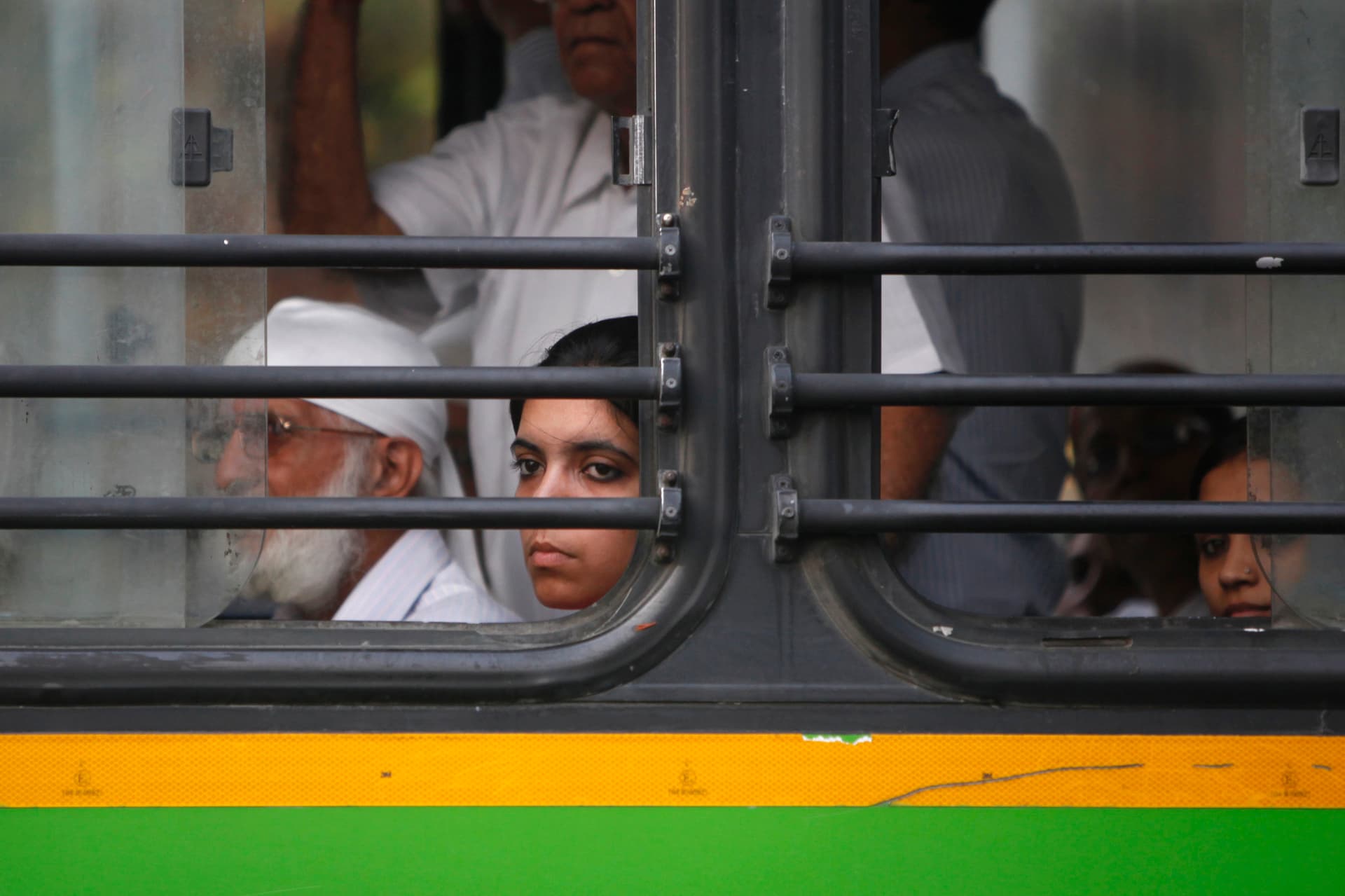
Photo © Reuters/Mansi Thapliyal
In recent years, women-only transportation options have emerged to serve women tired of being harassed on their way to work. But Dr. Shruti Kapoor asks, why can’t our public transportation systems keep women safe?
Women are scared to use public transportation in many major cities around the world.
I never feel safe traveling alone in a cab in New Delhi. It doesn’t matter what time of day it is. I worry about the route my driver is going to take. I am on high alert, with my phone in my hand, reading all street signs to ensure we are heading in the right direction.
Like many women around the world, I am often careful about the mode of transportation I use and the places I go. My level of caution varies depending on whether I am in Delhi, or in my current home of New York City. But the lack of safe, reliable, and accessible transportation is a global problem and a critical barrier for women that affects our work and education.
There are many families in India, for example, who don’t allow their daughters or the women in the house to take up work outside thehome due to lack of safe travel options.
Women in emerging economies tend to rely most on public transportation—and they are also the most at risk.
Where Are the Danger Zones?
A 2014 Thomson Reuters Foundation survey of some of the world’s largest cities shows that Delhi has one of the most dangerous transportation systems for women—along with Bogotá, Mexico City, and Lima.
In Bogotá, women are at risk of harassment, groping, and theft on crowded buses. In Mexico City, 6 out of 10 women suffer from some kind of verbal or sexual harassment while traveling on public transportation.
As a founder of Sayfty, an organization working against gender violence, I hear stories from women all over the world. In Cameroon, for example, many rural women restrict their working hours for fear of sexual harassment on public transportation.
Even in a city like London, travel options can have an impact on the type of jobs and shifts available to women. Chayya, a London resident and regular on Sayfty's weekly Twitter chat, always leaves work early to avoid the last train home.
The same survey that ranks Delhi among the worst cities for women’s safety on public transportation ranks New York City as the best. Having lived in both New Delhi and New York City, I can personally vouch for these results. I’ve taken the Subway in New York City late in the night, all alone, and never felt unsafe. Still, there is room for improvement. While I have personally never experienced any form of harassment when taking the Subway or the bus, 3 out of 10 women taking public transportation in New York City have.
In a study of women’s safety in US transit, professor Anastasia Loukaitou-Sideris says, “The perception that a bus station, train car, parking lot of a particular neighborhood is dangerous forces many women to alter their travel patterns. This limits their access to the most basic of rights—to move freely in the public sphere. ”
It is clear that women are scared to use public transportation in many major cities around the world and more must be done to change this.
Do Pink Cabs and Other Technology-based Solutions Keep Women Safe?
Due to the lack of safe public travel options for women, women-only trains, buses, and taxis are on the rise in major cities. With an increasing number of “pink” (women-only) services now available, though, one wonders if segregation can increase women’s safety while traveling. In my opinion, segregation is only a Band-Aid solution to the problem—it doesn't change a harasser’s mindset. Creating awareness and giving gender sensitization training to all is essential.
According to Chayya in London, gender segregation on public transportation simply validates the behavior of sex harassers. She feels teaching personal safety should be mandatory in all schools and colleges. Shamitha, a Canadian student and intern at Sayfty, doesn’t like the idea of segregation because it indicates that men who harass are unwilling to learn or empathize with women.
Private taxi services using smartphone technology, like Uber, Lyft, and Ola Cabs, are also doing roaring business. Many working women in India don’t mind paying extra to use an Uber (or an Ola cab) versus traveling in a public bus. It’s still an expensive option, however, for an average middle-class daily commuter in India. And after the recent case in India in which a court found an Uber driver guilty of rape, the safety of services like Uber in India are also in question.
Technology, however, is helping women stay safer by increasing harasser accountability. Today, we all have a powerful tool in our hands—the phone. We are quick to snap a picture, tweet, or record a video of a harasser. While we are creatively using technology to raise awareness and keep ourselves safe, we still need to address the root cause of harassment and violence.
Where are Women In Transportation Planning?
When it comes to transportation planning and policymaking, women’s issues are often ignored. Governments focus mostly on building roadways and formal transit systems and do not address the role of walking and non-motorized needs in women's travel patterns.
“Unless we acknowledge real time needs of women, their safety, our transport system cannot be efficient, ” tweets Abdul Shaheed from Fiji. Azra Khan, an employee of World Resource Institute, India, emphasizes the need to acknowledge and mainstream women’s needs and concerns at all stages of public transportation planning. Fasiha Farrukh, an activist from Pakistan, asks, “When policy makers don’t know what makes female travelers uncomfortable, how can they come up with solutions? ” According To Karuna, a resident of Delhi, “This is a huge lacuna that only the ngos monitor. ”
One reason for this gap—women are not at transportation planning and policymaking tables.
As Shruti Menon, co-founder of Make Room India, rightly points out, there is a need for gender equality in planning, procurement, operation, and evaluation of public transportation in all countries.
At the policy level, more women should be a part of transportation planning and research. This can easily be achieved through gender equity in employment and by making women more aware of the important human dimensions of transportation.
And while designing transportation projects, gender analysis should be conducted. Gender-specific indicators should be established, monitored, and assessed before and after a policy change.
Breaking unsafe travel barriers will not only allow women to travel for work; it will enable women’s financial empowerment and increase their presence in public space and in educational and economic activities.
A woman’s safety cannot be seen in isolation or fragments; all sections of her journey need to be safe. If my bus ride is safe but the walk from the bus station to home is not, I will avoid taking a bus. In the end, it’s about improving access to safe mass transit and public spaces.
To do this, greater community involvement is needed. It’s a pity that harassment of women on public transport is still seen as a minor offense and not sexual abuse. The transportation workforce needs gender sensitization, and transit agencies and police must respond better to increase public confidence and safety for all.
Whether I'm in New Delhi or New York City, I shouldn’t have to look over my shoulder before getting in a cab. I have as much right as anyone to move through my city without fear.
- Gender-based Violence
- South and Central Asia