
gender based violence in Nepal
Dec 26, 2022
first-story
Seeking
Connections


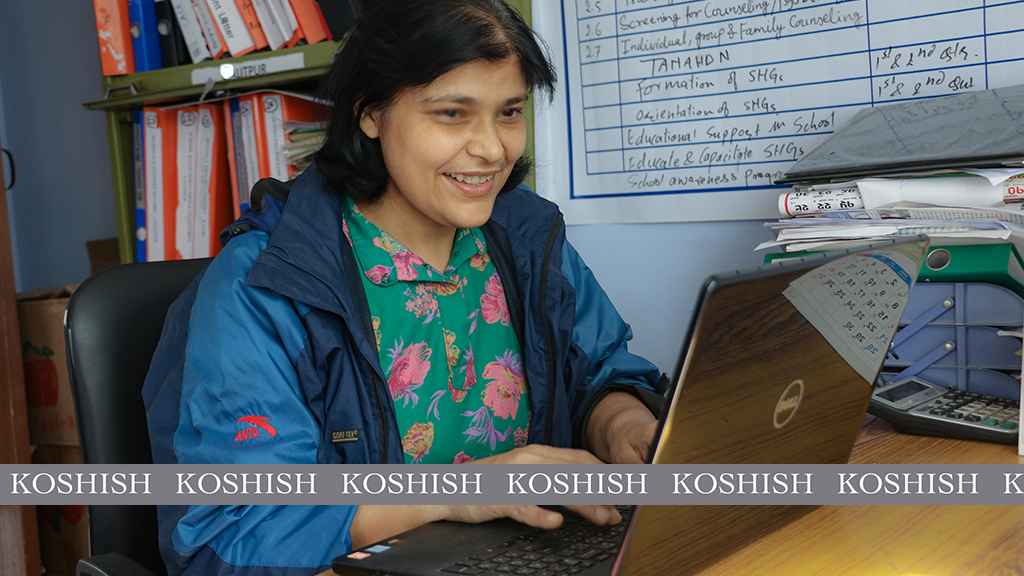
Photo Credit: KOSHISH Communication , Nepal
making an effort -KOSHISH in Nepalese language
My name is kamala. I am a women from Nepal and I am also a person with the lived experience of the mental health/psychosocial disability and I myself have gone through the various situations/challenges of the gender based violence in most of its gruesome forms. I spent almost one year in the streets of Nepal, from where KOSHISH, a disabled people grass root non-profit non-governmental organization rescued me and gave me free treatment and psychosocial supports and enabled me to rescue other sisters in my kind of situation.
The worst and the saddest part is it was not personally directed against me but it was the institutionalized, system generated prejudice on me and many more like me, in my kind of situation. This is the alarming part and brings despair to the situation.
This was so because of my mental health conditions I was considered an easy prey for the sexual abuse, and discrimination in the domain of consumer rights, wages, and betrayal in relationships romantic and non-romantic platonic friendships.
I could not keep any job for long since instead of social recognition of my effort to survive socially and economically despite my mental health conditions, I was laughed at, discriminated and humiliated and always sexual favors were demanded in lieu of anything and everything since it was thought being a subordinated woman from patriarchal Nepal, with a history of child trafficking and no family connections, belonging to the economically poor stratum and that too with the mental health issues I would not be able to stave off lewd and exploitative advances.
I was gang raped and my complaint was not registered for my welfare !!!!!! The police person was very concerned and said prosecution of rape would put me in social ridicule, emotional turmoil and would give me no personal benefits so I should forget the episode specially since I did not get pregnant. You may not believe but the police person was correct. In the Nepalese society, a mentally challenged victim of rape would only be victimized further with derogatory remarks, harassment and titles of being an easy sexual ride for fellow men since the women has already been raped once, she will get used to it.
More than actual mental health condition, the perceived notions of the mental health condition i.e. stigma and prejudice prevalent in the mindset , linking me with my vulnerability made me prone to insults and violence and socio-cultural misgivings.
I was made to feel embarrassed almost about everything about me and I was considered a nuisance factor by most of the people. My socio-economic faux pas existence became an insufferable ordeal for me but I did not know what to do and how to escape these situations.
That`s where it hurts the most. There was no one to suggest, aide, guide and persevere a socially healthy and conducive pathway post the violence and I just got more and more embroiled in the situation.
It is not just my story. Rather the situation of women with mental health issues in Nepal generally is very appalling. They have to face dual challenges of stigma, prejudice and discrimination and the worst of all targeted institutionalized gender based violence /sexual abuse because of being a woman as also because of being a woman with the mental health issues /psychosocial disability in the orthodox and patriarchal society of Nepal.
Experience of women with mental health/psychosocial disabilities
The biggest challenge is the stigma and prejudice against such women. For instance, in the remote villages due to lack of awareness as also due sensitization and the rigid caste structure, these women with the mental health conditions/psychosocial disability are still viewed as the evil witches and taken to local traditional healers, for fancy therapies by beating, smoking and torturing in other manners. This violence against these women is considered to be a healing therapy!!!
https://www.vbplatforma.org/uploaded_files/articles/Nepal%20WAP%20Report.pdf at page 16.
Mostly, these women are isolated, chained, locked up or simply abandoned on the streets and made a subject of derision/ ridicule. The society dissuades them by creating various barriers such as attitudinal, environmental and institutional barriers, as also the stigma, prejudice and discrimination etc. and deny a dignified identity to them, distorts the circumstances surrounding them as also the presentation of these circumstances.
Not just the justice but a right to human existence is denied to them.
Those of the women who are abandoned on the streets face gender based abuse and violence in various forms. Some of them end up being pregnant through unidentified males and give birth to the fatherless children who take birth with a decisive social and cultural curse.
There is lack of awareness, knowledge and sensitization and of course the courage to go against the patriarchal norms and question the validity of the male gender supremacy by seeking justice from the various agencies of the society. This is so, as to seek justice they have to tarnish the society and its norms –and https://nepal.unfpa.org/sites/default/files/pub-pdf/Factsheet%20GBV.pdf
unfortunately there is a direct conflict between the rights as also the interests of these women with the socio-political norms of the society.
The adversarial model of the complaint mechanisms does not allow space for negotiations and bargaining with the society and the stigma imposing tendencies of the society. Even women do not support such women if such women makes an attempt to seek justice against the social norms.
Seeking justice is still a taboo subject in the villages and other rural areas of Nepal wherein majority of the Nepalese population resides.
However, before we advert to the possible solutions and positive outcomes live from within the society, we must understand and create uniformity in the defined concept of the gender based violence.
What is gender based violence? In other words what all behaviors, i.e. the social, political, cultural and economic behaviors are culpable as gender based violence? Different people might have different opinions but I feel the opinion of the victim and the victims care giver /family should be given paramount importance since they are the one`s who have direct and proximate exposure to this behavior at the grass roots.
Inaccessibility is a form of prejudice and is, in itself a form of violence. Any behavior which takes away the holistic protection against socio-cultural inhumation/ genocide of the women with mental health /psychosocial issues in Nepal is violence. Looking around at the suffering it may cause/has caused any behavior which takes away the bargaining power from the victim, which does not let victim get rehabilitated, and which consolidates patriarchal norms are all gender based violence against women. Silence towards this kind of behavior is violence and accepting violence as fate is violence.
Thus, not just physical assault and molestation but also the discrimination, subjugation, violation of mental/physical integrity and gender specific prejudice, stigma all, individually and all together constitute gender based violence and accordingly deserve to be uprooted.
As per a UNFPA Nepal survey 48% of the women surveyed had suffered violence at some point in their life and only 25% were aware of the services available to the survivors of gender based violence . https://nepal.unfpa.org/sites/default/files/pub-pdf/Factsheet%20GBV.pdf
As per a UNFPA Nepal survey 61% of the women do not report against the gender based violence, abuse, exploitation suffered by them. https://nepal.unfpa.org/sites/default/files/pub-pdf/Factsheet%20GBV.pdf
Not surprisingly, the leading cause of death of the women among the reproductive age group, 15-49 years is suicide in Nepal. Most of the times other women become judge of their fellow women with the mental health/psychosocial disabilities and since they have a customary traditional belief that incidents of sexual abuse/gender based violence, domestic violence , discrimination, prejudice , insults/humiliation, etc. are the result of past bad deeds of the victim women herself and not the non-women segments such as the men, institutions, system itself, etc., they affect confidence , survival instincts, resilience, and social sustainability output of these women with the mental health issues and thereby end up distorting the focus for the women with mental health/psychosocial disabilities in the macro and micro spectrum of things.
Accordingly, as you may have anticipated, the women with mental health issues have no bargaining power and if they try to enforce their rights to protection against sexual and other forms of violence, sustainable living conditions or even basic human dignity, they
· fall on the wrong side of the socio-cultural as also economic fence and
· and they are ordained to fight against the entire society, its norms and other processes all on their own, and
· resultantly, they fall prey to socio-cultural and economic lynching in its various forms.
Clearly, it is a case of the guilty role models and unbalanced perceptions regarding women with mental health issues. It is about changing role models and the basic premises of the society which use a patriarchal lens to view the women. Thus a gender just perception where the women`s productivity would be respected and she would not just be an object of sex and a machine giving birth to children but also a productive member of the society , duly participating in the chain of human evolution would be created.
As put across in the baseline study brief of Nepal UNFPA, Gender-based Violence Prevention and Response (GBVPRII), not just women but also the men and the boys must be given responsibility for resolving the common situations pertaining to the gender based violence against their women folk. https://nepal.unfpa.org/sites/default/files/pub-pdf/20221220_baselinestudybrief-e.pdf
The legal obligation /coercive measures are a deterrent on men but the fear of punishment and/or monetary fine, both may fail to change the mindset of the men.
Social incentives, political mileage and economic gains to persuade the men and boys would put them in the reflective wisdom and they would question the socio-economic and cultural and economic benefits of gender based violence perpetrated against the women.
A separate law/treaty /convention based on these incentives has to be created which will work as a socio-cultural stupor for the otherwise system generated continuous processes of the gender based violence.
To defy fate of trafficking, prostitution and incest, other forms of sexual abuse these women have to be an activist and they need exposure at highest possible levels as also the resources for the same. However, the women face a terrible dilemma to choose between seeking justice against the prevalent social norms and seeking pleasant environment at work/home /in the community qua them. This compounds the feeling of guilt and shame. The society and the patriarchal culture does not support the victim women if she tries to seek justice.
In this situation one can imagine easily why women in general and specially those with the mental health conditions do not desire /are not willing to step out of the traditional role models of acquiescence in everything, howsoever, unfair it may be on them. Some such women because of their mental health condition /psychosocial disability are not in a position to make complaint to seek justice in the matter. But most of these women with supported decision making assistance, are capable of making complaint and to try to get justice. But still, they do not question validity and enforceability of gender unjust norms as also the stigma and prejudice attached to the victims of gender based violence. Instead they suffer in silence.
There is absolute lack of willingness to seek justice and/or to make complaints against the gender related and/or mental health conditions related abuse /exploitation.
Way forward
There is a vicious circle. The sexual abuse, socio-economic and cultural exploitation, emotional hurt and harassment, social ridicule/insults, strategic and institutionalized prejudice breaks trust and tortures emotionally and breaks confidence leaving behind no identity or status except that of a lost victim. This causes mental distress, emotional imbalance and leads to the mental health issues and mental health /psychosocial disability. In other words, this situation becomes a breeding ground of the mental health /psychosocial disability. Again, the women with mental health/psychosocial disability are more vulnerable to gender based violence in and outside their families/communities causing them to lead an isolated life, away from the society and its processes debarring all natural healing of emotions in the process. In the KOSHISH`s emergency care center, operating since 2011, a direct link between mental health issues and gender based violence has been established. More than 50% of the women beneficiaries at the center had suffered gender based violence in some form in their life which affected their psyche and led to the occurrence of the mental health/psychosocial issues because of which all, they became distanced and isolated from the society.
This holds very important factor specially in Nepalese society which practices social cohesion in terms of joint family structures, socially cohesive people based coagulated nodal centers of day to day social, cultural, economic, political and other activities and interactions.
Therefore, the short term desirable support for these women would be, initially,
an essential psychosocial support through the various realms of existence of these women in the society, and a separate parallel complaint mechanism as also duly selected/constituted separate and specific complaints authority at the local government level for reporting any violation of the guaranteed rights or any other complaint related to their day to day lives such as the police and political reports of the incident/s of violence/harassment against them and prosecution of the perpetrator if the circumstances, medical and otherwise, of the victim permit and the emerging power equations favor.
However, even if these power equations and circumstances are not favorable for getting justice for the victim, at least, against all tides, the rehabilitation (including fresh inclusion) must be guaranteed to these women with psychosocial disability. the bottom line is even one small incident should not be neglected. Again, efforts should be made to mobilize the men in support of these women as being brothers, fathers, friends, companions etc.
It is important to mention that such a mechanism has been introduced in Nepal through the hospital based one stop crisis management center`s ( the OCMC`S) since 2011. These OCMCs “provide free hospital-based health services including identification of survivors, treatment, psychosocial counselling and medico-legal services, and coordinate with multisectoral agencies that provide survivors access to safe homes, legal protection, personal security and rehabilitation. They also refer clients for specialist health services as required.” https://www.nhssp.org.np/Resources/GESI/Scaling%20Up%20OCMCs%20%20-%20April%202020.pdf
However,” coverage is extremely low and there is much more for the government to do to improve survivors’ access to services. OCMCs served between 3–4 percent of women who sought help for physical or sexual violencein 2018/19.” We all know that hardly any woman makes complaint against violence in Nepal , being fearful of banished socially and culturally. Therefore, you can well imagine the current coverage of the OCMCs in Nepal. “Community awareness of OCMC services is low, and few women reach them directly.” https://www.nhssp.org.np/Resources/GESI/Scaling%20Up%20OCMCs%20%20-%20April%202020.pdf
The wave of federalism has affected functioning environment of these OCMCs as also the coordination between the different activities of the OCMCs in Nepal.
“While the ‘district hospital’ remains a valid location to provide and coordinate multisectoral services that are available at this level (e.g. police investigation, legal services, safe home), a mechanism is required to enable all local governments within the orbit of OCMCs to participate ingovernance functions.” https://www.nhssp.org.np/Resources/GESI/Scaling%20Up%20OCMCs%20%20-%20April%202020.pdf
The practical realities are that the justice delivery system through the regular courts of law, administrative services through the bureaucratic network,etc. is very expensive and time consuming, and the delays in the process are apalling. Strangely, the victim always ends up on the wrong side of the fence and is blamed for the wrongs happened to them and cannot garner any support from the society and the social agents.
Therefore, the long term solution therefore, lies in self advocacy by these women themselves through their due capacity building through peer support self help groups and skill based empowerment which is being practiced at KOSHISH since its inception. Having said that,even otherwise in Nepal, as in most of the cultures only a woman can define a woman so, and those with lived experience of the mental health issues in their life understand the emotional agony, medical repercussions and psychosocial attributes and accordingly,
the women with the mental health issues have to be empowered and focus has to be on their capacity building for the larger common public good of gender balance and sustainable development of the society as a whole.
Role of the Disabled people Organizations in Nepal : the Opportunities for key improvement
Thankfully Nepal has a strong presence of the international community through the UN Agencies, country welfare projects by the Embassies of different countries and the International NGOs which all provide international platform and exposure to the distressful challenges imposed by the challenges posed and the prevalent barriers. We wish that more and more DPOs such as KOSHISH can be benefited by this presence as also the active role played by these international institutes in Nepal.
The presence of the international fraternity in so many forms lends an exposure to the international standards and practices of human rights for women with mental health conditions/psychosocial disability. It is very useful to devise a socio-political milieu favourable for justice to these women . This is possible through wide spread awareness and sensitization drives.
Again, at least in the big cities of Nepal there is rampant growth of the social media, and virtual psychosocial services. This can be utilized, along with the radio and television. Instead of the majorly adversarial system, compensatory cum rehabilitative system with a gender sensitive evidence collection can be employed to avoid this conflict. The perpetrator of violence has to be deterred evenly and the current punishment laws and policies may work as reactive and preventative in this regard which is definitely required. But beyond this, for the victim an immediate support and eventual rehabilitation is required as a matter of real justice in the matter.
In Nepal the Disabled People Organizations (DPOs) are very important to as an enabler, to facilitate and deliver justice to these women while being in conformity with the traditions of the Nepalese society as well. These DPOs have both the capacity as also the experience to understand the forbidding dilemma of the women with the mental health conditions /psychosocial disability in accessing justice. Unlike other organizations and stakeholders, they are already sensitized and also aware of the repercussions of the mental health issues and therefore they can be trusted to take timely as also effective action for supporting and protecting these women with the mental health issues. These DPOs are generally based at the grass roots of the communities and as such are the first point of contact for these women and can help them access wholesome justice through the local government resources very smoothly.
These DPOs are like senior peers for these women and they must be promoted as much as possible since the best support can come from the DPOs and peers having self experience of the situations arising for these women after surviving violence and thereafter a complaint can be lodged to seek justice.
As per the United Nations Convention on the Rights of the Persons with Disability (the ‘UN CRPD’) seeking justice has many forms such as the legal justice, social inclusion and justice, economic empowerment, cultural inclusion, medical aid on voluntary basis etc.
I was lucky I got rescued by KOSHISH but other Nepalese sisters and girl children who are not so lucky, my heart grieves for them. How I wish , this world to be a safer place as also nurturing for the persons, specially the women and girl child with the mental health conditions/ psychosocial disability.
- Gender-based Violence
- First Story
- South and Central Asia