
CAMEROON: The Internet Blackout Hurts Women and Girls
Apr 30, 2019
story


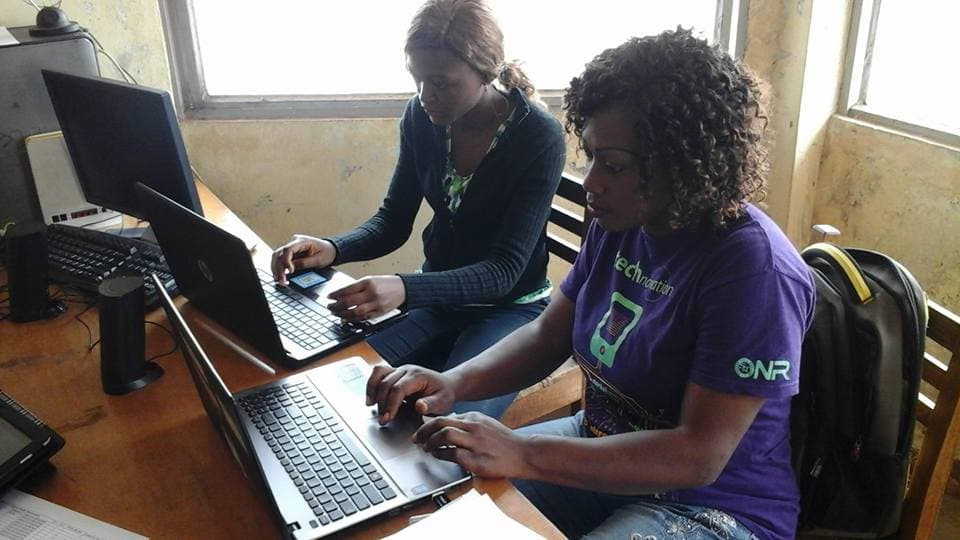
Photo Courtesy of Sophie Ngassa
Sophie Ngassa uses technology to empower girls in her community. But a months-long Internet blackout threatens to upend her efforts.
Our girls need to be online.
On a Monday morning in January I was seated in my office with 12 girls around my table. I was excited as I prepared to register the girls for the 2017 Technovation Challenge program, which would train them to create mobile applications to address everyday problems in our community of Bamenda, Cameroon. When I turned on my computer, I discovered that there was no Internet signal.
This was really strange to me, and at first I thought my laptop had a technical issue. Frustrated, I left to find out what was wrong from my co-workers, who run a cyber café in the next office. They were gazing at each other in confusion while customers complained.
We started hearing similar complaints from around my office. Soon, we were getting SMS messages from friends and family who were also unable to connect. After further investigating the issue, we found that the same situation prevailed throughout the entire North West and South West Regions of Cameroon. It was clear there was no Internet connection, but we could not understand any reason for the shutdown.
At the time, we had no idea that this was the beginning of an Internet blackout in English-speaking regions of Cameroon. We lost our connection on January 17, and we still do not have it nearly three months later.
To understand the blackout, you need to understand the language divide in my country. In Cameroon, both French and English are official languages, but only two out of our 10 regions are English speaking. These two regions have been marginalized for too long, and as conditions have worsened, the population has become very angry. Before the blackout, English-speaking regions had decided to speak out and protest. There was a lot of violence, causing people to lose property; some have even lost their lives.
As part of the protest, English-speakers were using the Internet to spread information about the situation, including sharing violent images of armed forces harassing those who were striking in the streets.
On that first day of the blackout, I remember returning to my office seriously disappointed, wondering how I would inform my team of girls that I would not be able to register them for this amazing online opportunity. I finally convinced myself to explain to the girls that it would not be possible to get them registered on the platform.
One of the frustrated girls exclaimed, “My dream of communicating and exchanging ideas with peers around the globe has just evaporated. ”
Another girl said to me, “So truly I am going to miss this opportunity to pitch my idea for the mobile application…i really want to be connected in order to compete with my peers from around the world. ”
They were devastated.
Last year, one of the teams from our region was a semi-finalist for the world-class competition and this year, these girls hoped that they would work harder to move to the finals this time. The sudden disappearance of the Internet significantly affected the girls, who were highly engaged and very eager to attend these sessions.
A few days after it began, the Internet blackout in our region became world news.
Meanwhile, we rely on the Internet in our work and in our lives, and we are still trying to understand why we have been deprived of this important basic need.
As the months went on, the close of the Technovation registration process approached and the girls became demoralized.
We had a brief moment of hope, however, during this turbulent period when we received breaking news that a boy from Bamenda won the Google coding competition. BBC and other international stations reported the story about this awesome 17-year-old boy and his struggles caused by the Internet outage. This boy is now a star! Learning This information gave hope to the Technovation girls, and they began thinking of other ways we could continue working.
The girls began contacting me to figure out other methods to continue the program. Although the registration date closed on March 8, all five regional ambassadors wrote a letter to the Technovation team pleading for an extension of the deadline, and as a result the date was extended by one week.
As the regional ambassador for the program in Bamenda, I felt responsibility for these girls. I traveled for over three hours on a very bad road for about 77km to the nearby French-speaking West Region, where Internet is available. There I tried and succeeded in registering some of the girls for the Technovation opportunity.
With the blackout continuing though, the future is uncertain for the 200 girls hoping to participate in the Technovation challenge in our region. They may not have the opportunity to fulfill their dream of going beyond the semifinals. That privilege shall be reserved only for the girls from the French-speaking regions of Cameroon, who have online access.
This is a huge disappointment, and the situation is even more serious for business people in affected regions who need an Internet connection to do their work. My co-worker relies on his cyber café business to support his family. Four of his workers have lost their jobs from the blackout. Many other businesses that rely on Internet have been shut down.
It is imperative for the government to reinstall the Internet connection in the areas affected.
Our girls deserve to be included in the development of our communities. Our girls need to be online.
STORY AWARDS
This story was published as part of the World Pulse Story Awards program. We believe everyone has a story to share, and that the world will be a better place when women are heard. Share your story with us, and you could be our next Featured Storyteller! Learn more.
- Girl Power
- Technology
- Human Rights
- Africa