
CAMEROON: Football Unites Us
Apr 30, 2019
story

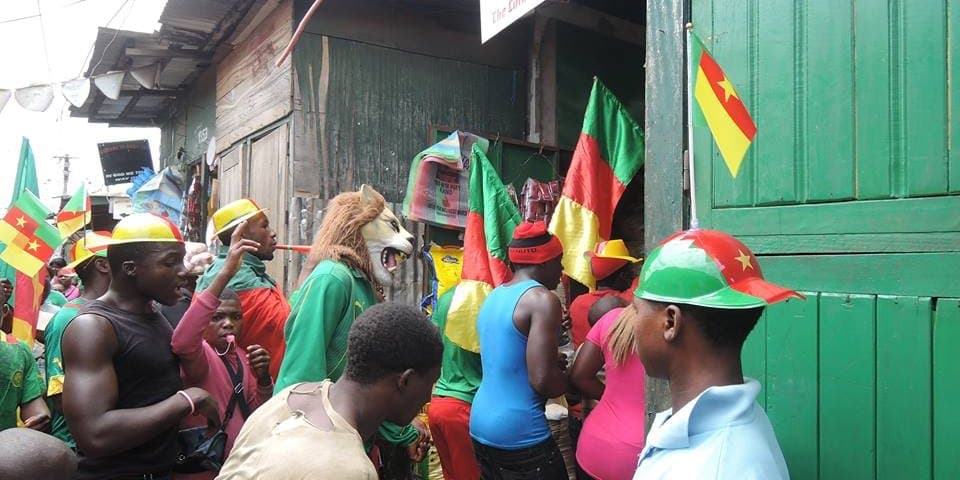
Photo Courtesy of Nakinti
In a country divided by language, a beloved sport brings Francophone and Anglophone Cameroonians together.
Football is the one thing that always makes me proud to be Cameroonian.
Every morning, I wake up feeling less Cameroonian. As an English speaker, I am a minority in a French dominated country. Whenever I travel to a French-speaking town, no one wants to hear me out because I speak English. I live with pain inside, especially when some French-speaking Cameroonians refer to us as ‘anglofools’ instead of the correct term ‘anglophones’.
When I try to put a problem through to someone in an office in French-speaking Cameroon, he will turn to his friend to ask, \"Ca c’est quel genre de langue? \" Which means, “What type of language is this? ” Every Time this happens, it leaves me in a pool of regret for being born Cameroonian.
Don't get me wrong; I love my country. What I don't like is the open discrimination and marginalization caused by two languages that divide us rather than unite us.
In the midst of all these insecurities, football is the one thing that always makes me proud to be Cameroonian. Come see how all Cameroonians unite and mobilize when the Indomitable Lions or Lionesses participate in an international match!
You need to see our bars, our streets, our attire, our moods. See our show of patriotism, oneness, and love for our country. See how Cameroonians celebrate victory and mourn defeat.
Sometimes after a defeat, I wonder why I am so anxious for a national team where the vast majority of team members are Francophones—a team representing a country that discriminates against us.
The seeds of today’s French-English divide were planted in 1916. France and Britain jointly assumed rule of Cameroon after the Germans were defeated in World War I and stripped of their foreign colonies.
While France administered Cameroon in French, Britain administered their own portion of Cameroon in English. The two Cameroons reunited in 1960 following a referendum that granted independence from France and England.
Today, Anglophones make up around 16% of Cameroon's total population, but major companies, industries, and top government services are all centralized in the French-speaking part of Cameroon. Our capital is Yaoundé, found in Francophone Cameroon. Our economic capital is Douala, also a French-speaking city. All of Cameroon’s international airports are located in Francophone Cameroon.
For many Cameroonians, football is our main unifying force. In June 2015, when the Lionesses, our women’s national team, played at the Women’s World Cup, I stayed up until after midnight to watch. It was a moment that made me feel Cameroonian.
Hilary Tafon, a man who sells football jerseys, laughed as he told me, “When the Lions are playing, I am proud to be a Cameroonian, but when the tournament comes to an end, I find myself asking myself whether I am really proud to be a Cameroonian with all the discrimination going on. ”
There are some people who think that justice should be served through a separation of the two Cameroons. The problems are there, but when the time for football comes, we forget the difficult moments and stand with our Lions and Lionesses. I’ve heard people say if there were no football, Anglophone Cameroonians would have hit the streets to ask for equality, equity, and respect.
This year, Cameroon will host the Africa Women Cup of Nations. The stakes are climbing. Cameroonians are once more uniting for this cause. We are worried and talking about the incomplete stadiums that are still under construction. We are disturbed about the hotels that are still under construction. We are tense about the state of our roads and security in the towns that will be hosting the championship. We are worried about the fact that the country has not put up banners, billboards, and TV and radio advertisements for this very important event. We are worried, but also eager to feel Cameroonian once again.
Because sports, and football in particular, make Anglophone Cameroonians feel Cameroonian, I think solutions for our problems can come from there. Something needs to be done to make all Cameroonians feel at home. Why not start by giving more Anglophone Cameroonians the chance to be a part of our men and women’s national squads? Or Build more stadiums in English-speaking Cameroon?
The good news is that the country is gradually using football infrastructure to make English Cameroonians feel a sense of belonging and patriotism. For the upcoming Africa Women’s Cup of Nations in November, Cameroon is building two international standard football stadiums in English-speaking Limbe and Buea. This has made many Cameroonians feel they are gradually being remembered in Cameroon’s infrastructure development agenda.
Despite all that, more still needs to be done. I am hoping that a day will come when I will wake up from my bed and feel completely proud to be Cameroonian—not because Cameroon is playing a football match—but because there will be equality, equity, and respect for everyone’s human rights in my beloved country.
- Africa