
CAMEROON: Breaking the Shackles of Disability
Dec 13, 2021
story
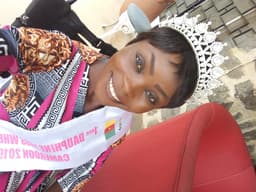

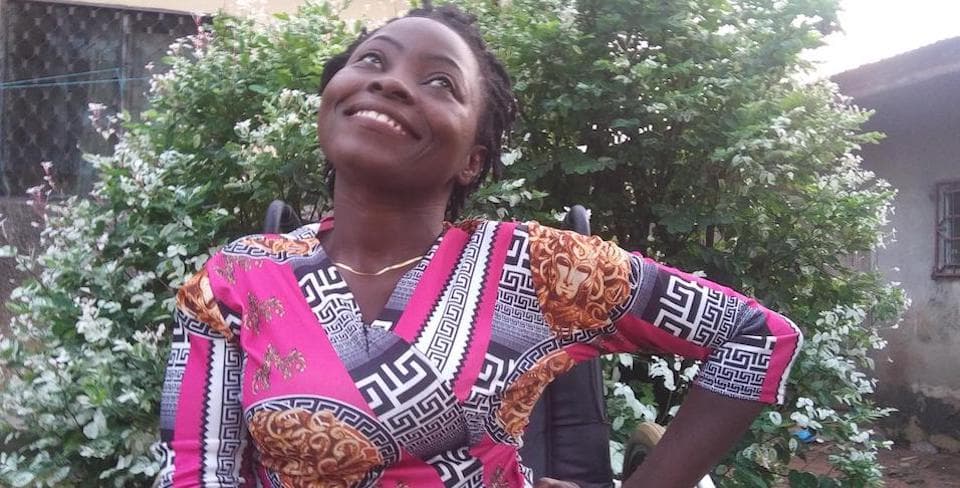
Image shows Lilian smiling while wearing colorful fabric and sitting in her wheelchair in front of a flowering bush (Photo courtesy of Lilian Dibo)
Lilian knows how it feels to be excluded and stigmatized as a woman with a disability. Today, her foundation offers women training, workshops, and financial support to pursue their dreams.
Together as a team, let's help the disability community through education, empowerment, and advocacy.
Growing up without any form of physical disability, I ran around and made childish noises like any child. I remember playing roughly with my elder sister, having fun. Then, unimaginably, my life took a turn when I contracted polio. My story changed from being an active, energetic little girl to a child who would sit in one spot, day in and out.
It was a new normal my mom could not accept. She tried all she could to restore my ability to walk again, to no avail. My life revolved around a daily routine of painful massage and fire burns — a traditional remedy believed to alleviate the effects of polio. But nothing happened. Rather, these remedies left me with so much pain.
Being an intelligent child and the last of 11 children, I received a lot of support from my family to ensure I went to school. My older siblings took turns carrying me on their backs to school and home. This continued until I got to college. Before college, my dad bought a second-hand tricycle that enabled me to move around town and gave me some level of freedom. I needed a push to move the tricycle, but at least I didn’t need to be carried on someone’s back.
A few years later, my dad died. All of my siblings were still in school. I felt heartbroken each time my tricycle fell into disrepair, and nobody could pay for the fixes. \"Dad, Why have you done this to me? ” I Would cry. “How could you leave me stranded in this poverty and expect me to cope? This Is just too much for me. ” My mom acted as my support system. She took on all sorts of side jobs to ensure that she provided for me.
I was the most brilliant student in each class, but the magnitude of stigma, inaccessibility, and marginalization I encountered was degrading. At the University of Buea, Cameroon, I was tempted to give up on the first day. Yet, I kept pushing.
My elder brother said, \"Dibo, you are now in the university, and this is a new life experience altogether. How well you will perform depends on how determined you will be. You have been a fighter, and I believe in you. Life has been so challenging to you, and this is the last challenge. You have to face it, and you must overcome it. Other persons with disabilities have passed through this institution. You, too, will do the same. ”
With these loving words, my brother boosted my confidence. I gave him a high five, telling him, \"I can do it! ” Some Days were less stressful, while others left me broken. Navigating campus was both a physical and mental battle for me. I lost count of the number of lectures I missed because the classrooms were inaccessible. Sometimes I would sit under the trees planted beside the administrative block and cry my eyes out.
I remember the times I would get home at 9 p. M. Because the car that transported me had a breakdown, and there was no extra money to pay for a taxi to take me home. My elder brother would come to wheel me a distance of five to 10 kilometers on a bumpy road. Upon reaching home, I was utterly exhausted to the extent of missing lectures for the next two days.
My life took yet another turn on November 28, 2017, two months after the Anglophone Crisis broke out in my country. The atmosphere was tense, with lawyers and teachers protesting and students striking on campus. As the crowd of students intensified, the military arrived, carrying fully loaded guns and setting off tear gas. A stranger wheeled me out of harm’s way. Yet, swept up in the frenzied crowd, I inhaled tear gas and collapsed. I was stranded, confused, and left to save my own life.
In the aftermath, the street was deserted. I didn’t know how I would get home, as the taxi man my brother had hired to drive me home from school said there was no way he could pick me up. I wheeled myself as far as I could before calling my brother. He answered and came immediately to wheel me home over the bumpy roads.
\"Is this the result of going to school? ” I Asked myself. “Will I ever be able to go to school again after this trauma? ”
“What if the running crowd would have run me over? ”
“What if that guy was not there to save me? ”
what if. .. What if . .. Millions of thoughts ran through my mind as we made our way to the house.
It was the worst experience I have ever had, a trauma I still live with today. I’m so grateful I wasn’t trampled by the confused crowd of students, but I dropped out of school due to concerns for my safety. My dreams and aspirations were shattered. My life became a dark dungeon of sorrow and regret as I could not send my son to school or buy meds for my sick mom.
Suicidal thoughts ran through my mind. Serendipitously, I met a psychosocial counselor who changed my life. Through our conversation, he discovered that I was not OK. Then he initiated some counseling sessions with me. “Life is sweet when you meet the right people, ” he told me. “Lilian, you are beautiful and filled with potential. You cannot fulfill your purpose sitting at home all day. Step out and explore. Meet new people. Go to new places. There are so many opportunities that are out there waiting for you. ”
I left the room, feeling as if someone had removed cobwebs from my face. \"Step Out and explore\" rang in my head. I asked my sister to help sponsor my tuition for a counseling institute, and she said yes. She sacrificed her first salary for me. I emerged as the best student in the trauma counseling program. Then I wrote a book titled “Living with Disability. ” I became a radio host for disability advocacy. I got into the Miss Wheelchair Cameroon beauty pageant and was nominated for the First Runner Up of Miss Wheelchair Cameroon 2020/2021.
As a young woman with a disability, seeing other women and girls with disabilities endure stigma and assault always breaks my heart. This is why I formed the Lilian Dibo Foundation, which focuses on inclusion, equality, and empowerment. Our foundation has organized numerous free trainings on how to design and produce Ankara fabric and beaded accessories. We hold gender-based violence workshops that cover disability rights advocacy and how to protect children.
Our foundation is currently on a mission to give out 23 scholarships for girls who are the children of parents with disabilities to pursue their education. We also donate everything from face masks to mattresses, along with funds for start-up capital and medical bills. We’re also planning to build an accessible multipurpose building to house displaced persons with disabilities, provide vocational training, and offer conference hall space.
We all have a role to play to help break the shackles of disability. Sometimes we just need that support to keep going. Together as a team, let's help the disability community through education, empowerment, and advocacy.
This story was published as part of World Pulse's #disabilityjustice campaign and Story Awards program. We believe every woman has a story to share, and that the world will be a better place when women are heard. Share your story with us, and you could receive added visibility, or even be our next Featured Storyteller! Learn more.
- Disability Justice
- Africa