
Butterflies Over the Graves
Feb 7, 2017
story


It is my last day in Cambodia. I am sitting in a crowded courtroom staring through bulletproof glass at the man who presided over the killing and torturing of more than 16,000 people in Tuol Sleng prison.
Kang Kek lew, commonly known as “Duch,” is wearing a freshly pressed blue shirt and glasses. He attentively adjusts his translation headset, and when he gets up to use the bathroom, he bows to the judges.
It is the opening day of the long-awaited Khmer Rouge trials. I am surrounded by nearly 500 members of the foreign and local press, all scribbling on their tablets. There are also members of Cambodia’s civil society: monks, teachers, youth leaders, human rights advocates, survivors. Many have lost loved ones in the genocide, which ended barely 30 years ago.
It is hard to breathe in this court room, and the room is silent with the held breath of hundreds more. The bile rises in my throat, and I can feel the crush of our questions. The whole room is arched forward, searching for an answer from Duch’s lips that could possible lend an explanation to the insanity of the Khmer Rouge years, an answer to the impossible question of “Why?\"
In February World Pulse traveled to Cambodia to experience the country through the eyes of her leading women. Across our brief 10 days, we descended into an increasingly heavy understanding of Cambodia’s corrupt and violent past. The residue of swallowed grief seemed to blanket everything.
Yet, at every turn, the clear, valiant voices of so many women pierced this layer of sorrow. By their very being, these leaders have become living monuments, leading a nation into a new chapter of healing. These new Cambodian temples of light, have become beacons for the many nations that are recovering from the aftermath of genocide, powerful testaments to the power of women everywhere.
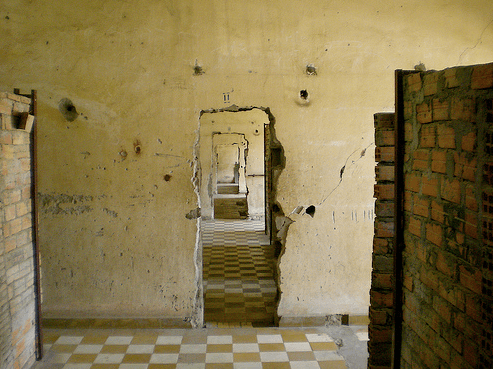
Led by the graceful Loung Ung, survivor, activist, and author, we wound through the Tuol Sleng prison where torture devices littered the floors, where nearby baby cries echoed off the blood-smeared walls. We learned that many who perpetrated the genocide still wield power in Cambodia’s current government.
Parliamentarian and women’s champion Mu Sochua lifted us with her rallying cries. Under her leadership, \"women are precious gems” became a widely recognized phrase. With Sochua’s young political associate, Reaksmey Arun by her side, we felt the next wave of Cambodia’s political future.
We walked alongside landmine survivors and their advocates in the Veterans International Rehabilitation Center. We felt the plastic limbs in our hands that allow mothers to hold their children despite their missing limbs. We came to realize that 40% of Cambodian land is still poisoned with these weapons.
We cautiously walked across a gaping plank walkway through an impoverished lakeside settlement that was set to be demolished by a government backed land grabbing.We met a woman who was about to lose her home. Standing in her doorway, she said she would stay until forced out: “I have nothing to fear by speaking out because I have done nothing wrong,” she said, her hands playing with her skirt.
We floated among the house boats on Tonle Sap Lake, the largest lake in South East Asia, where toxic runoff from China and Thailand is contaminating the waters.
We dined with human trafficking survivor and leader Somaly Mam. We learned about the epidemic of trafficking in this country, and the efforts to stop it.
In the garbage dumps, young teachers led us by the hands to their classrooms where children practiced English and awed us with their earnest traditional Khmer dancing.
Weeks later, long after my plane has departed, Duch would finally stand in that same room and say, “With sorrow and heartfelt regret, I am responsible for the crimes...especially the torture and execution of people. I apologize. I know that my crimes, in particular those towards women and children, cannot be tolerated.”
The people may have heard a long-awaited apology from one of the genocides master-minds, and it is significant. But, it is the voices of the women we met who are the healing lifeblood of a new Cambodia.
Editor's Note
World Pulseannually hosts intimate, international delegations to experience the world through the eyes of women leaders. Our 2010 trip will be announced later this year. We will return to Cambodia in 2011. To join our waiting list for the next World Pulse trip, emailinfo@worldpulse.com.
- Leadership
- Human Rights
- Northern America