
BRAZIL: Time to Break the Silence on Abortion
Feb 7, 2017
story



It was noon on a regular weekday; a Wednesday in March 2009. After coming home from university, I was having lunch with my brothers and watching the local news on TV. I was not paying much attention to the voice of the commentator until I was struck by a familiar name: Olimpio Moraes Filho—my father.
It took a while for my brothers and I to understand what was going on. My father—a doctor—and his medical team were being publicly excommunicated by the archbishop of our city, Jose Cardoso Sobrinho, for performing an abortion.
But this was not a common case of abortion. A 9-year-old girl from the interior of my state, Pernambuco, had become pregnant with twins after being sexually abused by her stepfather. Carrying on with the pregnancy represented an enormous risk of death to the girl, who was not yet prepared for such transformations in her young body.
Brazilian law considers abortion a crime, but there are exceptional cases in which it is legal for a doctor to perform an abortion. Abortion is legal here if there is no other way to save the pregnant woman’s life or if the pregnancy is the result of rape. Both of these circumstances were present in the 9-year-old girl’s case. Therefore, my father and his medical team were not doing anything illegal.
The archbishop argued, however, that the law of God is superior to the law of men, and that performing an abortion mandated excommunication from the Catholic Church. When asked about the girl’s stepfather who had raped her, the archbishop affirmed that rape was a dreadful sin. But abortion, he said, was even worse.
This led to an astonishing amount of attention from the media and generated wide public debate, not only in my state and in my country, but also internationally. The story was published in the New York Times and led to an apology by the Vatican itself. Reporters from all over the world came to visit our house to get more information about the story.
Brazilians started asking how the archbishop could claim to protect life while presenting a degree of tolerance for the rape of an innocent child. They started questioning the archbishop for condemning doctors who were acting with the support of the law and trying to save the child’s life. The case raised all sorts of questions about theology, morality, the role of religion in politics and law, gender-based violence, criminality in Brazil, among other crucial issues. But first and foremost, the 9-year-old girl’s case finally made people—young and old, progressive and conservative, religious and atheist, male and female—discuss abortion.
A Matter of Social Justice
Taking a position on abortion means dealing with very delicate and often intimate experiences and beliefs. Science currently does not offer a definitive answer to the question of when life begins. We often turn to religion to regulate our conduct, both morally and legally, and to understand complex issues like abortion. This is especially true in my country.
Brazil has legally been a secular state since 1890. This means the state and the Catholic Church have been officially separated for 120 years. In practice, the Catholic religion continues to shape public opinion. According to the national census from 2000, nearly 74% of the country’s population is Catholic. By the latter half of the 20th century, Brazil ranked as the largest Catholic country in the world. This strong influence has been considered harmful by many women’s rights organizations, whose work goes against the Catholic Church’s position on abortion and the use of contraceptives.
Brazil’s women’s rights movement argues that criminalization is ineffective at discouraging women with unwanted pregnancies from having an abortion. “What in fact happens is that the abortion is performed anyways,” says Benita Spinelli, the coordinator of the women’s health sector in my city, Recife. “The difference is that wealthy women can afford a safe abortion in clean clinics—legally or not—whereas poor women, who are the majority of the female population in Brazil, have to perform abortions in places with no adequate medical care, resulting in serious damage to their health.” Research led by the NGO Ipas Brasil, in 2007, in partnership with the Institute of Social Medicine of the University of the State of Rio de Janeiro (UERJ), showed that over a million abortions are performed in Brazil each year. Unsafe abortion is among the top three causes of maternal death in my country.
[paging]
The same research showed even more shocking results when statistics are broken down according to race/ethnicity, geographical location, and age. Black women in Brazil are three times more vulnerable to death due to unsafe abortion than the population of white women. Annual rates of unsafe abortion are visibly higher in states from poorer northern and northeastern regions, and abortions become even more dangerous for the adolescent population (between 10-19 years old).
These numbers lead to the consistent conclusion that unsafe abortion disproportionately victimizes less economically privileged social groups. And the statistics show the legacy of racism and social exclusion in Brazil that has lasted since the first Africans were brought here as slaves for Portuguese colonizers. Taking this context into consideration, it becomes clear that the issue of abortion, far from a topic to be kept exclusively in the intimacy of households, is a serious matter of public health and social justice, and deserves the attention of both government and civil society.
Criminalization Is Not the Answer
Proponents of criminalizing abortion in Brazil argue that it is a way of discouraging and repressing the practice. However, the evidence shows that a woman can usually find a way to have an abortion, even if it puts her own life at risk. In 2007 the United Nations Committee on Elimination of Discrimination Against Women (CEDAW) supported this position.
In Brazil, the codes criminalizing abortion punish only the woman. Although the man is involved in making the woman pregnant, if the pregnancy is unwanted or unfeasible and she gets an abortion, her partner is considered innocent. The Brazilian criminal code, which dates back to 1940, assumes a role for women in society that is very different than it is today.
In addition, the criminalization of abortion creates a threatening atmosphere that makes many women present symptoms of anxiety, depression, and insomnia once they have made the choice to end the pregnancy. Leila Adesse, one of the founders of Ipas Brasil, affirms that the penalization and stigmatization women in such a situation does not minimize the problem. “Instead of being discriminated against and put in jail, these women need psychological support, medical care and a more efficient coverage of contraceptive methods,” she says.
Towards Solutions
The most efficient way to reduce the rates of unsafe abortions is, of course, to reduce the rates of unwanted pregnancies. For that to happen, women have to be able to negotiate with their partners and engage in family planning. This demands a level field among men and women. We need to create an environment in our country in which women have a voice.
As a matter of public health and human rights, the reduction of unsafe abortions also demands a proactive attitude from the government. The situation requires public policies promoting education on sexual and reproductive health, reproductive rights, and contraceptive methods. In addition, it is necessary to make condoms and other contraceptive options widely available to the population. These programs should prioritize people living in at-risk communities, and they must involve men as well as women. Gender equality cannot be built by women alone.
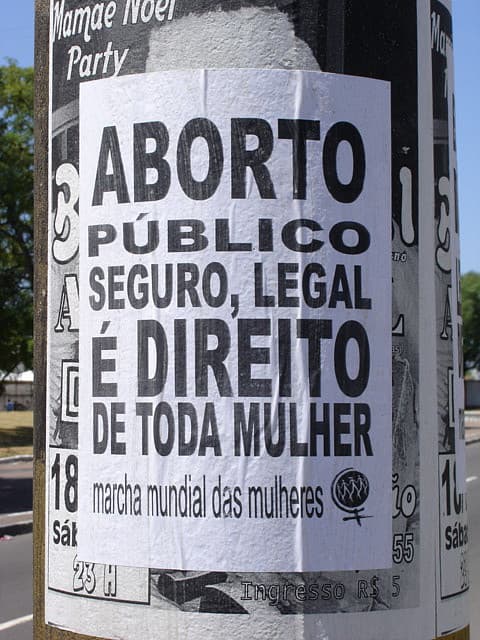
But even in countries where these policies are put in place effectively, they are not enough to entirely solve the problem of unwanted pregnancy and unsafe abortion. Therefore, we should legalize abortion in the first trimester of pregnancy, as is the case in most countries in Europe. This would remove barriers to women’s health in our country, especially for those women who are socially excluded.
It won’t be easy to get there. The fact is abortion is a contentious topic. It deals with the most serious issue of all—life. One day I caught myself talking to my grandmother about abortion. From this unlikely dialogue between a strongly Catholic 70-year-old woman and an agnostic 17-year-old girl, we did not reach any definitive conclusions, but we realized that we both had our reasons, which were legitimate and made sense, however different our beliefs were.
One can be against the legalization of abortion in order to protect life and one can also be in favor of the legalization of abortion for the exact same reason. The difference, in many cases, lies in whose life you are considering the most important. And to consider some lives more important than others is undoubtedly problematic.
Despite all these doubts, there is one thing I am certain about: unsafe abortion is a reality in Brazil. And thus, no matter how controversial this subject is, debate should not be avoided, but encouraged.
After my father was excommunicated, he told me that he was glad this had happened because it fostered debate. He added, “I just hope all this debate will be constructive.”
- Latin America and the Caribbean