
Best Chance to Make Foreign Policy Work for Women
Mar 8, 2017
story


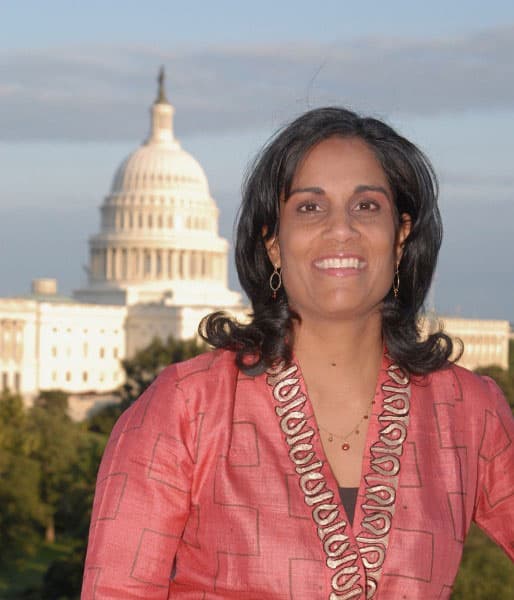

By Ritu Sharma
During her confirmation hearings, Secretary of State Hillary Clinton stressed the importance of prioritizing women and girls, who are at the greatest risk of being poor, and make up nearly 70% of the world’s hungry.
“If half of the world’s population remains vulnerable to economic, political, legal, and social marginalization,” she said, “our hope of advancing democracy and prosperity will remain in serious jeopardy.”
Then, just last week, the new Administration announced the unprecedented appointment of an Ambassador-at-Large for Global Women's Issues, Melanne Verveer of Vital Voices. And on the national level, President Obama signed an executive order to create the first-ever White House Council on Women and Girls which will “provide a coordinated federal response to the challenges confronted by women and girls and to ensure that all Cabinet and Cabinet-level agencies consider how their policies and programs impact women and families.\"
Secretary Clinton’s comments and the President’s actions underscore the United States’ renewed commitment to women’s equality and empowerment worldwide, but we must take this recognition to the next level and incorporate it into foreign policy. As Secretary Clinton expresses her commitment to “smart” foreign policy that includes both defense and diplomacy strategies, she must make international assistance a foreign policy priority and ensure that this assistance benefits the world’s women.
Amounting to less than one percent of our nation’s budget, these international programs buy us enormous global goodwill and are the best examples of partnerships intended to resolve common global problems in public health, the environment, and education. It is in our own best interests—especially in the midst of global economic distress—to help the world’s poorest find a way out.
It’s widely acknowledged within Congress, the international aid community, and the Obama Administration, including by Secretary Clinton herself and Secretary of Defense Robert Gates, that foreign assistance is seriously underfunded and viewed as an afterthought to defense and diplomacy. We have soldiers giving out microloans to women in Iraq, when women do not have the courage to approach the American military, and our soldiers do not have the training to handle these efforts. We have agriculture programs in Africa that are directed toward male heads of households, when women do the bulk of the farm work. And we have yet to figure out where crucial economic development programs fit within our engagement in Afghanistan, and how these programs can truly empower women.
These international assistance programs were mostly set up in the 1960s during the Cold War, and are out of date and inadequate. The Foreign Assistance Act, the law which currently governs US foreign assistance, is a mish-mash of contradictory provisions. At least 12 departments and 25 different agencies are involved in overseeing these programs, and only about a third of assistance flows to the least developed and lowest income countries, while 18% is overseen by the military.
We have a once-in-a-generation chance to modernize this assistance, to make it more efficient, and to make it more independent. At this time of economic distress at home, it’s doubly important that existing assistance programs have a laser-like focus on the poorest and most vulnerable, and on investments that truly work. Investing in the world’s women is the single most important step we can take on both these fronts. Decades of research and experience have shown that investing in women pays off many times over because women reinvest in their families and communities, resulting in healthier, better educated, and better fed children. Institutions like the World Bank have confirmed over decades that societies that discriminate on the basis of gender pay the cost of greater poverty, slower economic growth, weaker governance, and a lower living standard for their people.
Our foreign policy must prioritize poverty—the greatest challenge we face as a global community—and especially recognize the impediments that keep women and girls poor. Our taxpayers and the world’s women deserve an international assistance system that finally matches America’s ideals and ingenuity, and we now have the best chance in decades to make this happen.
About Ritu Sharma
Ritu Sharma is co-founder and president ofWomen Thrive Worldwide, the leading organization in Washington D.C. advocating for US international assistance and trade policies that prioritize the needs of women and girls worldwide.
- Economic Power
- Leadership
- Human Rights
- Latin America and the Caribbean