
Are Women a Disability in Politics? The Cost of Political Sexism in Kenya
Aug 25, 2026
story
Seeking
Action


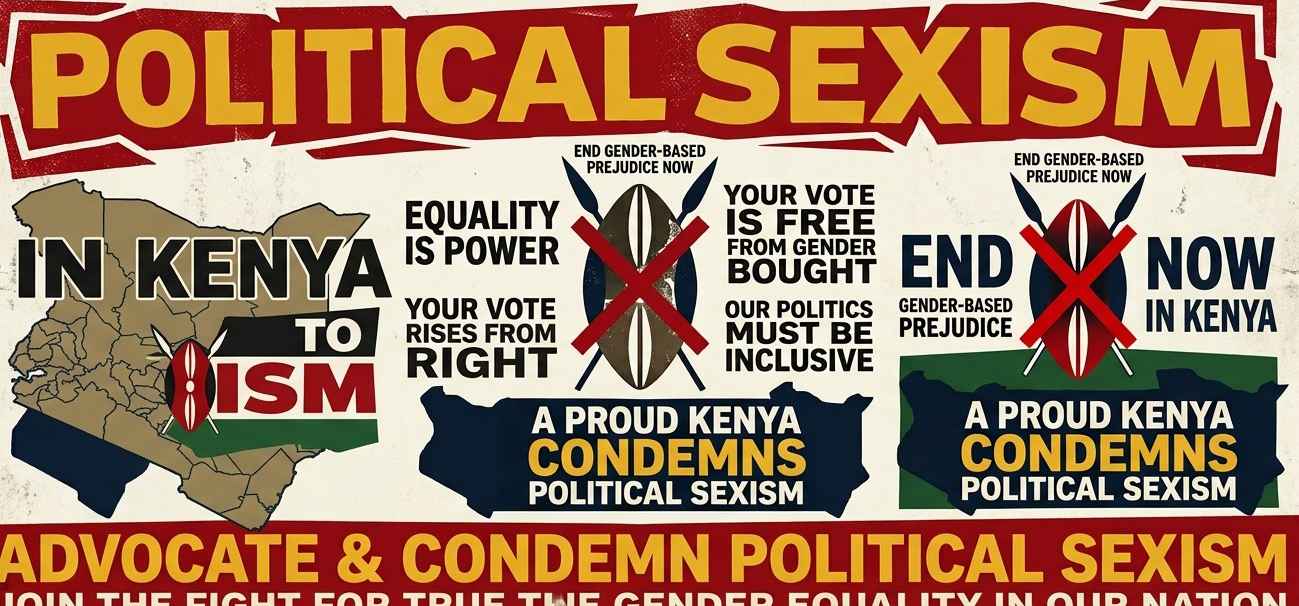
Judge her policies, not gender
When a Woman Enters Politics, Must She Leave Her Dignity at the Door?
Are women a disability in politics?
It is a question I find myself asking as I watch the language increasingly used against women in Kenya's political arena.
When did a woman's decision to participate in politics become an invitation to discuss her body, sexuality, marriage, appearance or character? When did political disagreement become permission to humiliate women? And when did supporting a particular political movement become enough reason to question a woman's loyalty, dignity or worth?
These are uncomfortable questions, but they must be asked.
Recent political exchanges have once again exposed the ugly side of political discourse in Kenya, particularly the language directed at women leaders. Remarks attributed to political figures have included descriptions of women as “traitors,” derogatory references to their character and sexuality, comments about their appearance and makeup and humiliating remarks involving their marriages and families. Some women have reportedly been subjected to local-language insults intended to portray them as disloyal or morally compromised.
There have also been claims of women leaders being mocked for their appearance, accused of using makeup or their bodies to attract young male voters and subjected to remarks suggesting that their political positions make them disloyal. In another reported exchange, a woman leader was allegedly told that after political opponents were removed, she should return to a rural home and serve as a maid. Other remarks have reportedly dragged marriages and family backgrounds into political disputes.
These are not merely words.
Words from powerful political figures carry weight. They are amplified by supporters, reproduced on social media and sometimes transformed into entertainment. What begins as an insult at a political rally can become a national narrative repeated thousands of times.
So what exactly are we teaching our country when political disagreement becomes gendered humiliation?
Let me be clear: women in politics are not asking to be exempted from criticism.
They should be criticised, questioned and held accountable.
If a woman makes a poor decision, let Kenyans question it. If she supports a harmful policy, challenge it. If she fails in her responsibilities, examine her record. If her political arguments are weak, defeat them with stronger arguments.
But criticise her as a leader, not as a woman.
When the conversation moves from a woman's policies to her body, from her political decisions to her sexuality or from her leadership record to her marriage, we have stopped debating leadership.
We are weaponising her womanhood.
Women in politics are not sexual objects or decorations on political platforms. They are citizens with the same political rights as men. They are thinkers, professionals, builders, mothers, daughters, wives and decision-makers.
And their political choices belong to them.
A woman has the right to support the government or opposition, join any political party, campaign for the candidate she believes in, change her political position and disagree with people from her own community.
Supporting a political movement that someone else opposes does not make a woman less Kenyan. It does not automatically make her a traitor. Her vote is hers. Her conscience is hers. Her political ideology is hers.
Democracy cannot mean that people are free only when they agree with us. Political diversity is part of democracy.
The answer to political disagreement should therefore be persuasion, not humiliation.
There is something particularly disturbing about the way women's sexuality becomes a political weapon. When women leaders are mocked through comments about their bodies, accused of using their appearance to entice voters or subjected to sexually degrading language, their leadership is reduced to their physical appearance and their bodies are treated as legitimate political territory.
They are not.
A woman's appearance is not her political manifesto.
Her marriage is not her political manifesto.
Her sexuality is not her political manifesto.
Her motherhood is not her political manifesto.
Her ideas are. Her record is. Her policies are. Her leadership is.
Challenge those.
Why should a woman's political career become an opportunity to attack her husband or drag her marriage into political disputes? Whether she is married or unmarried, whether she is a mother or not, her dignity remains hers.
A woman does not surrender her identity when she enters politics.
We must also acknowledge that women can fight back. Some women targeted by political attacks have responded boldly, defended their records and challenged their attackers. Their courage is admirable.
But their ability to respond does not make the abuse acceptable.
A strong woman can still be hurt. A confident woman can still be humiliated. Strength should never become an excuse for mistreatment.
And the problem extends beyond women already in political office.
What about the university student attending her first political meeting? The young woman dreaming of becoming an MCA? The girl sitting in a classroom today who dreams of becoming a governor, senator, Cabinet Secretary or President?
She is watching.
If she sees women mocked for their bodies, marriages and sexuality, she may associate political leadership with humiliation. If she sees women subjected to online abuse, manipulated images and degrading cartoons, she may conclude that public leadership comes at the price of her dignity.
We should not measure the damage only by counting the women who were directly insulted. We must also think about those who watched and quietly decided:
“Politics is not for me.”
Political sexism can therefore become a barrier to democratic participation.
Technology has made this even more serious. In the digital age, humiliation can travel faster than truth. Manipulated photographs, videos, cartoons and AI-generated images can be created and circulated to thousands within minutes. Women in public life can become targets of digitally manufactured sexual humiliation designed to damage their reputations.
Technology should expand political participation, not become a weapon for silencing women.
And this is not a war between women and men.
Kenya needs men who will reject political misogyny even when the woman being attacked belongs to the opposing political camp. We need fathers who teach their sons that strength does not mean humiliating women. We need leaders who understand that defending a woman's dignity does not weaken their political position. We need supporters who can love their political party without losing their humanity.
Women themselves are not perfect. They can be wrong, partisan, ambitious or unfair. They can make political mistakes or attack opponents.
None of these things makes them undeserving of dignity.
Dignity, however, does not mean immunity from accountability. If any political leader, supporter or citizen crosses the line into conduct prohibited by law—whether through threats, unlawful harassment, incitement, defamation or other offences—they should be held accountable through appropriate legal and judicial processes, regardless of political position or affiliation. Equally, the law should never be weaponised to silence legitimate criticism or political disagreement. If a woman breaks the law, she should be held accountable; if a man does, he should be held accountable too. Our response to wrongdoing should be justice, not humiliation, and our political differences should be settled through lawful democratic processes.
This is the political culture Kenya must build: one where men and women can stand on opposite sides of the political divide without dehumanising each other; where rallies are spaces for ideas; where women have equal opportunities during party nominations; where women can address citizens without intimidation; and where technology is not weaponised to sexually humiliate them.
Because women are not a disability in politics.
Their womanhood is not a weakness. Their political choices are not a betrayal of their gender. Their voices are not less valuable because they are women.
They deserve equal opportunity, equal participation and equal dignity.
I may never vie for political office myself. But I believe raising my voice when women are victimised is a responsibility I cannot ignore.
Standing with women does not require me to belong to their political party or agree with every position they take. It requires me to believe that they deserve to participate without being degraded for being women.
I stand with the woman who has entered politics.
I stand with the woman preparing to contest for office.
I stand with the woman who is afraid to enter politics.
I stand with the woman whose political beliefs are different from mine.
And I stand with the little girl who already dreams of becoming a leader.
To that young woman, I say:
Do not let political insults define the size of your dream.
Stand firm.
Speak.
Participate.
Lead.
Be fearless.
You do not need permission to dream of leadership.
And to those already in positions of political influence, I say: our children are watching us.
Let us show them that political strength does not require cruelty, disagreement does not require degradation and intelligence is demonstrated through ideas, not insults. Let us show them that leadership is not about who can humiliate an opponent the most, but who can persuade, serve and build.
We cannot continue normalising political language that teaches women that entering leadership means surrendering their dignity.
Women should not have to choose between leadership and respect.
They deserve both.
Kenya deserves better politics.
Women deserve better politics.
And the young girls watching us deserve to inherit a political culture where they can say:
“I want to lead.”
—and not have to add—
“if I can survive being a woman in politics.”
Let us raise the flag of women's leadership higher.
Let us defend equality, equity and dignity.
Let us disagree without degrading.
Let us criticise without sexualising.
Let us compete without humiliating.
And let us build a Kenya where women do not merely enter political spaces—
but belong, participate, lead and thrive in them.
- Gender-based Violence
- Girl Power
- Global