
Appalling Public Healthcare System: Wake up Africa
Jan 24, 2022
story

Africa is a continent that has been ravaged by pandemics. According to the World Health Organisation(WHO) Africa was home to 25.8 million people living with HIV in 2018. The 2014–2016 outbreak in West Africa was the largest and most complex Ebola outbreak since the virus was first discovered in 1976. The first EVD outbreaks occurred in remote villages in Central Africa, near tropical rainforests. The emergence of Ebola in West Africa resulted in infection of 28,616 and 11,310 deaths reported in Guinea, Liberia and Sierra Leone[1].Ebola virus disease (EVD), formerly known as Ebola haemorrhagic fever, is a severe, often fatal illness affecting humans and other primates. The virus is transmitted to people from wild animals such as fruit bats and porcupines then spreads to human population then spreads in the human population through direct contact with the blood, secretions, organs or other bodily fluids of infected people, and with surfaces and materials (e.g. bedding, clothing) contaminated with these fluids[2].
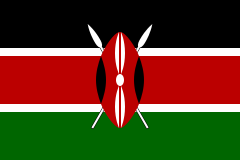
African governments need to have learnt from these pandemics and worked on their public health systems. It is very sad that in this year and age doctors and nurses[3] in Africa can still go on strike to demand pay. The other compounding factor is brain drain through which Africa’s best brains in the medical sector are crossing borders to go to Europe and other continents in search of greener pastures. The existing healthcare system is appalling, in some places patients sleep on the floor, in others patients share beds and when doctors and nurses go on strike, patients are turned away with some dying in the process. For example, The Kenya Medical Practitioners Pharmacists and Dentists Union announced its 7,200 members have been asked to stop working until the government meets their demands[4].This means a majority of Kenyan medical personnel in public hospitals are picketing amid a growing pandemic, the health workers are protesting inadequate insurance benefits and lack of protective gear while treating COVID-19 patients[5].In addition, the death of doctors and nurses while in line of duty is another sad story and this is often coupled with working conditions that are strained in relation to resources. A heart-breaking example is the death of 28-year-old Rd. Stephen Mogusu who was employed on a temporary contract and was never paid for the five months he worked in a COVID-19 ward at a public hospital in the town of Machakos[6].
The sad reality of public hospitals can be said to be an Africa- wide problem. At independence , many African leaders pledged that they would address poverty, ignorance and disease , but sadly disease continue to ravage Africa , poverty is on the rise despite Africa being the richest continent in terms of natural resources and Africa’s youth continue to make the precarious journey across the Mediterranean or the Sahara desert in search of greener pastures , while politicians continue to give promises that they cannot keep every 5 or 6 years depending on a country’s election cycle.
The inadequate infrastructure in the healthcare system permeates the entire system. For example, maternity services are about giving life. They should be respected and protected and provided with all the support and state of the art machines. Giving birth should be a joyous moment for every mother and access to the highest standard of health is contained in many Constitutions across Africa, Kenya[2] included. But this not the case for a mother who gave birth outside Pumwani Maternity Hospital[3] a public hospital in Kenya when medical staff downed their tools over a revenue sharing stalemate with the County governments.The nationwide strike by health care workers was as a result of delayed wages and allowances.
To continue the woes in Africa’s public healthcare systems, in some hospitals when patients go for treatment, they are told to go and buy drugs outside the hospital facilities, by the time they come back with the drugs, the patients have sadly died. Families are therefore left with the heavy burden of paying hospital bills and burying their dead. Some hospitals do not have adequate ambulances, beds and beddings or medicines. Most maternal deliveries are in public facilities, but private facilities play a large role especially in urban areas. Rural communities in various part sofa Africa suffer from inadequate healthcare services, furthermore pregnant women are more likely to give birth at home than in a hospital in many rural settings. Additionally, in rural areas Traditional Birth Attendants are a recognised source of healthcare services due to their availability within the community as well as affordability.
Health and transport system go hand in hand. For example, if there are not roads, community members cannot go to hospital on time and may die enroute to hospital. Families will tell you of incidences where they have to push their sick on wheelbarrows[1] or carts to take them to hospital because they do not have money or the roads are impassable and in some cases the only available transport to take a patient to hospital is a bodaboda[2] . If you come from a remote village, your chances of getting to a hospital are even slimmer. There are reported cases of citizens demonstrating over state of health in public hospitals in different localities These complaints are often about lack of vital health related facilities such as ambulances. When ambulances are inadequate, residents have to hire private transport, transferring another burden to families, some islands can only be accessed by a boat, imagine the distress of carrying a sick family member on a boat.
Doctors migrate from developing countries to wealthier countries in order to further their careers, or improve their economic or social situation. The World Health Organization (WHO) has long recognised that migration of health personnel from developing to developed countries creates unfortunate imbalances in the global health workforce[1]. Covid 19 further reminds us of the dangers of having a healthcare system that is crumbling. One after the declaration of the Covid 19 pandemic, the People’s Vaccine Alliance is warning that developing countries are facing critical shortages of oxygen and medical supplies to cope with Covid 19 cases. In contrast, rich nations have vaccinated their citizens at a rate of one person per second over the last month, additionally majority of the poorest nations are yet to get a single dose[2].
Immigration theory informs us that “push factors” that contribute towards professionals leaving poor countries in favour of settling in higher income countries.[1] Doctors leave their homelands because of lower pay, poor working conditions , lack of resources to make their work easy , poor infrastructure and technology as well as government systems that are not responsive to the demands of the healthcare fraternity .On the other hand, the “pull factors” which attract doctors to wealthier nations include higher standards of living, training opportunities and a more sophisticated research conditions.[2]
The hard question African politicians should be asking themselves is why they allow Africa’s best brains to leave the continent and the healthcare systems to continue deteriorating. Whenever large numbers of Africa -trained physicians leave the continent upon completion of their medical school training in search of careers in higher-income countries, they leave behind a healthcare system that is severely stresses , a life expectancy that has drastically reduced to 50 years whereas in other parts of the world people live up to 80 or 90 years , high mortality rates for children under five and where some parts of the continent access to clean water is but a dream.
In 2019 , for example ,there was an estimate 229 million cases of malaria worldwide .According to WHO , Africa was home to 94% of malaria cases and deaths[3] Malaria is a life-threatening disease caused by parasites that are transmitted to people through the bites of infected female Anopheles mosquitoes. It is preventable and curable. Many of the diseases that kill African people can be prevented or treated with timely access to appropriate and affordable medicines, vaccines and other health services. But less than 2% of drugs consumed in Africa are produced on the continent, meaning that many sick patients do not have access to locally produced drugs and may not afford to buy the imported ones.
African politicians are notorious for going abroad to seek medical treatment. This confirms that they do not believe in the capability and capacity of local hospitals and local medic. For example Nigeria President Buhari went abroad for treatment and so did Robert Mugabe , former president of Zimbabwe[1].This contradiction is also echoed by Livingstone Sewanyana of the Foundation for Human Rights Initiative who said of travelling abroad for healthcare Perhaps “COVID-19 is an opportunity for our leaders to re-examine their priorities,” which has long urged African countries to increase health care spending[2].In addition , African health budget continue to get lower percentages inters of budgetary allocation whereas military gets the most and the sad part is that many African countries are not waging any wars at the moment. Why have state of the art military apparatus when your citizens are dying because of preventable diseases? when citizens die, whom will you ask to vote for you?
Sadly, instead of fixing local public healthcare system that will ensure doctors and nurses are paid, essential medicines are available, doctors are motivated not to travel to other countries in search of greener pastures many governance systems in Africa instead jail[3] doctors or dismiss striking medical workers. Another problem is instead of motivating own medic, countries prefer importing[4] doctors from other countries for the same healthcare service provision. It is about time we started reflecting on politicians including presidents in Africa do not to local national hospitals such as Kenyatta National Hospital in Kenya, Muhumbili National Hospital in Dar Es Salaam, Mulago Hospital in Kampala or Chris Hani Baragwanath hospital in Johannesburg among others. Covid 19 should be an eye opener to politicians to rethink public health systems. Closure of international borders meant that each country had to treat her sick citizens including politicians. It is about time that African politicians invested in a healthcare system that has infrastructure and the required equipment, where procurement of medicines are done in a transparent way that ensured hospitals are well stocked with medicines, a system where doctors, nurses and all medical personnel are treated with dignity a procurement system that is not tainted with corruption [5].It is only then that Africa will boast of addressing the burden of healthcare.
References
Cover photo credit @Quartz Africa
https://qz.com/africa/894578/kenyas-refusal-to-agree-to-the-demands-of-s...
[1] https://qz.com/africa/1017973/zimbabwes-mugabe-and-nigerias-buhari-are-t...
[2] https://www.usnews.com/news/world/articles/2020-04-04/african-elite-who-...
[3] https://citizentv.co.ke/news/doctors-union-officials-sentenced-to-one-mo...
[4] https://www.aa.com.tr/en/africa/kenya-health-workers-oppose-import-of-cu...
[5] https://www.youtube.com/watch?v=SKzFj4ssY-0
[1]https://applications.emro.who.int/imemrf/J_Coll_Physicians_Surg_Pak/J_Co...
[2] ibid
[3] https://www.who.int/news-room/fact-sheets/detail/malaria
[1] https://human-resources-health.biomedcentral.com/articles/10.1186/1478-4...
[2]https://www.oxfam.org/en/press-releases/rich-nations-vaccinating-one-per...
[1] https://news.wjct.org/post/patients-wheelbarrows-inspired-him-start-free...
[2] Bode boda is a motorcycle
[1] ibid
[2] http://kenyalaw.org:8181/exist/kenyalex/actview.xql?actid=Const2010
[3] https://citizentv.co.ke/news/pumwani-hospital-says-nurses-eventually-att...
[1] https://www.cdc.gov/vhf/ebola/history/2014-2016-outbreak/index.html#:~:te
[2] https://www.who.int/health-topics/ebola/#tab=tab_1
[3] https://www.youtube.com/watch?v=ZLZ7ssAN8m0
[4] https://www.africanews.com/2021/01/07/kenyan-government-sacks-86-strikin...
[5] https://www.africanews.com/2020/12/22/kenya-patients-left-stranded-as-st...
[6] https://www.reuters.com/article/us-health-coronavirus-kenya-vigil-idUSKB...
References
Cover Photo Credit @Quartz Africa
https://qz.com/africa/894578/kenyas-refusal-to-agree-to-the-demands-of-s...
[1] https://www.cdc.gov/vhf/ebola/history/2014-2016-outbreak/index.html#:~:te
[2] https://www.who.int/health-topics/ebola/#tab=tab_1
[3] https://www.youtube.com/watch?v=ZLZ7ssAN8m0
[4] https://www.africanews.com/2021/01/07/kenyan-government-sacks-86-strikin...
[5] https://www.africanews.com/2020/12/22/kenya-patients-left-stranded-as-st...
[6] https://www.reuters.com/article/us-health-coronavirus-kenya-vigil-idUSKB...
[7] https://theconversation.com/african-politicians-seeking-medical-help-abr...
[8] ibid
[9] http://kenyalaw.org:8181/exist/kenyalex/actview.xql?actid=Const2010
[10] https://citizentv.co.ke/news/pumwani-hospital-says-nurses-eventually-att...
[11] https://news.wjct.org/post/patients-wheelbarrows-inspired-him-start-free...
[12] Bode boda is a motorcycle
[13] https://human-resources-health.biomedcentral.com/articles/10.1186/1478-4...
[14]https://www.oxfam.org/en/press-releases/rich-nations-vaccinating-one-per...
[15]https://applications.emro.who.int/imemrf/J_Coll_Physicians_Surg_Pak/J_Co...
[16] https://www.who.int/news-room/fact-sheets/detail/malaria
[17] https://qz.com/africa/1017973/zimbabwes-mugabe-and-nigerias-buhari-are-t...
[18] https://www.usnews.com/news/world/articles/2020-04-04/african-elite-who-...
[19] https://citizentv.co.ke/news/doctors-union-officials-sentenced-to-one-mo...
[20] https://www.aa.com.tr/en/africa/kenya-health-workers-oppose-import-of-cu...
- Health
- Human Rights
- Africa