
A valley where '' MENSTRUATION IS A SIN''
Jul 12, 2023
story
Seeking
Visibility


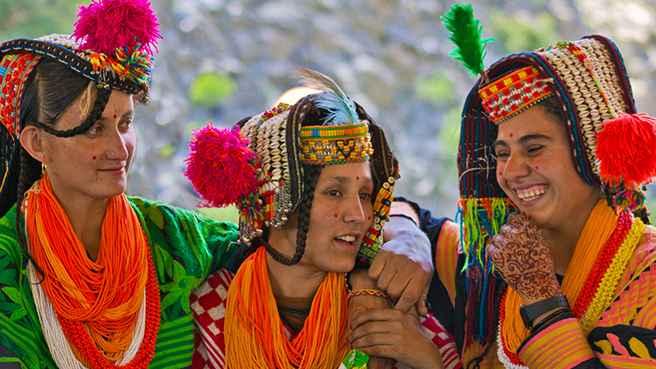
The Kalasha people are native inhabitants of the Chitral District in Pakistan's Khyber-Pakhtunkhwa province. Kalasha women typically wear long black robes adorned with cowrie shells, leading to their nickname, "the Black Kafirs," in Chitral. Men have adopted the Pakistani shalwar kameez, and children wear miniature versions of adult clothing after reaching the age of four. The Kalash religion emphasises the concepts of purity and impurity, holding high mountains, lakes, green pastures, cooking areas, gods and deities, and worship areas as pure ("ongesta"). In contrast, they regard maternity houses (female "Bashalini") and graveyards as impure ("paragata").
The Valley of Kalash contains both Muslim and non-Muslim populations; despite apparent diversity in religious and cultural ideologies, they claim to practise egalitarianism without discrimination based on gender, race, class, status, or religion. However, this claim is flawed as certain instances of discrimination against women exist in the name of honour or religious decree. In the Himalayan region, verticality is significant due to the stark contrast between towering mountain peaks and deep valley bottoms.
In Kalash society, women's biological facts lead them to be forbidden from directly drinking clear liquids from a glass; they are also discouraged from sharing utensils with male family members. As a tradition, during menstruation, Kalash women must leave their homes to spend a week in the Bashalini (Menstruation Home), which is considered impure. Older Kalash women say that when they were younger, they left for the menstrual house immediately upon their period starting—even in the middle of the night—but now have the option to spend that first night at home. This change exemplifies flexibility and shifts in tradition.
The young jubilant Kalash girls wholeheartedly agreed that they do manage to take pleasure at this time because they are free, can spend time with their acquaintances, and can gossip about friends and foes. The dissatisfaction and antagonism on the part of these females, who regard this tradition as a disgrace to their sanity and sense of shame, were evident in their nonverbal communication. They believe that when they have to leave for the Bashalini, they reveal very personal information to the public. Sometimes they are teased and suspected of illicit relations if they miss their cycle due to any biological disability. They share their disgust regarding the tradition according to their own needs, and since they are obliged to keep the tradition alive and respect the preaching of their shamans, they suppress their innermost desire. In some instances, women have been using their stay in Bashalini as an escape from their strict and angry husbands.
The Bashalini is a small cottage near a stream with a four-wall boundary; families of menstruating women prepare food and leave it at the Bashalini's doorstep, fearing the impurity bestowed upon them. Sending women to the Bashalini is a long-standing tradition and a traditional practise transmitted to them by their elders, "who believed that the females are cursed by the gods," so it is a punishment for them and they should suffer. Some claim it descends from the biblical story of Adam and Eve. The Kalash have their own version of this tale, emphasising that Muslims also believe Adam was punished by God for his disobedience. Thus, they avoid committing a similar offence or irritating their gods as their pre-Islamic ancestors did, invoking divine wrath. The practise of checking seven generations alludes to the existence of seven siblings.
Menstrual health and hygiene remain taboo subjects, and there is a culture of silence surrounding women’s reproductive health, including menstruation, in some sections of society. It is therefore imperative that we talk about it and take action to improve girls’ access to the knowledge, tools, and facilities they need to manage menstrual hygiene with dignity and confidence.
In conclusion, presently the society is passing from the phase of transition and transculturation due to the impact of modernization and change, but still the people are trying hard to preserve and maintain their identity, but gender discrimination is present within Kalash society under the guise of religious customs. It is important to remember that cultural practises should not justify mistreatment or inequality among members of society; change and flexibility in tradition can bring about a more inclusive environment for all.
- Health
- Gender-based Violence
- Human Rights
- Education
- Girl Power
- Salud menstrual
- Indigenous Rights
- South and Central Asia