
A Love Letter to Earth
May 24, 2026
story
Seeking
Feedback

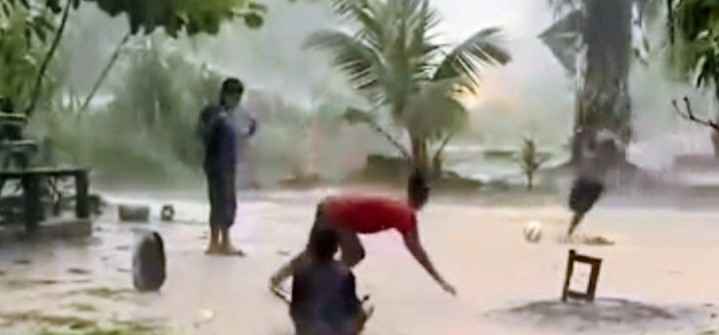
Children playing while it's raining
My Dearest Earth,
There is a particular smell that belongs only to you here, to this corner of you that I was born into. It is the smell of rain hitting hot laterite soil just before a storm breaks. It arrives a few seconds before the downpour, a warm, ancient scent that rises from the ground like breath, like something living waking up.
Every Nigerian child knows this smell. It means run inside or play under the rain with your friends, let it soak through your clothes, let the earth remind you that it is still here, still breathing, still generous.
As one from the South-South. The Niger Delta. A region of the world so laced with rivers and creeks and mangrove forests that from the sky, they say, it looks like the land and the water cannot decide where one ends and the other begins. Growing up near water that was not the sea but felt endless. Water that local boats crossed every morning carrying people and fish and conversation. Water that children stood beside without fear, because it was familiar the way a neighbour's face is familiar. The way home is familiar.
Picture this, if you have never been; thick green mangroves rising from the edge of the water, their roots tangled above the surface like fingers gripping the riverbank. The air is heavy with humidity, not unpleasantly more like a warm room full of people you love. Fishing nets spread out to dry on the shore. A woman balancing a basin on her head, moving with the particular ease of someone who has carried weight all her life and made peace with it.
Children running barefoot on sand the colour of pale gold. Above all of it, a sky so blue in the dry season it seems almost aggressive.
This is what you gave us here. This is what I mean when I say I love you.
You gave us the Nun River and the Forcados. The Bonny and the Brass. The great Niger itself, splitting into a hundred smaller streams as it reaches the sea, as if it cannot bear to leave the land all at once. You gave us forests so dense that sunlight arrived in patches, dappled and quiet, the way a secret is told. You gave us birds whose names I never learned in school but whose calls I still hear in my memory. You gave us banga soup made from palm fruits pulled straight from the tree.
You gave us a way of life so tied to water and land that our language, our food, our movement, our entire identity grew directly from the soil and the river.
You were so generous. You still are, in the places that remain untouched. And that is what makes the rest so painful to say.
Because I have also seen what has been done to you here.
I have seen oil, crude, black, unhurried spreading across the surface of your creeks like a slow catastrophe. It does not arrive dramatically. It seeps. And then one morning the fisherman returns with an empty net, and the next morning, and the next, and eventually he stops going to the river at all because the river has stopped answering. The fish are gone. The water is wrong. The ecosystem that sustained generations of families has been quietly, thoroughly poisoned. And the people who caused it are rarely the people who suffer from it.
I have seen the soot. If you have never been to a community near illegal crude oil refining, let me describe it: a dark, oily residue that settles on rooftops, on walls, on clothes hung out to dry, on the lungs of children who play outside. It comes from makeshift pits in the creeks where stolen crude is cooked down in barrels, thick smoke rising into the air and then descending on everything within reach. The sky above these communities has a colour that sky should not have. The children cough. The adults have learned not to speak about it too loudly.
I have seen the trees come down not in a grand act of industrial deforestation, but slowly, personally. One tree at a time, cut for firewood because there is no other way to cook dinner tonight. Poverty and environmental destruction are not separate conversations here. They are the same conversation. A woman who cannot afford gas will use wood. A community with no infrastructure will take from the forest. And the forest thins, and the shade disappears, and the soil loosens, and the birds move on, and nobody holds a ceremony to mark what has been lost.
I have seen the waterfronts sold. The sandy stretches where children once ran barefoot turned into estates. The mangrove edges where the river met the land in a natural, breathing boundary filled with sand and concrete, built over, fenced off. A developer looks at a waterfront and sees opportunity. I look at the same place and see a childhood, a community's gathering point, a piece of living earth that cannot be rebuilt once it is gone.
The Nigeria I carry in my body is both the one that was rich, river-threaded, alive and the one that is becoming, acre by acre, creek by creek, tree by tree.
And still. Still I love you.
Because the rains still come. Because somewhere in the Delta, a woman is still cooking banga soup😊 over a fire and the smell is still one of the most comforting things on earth. Because the Atlantic still rolls onto Bar Beach in Lagos with the indifference of something eternal, indifferent to everything we have built along its edge. Because when the harmattan comes in from the north and the air goes dry and dusty and the nights turn cold, Nigerians all across the country pull out blankets and drink hot tea and feel, despite everything, that they are exactly where they belong.
You are not finished with us. And we are not finished trying to deserve you
This letter is part of that speaking.
Nigeria, my beloved, your rivers run through me. Your rain was the first language I understood. Your soil holds the bones of my ancestors and the footprints of my childhood. I do not know everything that is coming, but I know that love, real love, does not disappear when things become difficult. It leans in.
I am leaning in.
With all the love the Niger Delta taught me to carry.
Dear Earth, you are beautiful ❤️
- Environment
- Earth Emergency
- Global