
16 Days of Global Action on Agroecology: Youth March on for Agroecology and Food Sov.
Feb 25, 2023
story
Seeking
Feedback

Millions of smallholder farmers and food producers particularly in poor countries do not have access to land and other resources .This hampers food sovereignty .Movements are rising to counter through solidarity and building on the ground alternatives. The 16 Days of Activism on Agroecology campaign was organised by Pesticide Action Network -Asia Pacific(PANAP).
The objectives of the campaign were:
-To raise awareness to the public on the benefits of agroecology on food security, health, the environment, on land and resources and on the economy of food producers and rural communities
-To generate solidarity among the youth across the globe to push for policy changes in the local, national and international level for agroecology- and gather the support of and all other sectors within the rural community and beyond, in the struggle to defend collective rights to land and resources and mobilise people to be involved in the global resistance against corporate agriculture, land grabbing and all forms of repression.
-To gather the broadest support possible and promote youth’s leadership and initiatives and advance further the widening call for agroecology as an alternative to corporate agriculture
The goal of the campaign was to raise awareness on agroecology as a viable solution towards the achievement of food sovereignty. The campaign recognised the role of youth on the frontlines for agroecology through their strength in numbers (16% of the world population ) at the time as well as acknowledgement of the challenges that young people face that hinder them from achieving their full potential such as landlessness, lack of access to education , joblessness among other challenges .The campaign was a motivation to young people to organised and lead initiatives including building solidarity with farmers , rural women , fisherfolk , consumers and other advocates to achieve transition to agroecology.
Key issues discussed in the campaign were:
-Highlighting youth's role in the struggle for food sovereignty and agroecology and their contribution in agriculture and the various challenges they face such as landlessness , lack of opportunities and rural -urban migration
-Agroecology policies in the local and national government and how the youth can influence change
-Food security ;food crisis , hunger, food injustice ;understanding food sovereignty framework and people's rights
-Hazardous technologies /GMO/GE crops :Understanding the dangers and impacts on health , environment , food and agricultural systems, contamination of traditional and local varieties and traditional knowledge systems
-Highlighting women's roles in managing sustainable farms and conserving seeds
-Right to land , water and resources: Landlessness, land grabbing, conversion of land and coastal areas, agro-fuel plantations, impacts and violations to people's rights to land and resources of small food producers and supporting local struggles.
The campaign also focused on the youth’s rile in agroecology , as well as their contribution in the struggle for food sovereignty and the fight against corporate agriculture. At the onset , the campaign expected to have participation from 20 countries reaching a total of 600,000 people globally. The campaign had specific dates of relevance , linked to food which was to be organised around. Such include International Day of Rural Women( 15th October ) and World Food Day (16th October).
The range of issues to be discussed during the campaign were:
Activities that individuals and organisations could undertake were laid out and included promoting youth initiatives , capacities and youth led campaigns and policy advocacy for agroecology in the local and national governments and international platforms , consultations and dialogues with policy makers, workshops on youth demands and policy briefs, filming videos on the importance of youth in agroecology and agriculture as a whole, community discussions, public forums, workshops, community meetings and trainings, mass mobilisations such as rallies, demonstrations, assemblies, marches and boycotts, celebrations , seed festivals and exchanges and mass distribution of information materials as well as social media campaigns.
The range of issues to be focused on during the 16 days included :
The campaign participants were to post photos and videos using the campaign logo, slogan and demands on Facebook and Twitter and use selected hashtags which included #AgroecologyNow! #YouthMarchOn #YouthRiseUp #AgroecologyInAction
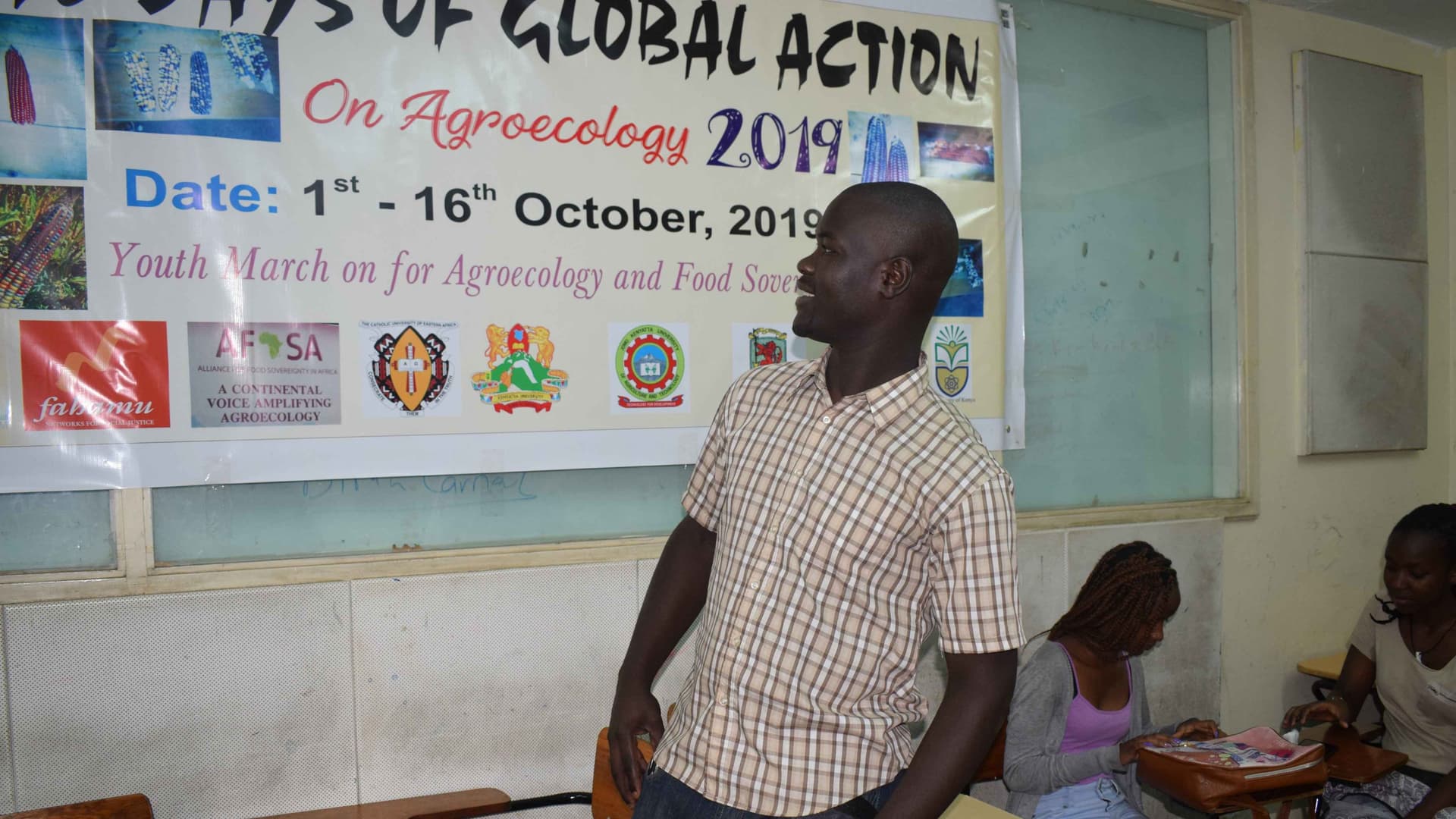
As part of the campaign my target was university students and rural communities .I organised sessions with students at the University of Nairobi and Catholic University of Eastern Africa and in a rural community with farmers in Eastern part of Kenya.
In measuring impact , the elements observed were number of people reached, level of understanding about agroecology and willingness to continue to have similar discussions beyond the campaign. The impact also looked at number of online interactions via social media platforms such as Twitter and Facebook and the level of engagement of people including comments harvested.
The impact was documented in a report with screen shots of the twitter images .
- Human Rights
- Environment
- Training - Online Advocacy
- Global